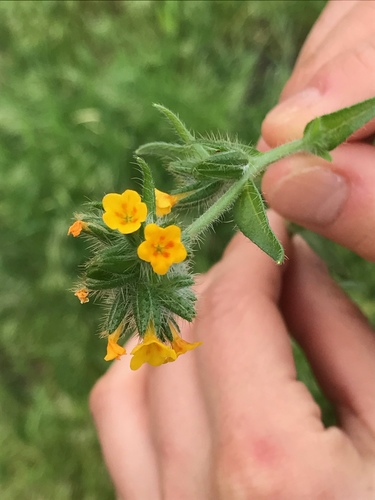
Heliotropium steudneri
Vatke

(c) Bernard DUPONT, some rights reserved (CC BY-SA)

no rights reserved
What to Eat
Edible parts: Fruit, Leaves
The flesh of the fruit is eaten raw. The leaves are eaten as a vegetable.
Known Hazards
Where to Find It
It is a tropical plant.
Africa, Asia, Botswana, East Africa, Ethiopia, Himalayas, Nepal, South Africa, Southern Africa,
How to Identify
A tropical tree in the borage family (Boraginaceae) native to tropical regions.
How to Grow
Several butterfly species depend on plants to provide them with lycopsamine as a precursor of the pheromone danaidone. The flowers have a bad smell which is believed to help pollination by flies.
Medicinal Uses
The leaf juice is applied to cuts to stop bleeding and to prevent infection. The plants are dipped in boiling water and then squeezed over bruises. Drops of the leaf juice are applied to the eyes of cattle to cure conjunctivitis. The pyrrolizidine alkaloid lycopsamine has been isolated from the leaves. Since its uses are similar to those of some better studied species of the genus such as Heliotropium indicum L. And Heliotropium ovalifolium Forssk., pyrrolizidine alkaloids are probably responsible for the alleged medicinal properties of this plant.
Names & Synonyms
Gabo
References (4)
- Lulekal, E., et al, 2011, Wild edible plants in Ethiopia: a review on their potential to combat food insecurity. Afrika Focus - Vol. 24, No 2. pp 71-121
- Ruiters-Welcome, A. K., 2019, Food plants of southern Africa. Ph.D. thesis. Univ. of Johannesburg p 38
- Teklehaymanot, T & Giday, M., 2010, Ethnobotanical study of wild edible plants of Kara and Kwego semi-pastoralist people in Lower Omo River Valley, Debub Omo Zone, SNNPR, Ethiopia Journ. of Ethnobiology and Ethnomedicine. 6:23
- Welcome, A. K. & Van Wyk, B.-E., 2019, An inventory and analysis of the food plants of southern Africa. South African Journal of Botany 122 (2019) 136–179