Poeppigia procera
(Poepp. ex Spreng.) C. Presl.
Guaje
(c) Luz de los Milagros, some rights reserved (CC BY-NC), uploaded by Luz de los Milagros
(c) María Eugenia Mendiola González, some rights reserved (CC BY-NC-SA)
What to Eat
Edible parts: Leaves, Fruit
Both the leaves and fruit are eaten.
Where to Find It
It is a tropical plant.
Bolivia, Brazil, Central America, Colombia, Costa Rica, El Salvador, Guatemala, Honduras, Mexico, North America, Panama, Peru,
How to Identify
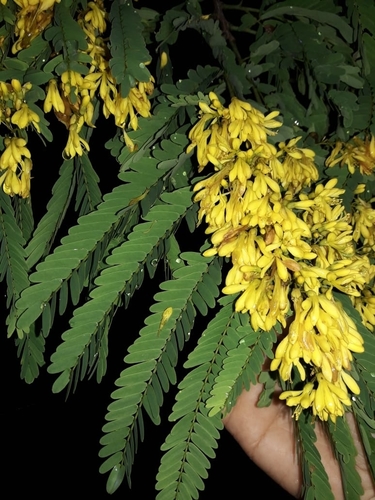
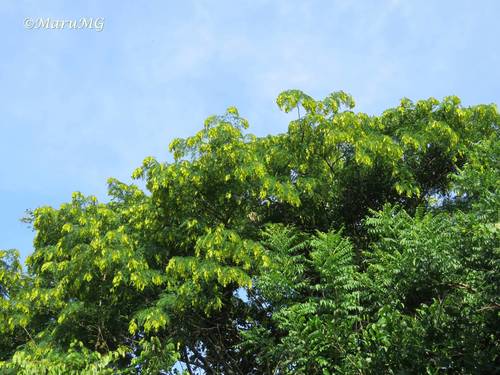
A tree. The leaves have leaflets in pairs along the stalk. The flowers are yellow. They are in clusters at the ends of the branches.
Other Uses
The thin bark is rich in tannins. The heartwood is pinkish to reddish or pale chocolate brown and beautifully veined; it is clearly defined from the 5cm wide band of white sapwood. The texture is medium; the grain is straight; the seasoned wood has no pronounced odour or taste. The weight is medium to heavy, the wood is hard, strong and durable. It is not difficult to work, takes a smooth, fairly lustrous polish, and holds its place well when finished. It lacks commercial possibilities in much of its range because of its small size, but where larger specimens are found the wood is highly valued for beams and house construction, and is also used for purposes such as railroad ties, cart axles, house supports, semi-heavy construction etc[, 453 1309]. The flowers are much frequented by bees.
Wikipedia
Source ↗Poeppigia procera is a species of flowering plant in the family Fabaceae. It is a tree native to the tropical Americas, ranging from southern Mexico to Bolivia and southeastern Brazil, including Cuba. It grows in forest and woodland, savanna, and shrubland.
Notes
Also as Caesalpinaceae.
Names & Synonyms
References (2)
- Anguilar-Stoen, M, et al, 2009, Home Gardens Sustain Crop Diversity and Improve Farm Resilience in Candelaria Loxicha, Oaxaca, Mexico. Human Ecology, 37:55-77
- Kew Plants of the World On line




