Adiantum pedatum
L.
Northern Maidenhair fern, Five fingered fern
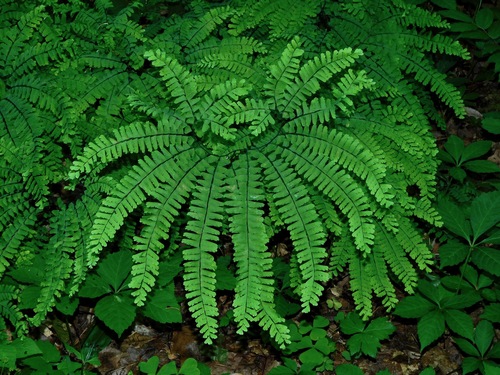
(c) Michael J. Papay, some rights reserved (CC BY), uploaded by Michael J. Papay
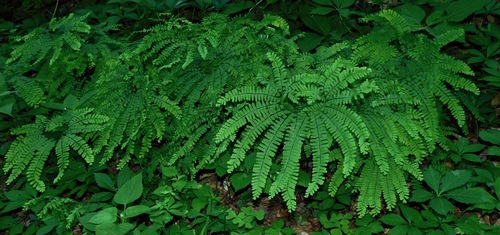
(c) Michael J. Papay, some rights reserved (CC BY), uploaded by Michael J. Papay

(c) aarongunnar, some rights reserved (CC BY), uploaded by aarongunnar
What to Eat
Edible parts: Fronds, Leaves
None known.
Known Hazards
Where to Find It
It is a temperate plant. In China it grows between 300-3,500 m above sea level. It suits hardiness zones 3-8.
American Samoa, Asia, Australia, Bhutan, China, Himalayas, India, Japan, Korea, Nepal, North America, USA,
How to Identify
Slow-growing fern reaching 0.5 m with seeds ripening August to October. Hardy to UK zone 3. Adapts to light sandy, medium loamy, and heavy clay soils with mildly acid to basic pH and good drainage. Grows in semi-shade in light woodland and prefers moist soil.
How to Grow
Easily grown in a cool moist shady position. Requires an abundance of moisture in the air and soil. Prefers an alkaline soil. Requires an acid soil according to another report. A very ornamental plant, it does not always succeed outdoors in Britain. It probably prefers to be covered in snow overwinter - could a mulch help? This species is often divided into three separate species by botanists - the type species is found in eastern N. America, A. aleuticum is found in western N. America and a third species is found in eastern Asia. Members of this genus are rarely if ever troubled by browsing deer. Plants have a slowly-increasing rootstock.
Propagation: Spores are best sown as soon as ripe on the surface of humus-rich sterilised soil. Keep the compost moist, ideally by covering the pot with a plastic bag. Pot on small clumps of plantlets once large enough to handle and maintain humidity until well established. Do not plant outside until ferns are at least 2 years old, and then only in a very well sheltered position. Division can be carried out in spring or autumn.
Medicinal Uses
The whole plant is considered antirheumatic, astringent, demulcent, emmenagogue, expectorant, febrifuge, haemostatic, pectoral, and tonic. A tea or syrup treats nasal congestion, asthma, and sore throats. A root decoction was massaged into rheumatic joints. Native Americans chewed the fronds and applied them to wounds to stop bleeding. A strong infusion of the whole plant has been used as an emetic in the treatment of ague and fevers. This plant was highly valued medicinally in the 19th century and is considered worthy of further scientific investigation.
Other Uses
The stipe is used as a decorative element in basketry. Leaves can line baskets and racks used for carrying or storing fruits. The plant acts as a hair conditioner, and the stems have been used as a hair wash to add shine. Planted roughly 30 cm apart in each direction, plants form a slowly spreading clump suitable for ground cover. Noted uses include food forest and ground cover applications.
Wikipedia
Source ↗Adiantum pedatum, the northern maidenhair fern, is a species of fern in the family Pteridaceae, native to moist forests in eastern North America. Like other ferns in the genus, the name maidenhair refers to the slender, shining black stipes. Taxonomy classification disputes occur due to the distribution of A. Pedatum in both North America and East Asia.
Notes
Also put in the family Adiantaceae. It is used in medicine.
Names & Synonyms
References (2)
- Jackes,D. A., Edible Forest Gardens
- www.eFloras.org Flora of China


