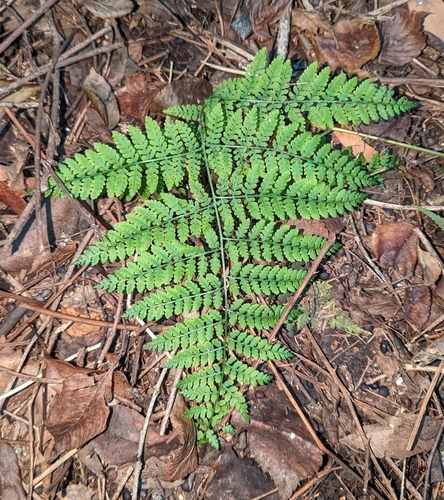
Dennstaedtia punctilobula
(Michx.) T. Moore
Eastern hay-scented fern

(c) Matt Tomlinson, some rights reserved (CC BY-NC)

(c) Matt Tomlinson, some rights reserved (CC BY-NC)

(c) Matt Tomlinson, some rights reserved (CC BY-NC)
What to Eat
None Known
Where to Find It
It is a temperate plant. It suits hardiness zones 3-8.
North America, USA,
How to Identify
Fast-growing evergreen fern reaching 0.6m tall and 0.3m wide. Hardy to UK zone 4. Tolerates light sandy, medium loamy, and heavy clay soils with good drainage. Grows in mildly acid, neutral, or very acid soil. Thrives in full shade, semi-shade, or full sun. Prefers consistently moist soil. Notable for attracting wildlife.
How to Grow
It can be grown by spores or rhizomes.
Propagation: Propagate by spores or by dividing the rhizome. To divide, cut the rhizome between fronds, space the sections apart, and trim back at least half of each frond.
Medicinal Uses
None known
Other Uses
Hay-scented fern works well as a groundcover for shaded areas, spreading at a low to medium density but capable of taking over large areas quickly — making it unsuitable for small gardens. Growing in large colonies, it provides good cover for wildlife. The lacy, triangular fronds are light green in summer and turn shades of yellow and copper in autumn. The fronds release a scent reminiscent of hay or cut grass when brushed, bruised, or crushed. The plant is well suited to naturalizing in woodland areas, shade gardens, cottage gardens, or wild areas.
Wikipedia
Fast-growing evergreen fern reaching 0.6m tall and 0.3m wide. Hardy to UK zone 4. Tolerates light sandy, medium loamy, and heavy clay soils with good drainage. Grows in mildly acid, neutral, or very acid soil. Thrives in full shade, semi-shade, or full sun. Prefers consistently moist soil. Notable for attracting wildlife.
Names & Synonyms
References (1)
- Jackes, D. A., Edible Forest Gardens