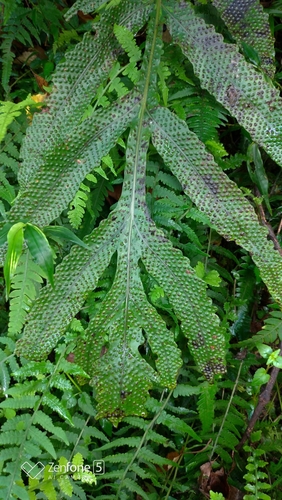
Tectaria gemmifera
(Fee) Alston
Snail fern
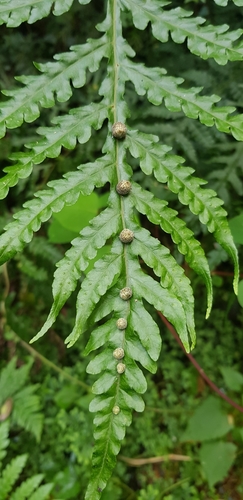
(c) Suvarna Parbhoo Mohan, some rights reserved (CC BY-SA), uploaded by Suvarna Parbhoo Mohan

(c) setapion, some rights reserved (CC BY-NC)
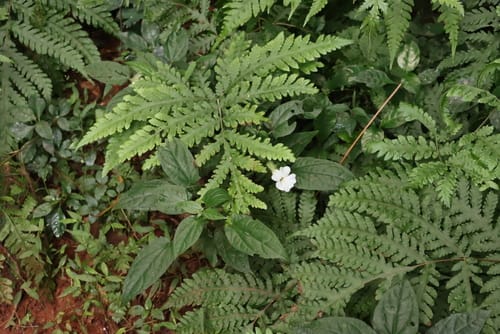
(c) Tony Rebelo, some rights reserved (CC BY-SA)
What to Eat
Edible parts: Leaves, Fronds
The leaves and fronds are cooked and eaten as a vegetable, and are sold in local markets.
Where to Find It
It is a tropical plant. In Zimbabwe it grows in deeply shaded forests between 550-1,680 m above sea level.
Africa, Angola, Asia, Bhutan, Burundi, China, East Africa, Himalayas, India, Indochina, Laos, Madagascar, Malawi, Malaysia, Mozambique, Myanmar, Nepal, Northeastern India, Rwanda, SE Asia, South Africa, Sri Lanka, Taiwan, Tanzania, Thailand, Uganda, Vietnam, Zambia, Zimbabwe,
How to Identify
A fern. It grows 30-100 cm tall. It has an erect rhizome 2 cm across. This has dark brown scales with lighter edges. The fronds are in tufts and arch over. They are 1.8 m long. The fronds near small plantlets.
Wikipedia
Source ↗Tectaria gemmifera, the snail fern, is a species of fern in the family Tectariaceae. It is native to Africa from the equator southwards, and is present in the DRC, Uganda, Kenya, Tanzania, Rwanda, Burundi, Angola, Zambia, Malawi, Mozambique, Zimbabwe, South Africa and Madagascar. Its natural habitat is deeply shaded forest floors of moist subtropical or tropical forest, and it occurs from 600 to 2,550 metres above sea level. The Latin name refers to the gemma that are produced by the fronds of this species.
Other Information
Leaves are sold in local markets
Notes
Also put in the family Dryopteridaceae.
Names & Synonyms
Dantheniuro, Dhagrajawa, Kalo neuro, Ningro
References (6)
- Bhattarai, S. & Rajbhandary, S., 2017, Pteridophyte Flora of Manaslu Conservation Area, Central Nepal. American Journal of Plant Sciences, 2017, 8, 680-687 (As Tectaria coadunata)
- Dobriyal, M. J. R. & Dobriyal, R., 2014, Non Wood Forest Produce an Option for Ethnic Food and Nutritional Security in India. Int. J. of Usuf. Mngt. 15(1):17-37 (As Tectaria coadunata)
- Ghosh, C. & Das A. P., 2011, Some useful and poisonous tea garden weeds from the Darjiling District of West Bengal, India. Pleione 5(1): 91 - 114 (As Tectaria coadunata)
- Joshi, N. & Siwakoti, M., 2012, Wild Vegetables Used by Local Community of Makawanpur District and Their Contribution to Food Security and Income Generation. Nepal Journal of Science and Technology Vol. 13, No. 1 (2012) 59-66 (As Tectaria coadunata)
- Khakurel, D., et al, 2021, Foods from the wild: Local knowledge, use pattern and distribution in Western Nepal. PLOS ONE. (As Tectaria coadunata)
- Uprety, Y., et al, 2012, Diversity of use and local knowledge of wild edible plant resources in Nepal. Journal of Ethnobotany and Ethnomedicine 8:16 (As Tectaria coadunata)