Catharanthus roseus
(L.) G. Don.
Madagascan Periwinkle
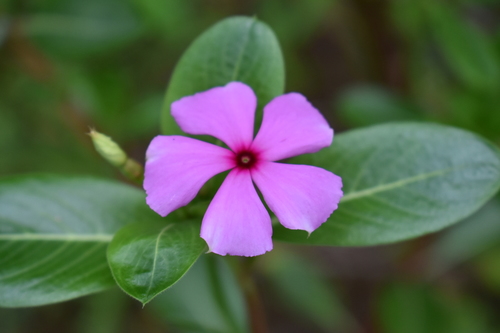
(c) Desita Dyah D A Kusumaningrum, some rights reserved (CC BY-NC), uploaded by Desita Dyah D A Kusumaningrum

(c) myakuzwayo, some rights reserved (CC BY-NC)
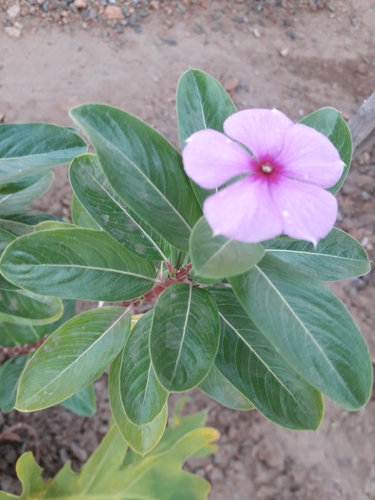
(c) mapulamaringa, some rights reserved (CC BY-NC)
What to Eat
A tea is made from the leaves.
Known Hazards
Where to Find It
Africa - eastern and southern Madagascar.
Often found in sandy locations along the coast, but also inland on river banks, in savannah vegetation and in dry waste places and roadsides, sometimes in open forest or scrub, usually near seal level, but occasionally to 1,500 metres.
How to Identify
An evergreen perennial reaching 0.7 meters in height and spread, with fast growth. Hardy to UK zone 9 and frost tender. Flowers are butterfly-pollinated and the plant is self-fertile. Grows in light sandy, medium loamy, and heavy clay soils, including poor soils. Tolerates very acidic, very alkaline, saline, and mildly acid to basic soils. Can grow in semi-shade or full sun, prefers moist soil but tolerates drought. Noted for attracting wildlife.
How to Grow
A plant of the tropics and subtropics, it can also be cultivated as an annual crop in warm temperate areas. It grows best in areas where annual daytime temperatures are within the range 20 - 30°c, but can tolerate 10 - 34°c. At temperatures below 5°c, some branches or even the whole plant will die. When the temperature rises, the plant will usually regrow from basal axillary buds, especially after hard pruning of the shoots and roots. Without pruning, the plant regrows mainly from the tops. It prefers a mean annual rainfall in the range 1,000 - 1,200mm, but tolerates 800 - 1,400mm. Established plants are drought tolerant. An easily grown plant, it prefers a fertile, moist but well-drained soil in a sunny to partially shaded position. Usually found on sandy soils in the wild, but sometimes also on rocky soils. It is very tolerant of salt in the soil. Prefers a pH in the range 6 - 7, tolerating 5.5 - 7.5. The plant can flower all year round. It may become a naturalised weed, especially when growing in dry habitats. In the tropics, the roots are ready for harvest after one year. In Hungary, when grown as an annual, average yield is 3.5 - 4.5 tonnes/ha of the fresh herb, or 1 - 1.5 tonnes/ha of dried herb. Under irrigation conditions, 1.5 tonnes/ha of roots, 1.5 tonnes/ha of stems and 3 tonnes/ha of leaves can be obtained. The plant is usually self-fertile, but self-incompatible strains exist and can be locally common in the wild.
Propagation: Sow seed in a seed tray. Germination takes 15–21 days at 21°C, with a sprouting rate above 95%. Seedlings are ready to pot up after 3 weeks. Seed remains viable for 3–5 years. Greenwood or semi-ripe cuttings can be taken; with rooting hormone applied, roots develop after 4–5 weeks. Placing cuttings in water will also induce rooting, though more slowly than in soil.
Medicinal Uses
Madagascar periwinkle has a long history in traditional medicine. Pharmaceutical research in the 1950s identified a range of medically active alkaloids, most notably vincristine, which showed activity against leukaemia. When isolated, these alkaloids are highly toxic but reduce white blood cell counts, leading to applications that have transformed conventional cancer therapy. The alkaloids vincristine and vinblastine are used in anticancer treatment, particularly for acute leukaemia (especially in children) and Hodgkin's lymphoma, usually as part of complex chemotherapy protocols. Used in isolation they can cause side effects including alopecia, nausea, and bone marrow depression. The dried root is an industrial source of ajmalicine, which increases blood flow to the brain and peripheral tissues. Ajmalicine preparations are used to treat psychological and behavioural problems associated with senility, sensory disorders such as dizziness and tinnitus, cranial trauma, and related neurological complications. The leaves and aerial parts are widely used in traditional medicine. The plant is well known as an oral hypoglycaemic agent and is also considered depurative, diaphoretic, diuretic, emetic, purgative, and vermifuge. Decoctions are taken to treat hypertension, asthma, menstrual irregularities, chronic constipation, diarrhoea, indigestion, dyspepsia, malaria, dengue fever, diabetes, cancer, and skin diseases. Leaf extracts applied externally serve as antiseptics to aid wound healing, relieve wasp stings, address haemorrhage and skin rash, and act as a mouthwash for toothache. Leaves are harvested at flowering and may be dried for later use. An infusion of the flowers is used to treat mild diabetes. A root decoction is taken to treat dysmenorrhoea.
Other Uses
Cultivated as an ornamental bedding plant in temperate gardens, noted for its long flowering period. The plant attracts bees, butterflies, and birds.
Wikipedia
Source ↗Catharanthus roseus, commonly known as bright eyes, Cape periwinkle, graveyard plant, Madagascar periwinkle, old maid, pink periwinkle, rose periwinkle, is a perennial species of flowering plant in the family Apocynaceae. It is native and endemic to Madagascar, but is grown elsewhere as an ornamental and medicinal plant, and now has a pantropical distribution. It is a source of the drugs vincristine and vinblastine, used to treat cancer. It was formerly included in the genus Vinca as Vinca rosea. It has many vernacular names among which are arivotaombelona or rivotambelona, tonga, tongatse or trongatse, tsimatiririnina, and vonenina.
Names & Synonyms
Ainskati, Arivotambelona, Billaganneru, Caca poule, Cape periwinkle, Conchita, Chuchurika, Kakuti, Kotomisi, Losa, Madagaskarski zimzelen, Malikuruvaa, Nayantara, Old maid, Phaeng-phuai-farang, Pink Periwinkle, Rosy periwinkle, Sada-phul, Sadabahar, Sudukadu mallikai, Te buraroti, Thinbaw-ma-hnyo-pan, Ushamalari, Vinka, Winka
References (47)
- Ambasta S.P. (Ed.), 2000, The Useful Plants of India. CSIR India. p 111
- Bodkin, F., 1991, Encyclopedia Botanica. Cornstalk publishing, p 228
- Bodkin, F., 1991, Encyclopedia Botanica. Cornstalk publishing, p 649 (As Lochnera rosea)
- Bremness, L., 1994, Herbs. Collins Eyewitness Handbooks. Harper Collins. p 158
- Brickell, C. (Ed.), 1999, The Royal Horticultural Society A-Z Encyclopedia of Garden Plants. Convent Garden Books. p 237 (Picture)
- Brown, D., 2002, The Royal Horticultural Society encyclopedia of Herbs and their uses. DK Books. p 159
- Burnie, G. (Ed.), 2003, Annuals and Bulbs. The Gardener's Handbooks. Fog City Press. p 136
- Checklist of NT Vascular Plant Species. January 2003.
- Cooper, W. and Cooper, W., 2004, Fruits of the Australian Tropical Rainforest. Nokomis Editions, Victoria, Australia. p 35
- Cowie, I, 2006, A Survey of Flora and vegetation of the proposed Jaco-Tutuala-Lore National Park. Timor-Lests (East Timor) www.territorystories.nt/gov.au p 43
- Cundall, P., (ed.), 2004, Gardening Australia: flora: the gardener's bible. ABC Books. p 343
- Flora of Australia, Volume 28, Gentiales, Melbourne:CSIRO Australia, 1996. p 123, Map 159 p 295
- Fowler, D. G., 2007, Zambian Plants: Their Vernacular Names and Uses. Kew. p 76
- Franklin, J., Keppel, G., & Whistler, W., 2008, The vegetation and flora of Lakeba, Nayau and Aiwa Islands, Central Lau Group, Fiji. Micronesica 40(1/2): 169–225, 2008
- Gen. hist. 4:95. 1837
- Gouldstone, S., 1983, Growing your own Food-bearing Plants in Australia. Macmillan p 193
- Henty, E.E., 1980, Harmful Plants in Papua New Guinea. Botany Bulletin No 12. Division Botany, Lae, Papua New Guinea. p 16, 18
- Heywood, V.H., Brummitt, R.K., Culham, A., and Seberg, O. 2007, Flowering Plant Families of the World. Royal Botanical Gardens, Kew. p 40
- Hibbert, M., 2002, The Aussie Plant Finder 2002, Florilegium. p 61
- Hussey, B.M.J., Keighery, G.J., Cousens, R.D., Dodd, J., Lloyd, S.G., 1997, Western Weeds. A guide to the weeds of Western Australia. Plant Protection Society of Western Australia. p 84
- Jardin, C., 1970, List of Foods Used In Africa, FAO Nutrition Information Document Series No 2.p 64
- Karim, F. M. & Dakheel, A, J., 2006, Salt-tolerant plants of the United Arab Emirates. 2006. International Center for Biosaline Agriculture, Dubai, UAE.
- Kermath, B. M., et al, 2014, Food Plants in the Americas: A survey of the domesticated, cultivated and wild plants used for Human food in North, Central and South America and the Caribbean. On line draft. p 199
- Kiple, K.F. & Ornelas, K.C., (eds), 2000, The Cambridge World History of Food. CUP p 1833 (As Vinca rosea)
- Latham, P., 2004, Useful Plants of Bas-Congo province. Salvation Army & DFID p 71
- Lazarides, M. & Hince, B., 1993, Handbook of Economic Plants of Australia, CSIRO. p 52
- Llamas, K.A., 2003, Tropical Flowering Plants. Timber Press. p 65
- Lord, E.E., & Willis, J.H., 1999, Shrubs and Trees for Australian gardens. Lothian. p 213
- Martin, F.W. & Ruberte, R.M., 1979, Edible Leaves of the Tropics. Antillian College Press, Mayaguez, Puerto Rico. p 49, 175
- Martin, F.W. & Ruberte, R.M., 1979, Edible Leaves of the Tropics. Antillian College Press, Mayaguez, Puerto Rico. p 175 (As Lochnera rosea)
- McMakin, P.D., 2000, Flowering Plants of Thailand. A Field Guide. White Lotus. p 87
- Melzer, R. & Plumb, J., 2011, Plants of Capricornia. Belgamba, Rockhampton. p 546
- Molla, A., Ethiopian Plant Names. http://www.ethiopic.com/aplants.htm
- Morley, B. & Everard, B., 1970, Wild Flowers of the World. Ebury press. Plate 71
- Paczkowska, G. & Chapman, A.R., 2000, The Western Australian Flora. A Descriptive Catalogue. Western Australian Herbarium. p 149
- Plants of Haiti Smithsonian Institute http://botany.si.edu
- Sujanapal, P., & Sankaran, K. V., 2016, Common Plants of Maldives. FAO & Kerala FRI, p 75
- Sukarya, D. G., (Ed.) 2013, 3,500 Plant Species of the Botanic Gardens of Indonesia. LIPI p 1089
- Swaziland's Flora Database http://www.sntc.org.sz/flora
- Teneso, J. & Salvador, M., Apocynaceae (Dogbane Family) College of Science, Polytechnic University of the Philippines.
- Thaman, R. R., 1987, Plants of Kiribati: A listing and analysis of vernacular names. Atoll Research Bulletin No. 296
- Thaman, R. R, 2016, The flora of Tuvalu. Atoll Research Bulletin No. 611. Smithsonian Institute p 64
- Topp, J. M. W., 1988, An Annotated Check List of the Flora of Diego Garcia, British Ocean Territory. Atoll Research Bulletin No. 313
- Vickery, M.L. and Vickery, B., 1979, Plant Products of Tropical Africa, Macmillan. p 92 (Incl. drawing)
- World Checklist of Useful Plant Species 2020. Royal Botanic Gardens, Kew
- Zizka, G., 1991, Flowering Plants of Easter Island. Palmarum Hortus Francofurtensis
- Zuchowski W., 2007, Tropical Plants of Costa Rica. A Zona Tropical Publication, Comstock Publishing. p 116


