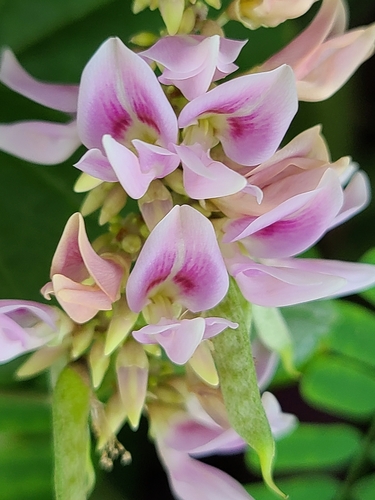
Dialium polyanthum
Harms
FabaceaeFruit

gbif · cc-by-sa
Saint Fédriche NDZAI
Saint Fédriche NDZAI

gbif · cc-by-sa
Saint Fédriche NDZAI
Saint Fédriche NDZAI

gbif · cc-by-sa
Saint Fédriche NDZAI
Saint Fédriche NDZAI
What to Eat
Edible parts: Fruit
The fruit is eaten.
Where to Find It
It is a tropical plant.
Africa, Central Africa, Central African Republic, CAR, Congo DR,
Countries: Angola, Burkina Faso, Burundi, Benin, Botswana, Congo (DRC), Central African Republic, Congo (Republic), Cote d'Ivoire, Cameroon, Cape Verde, Djibouti, Algeria, Egypt, Eritrea, Ethiopia, Gabon, Ghana, Gambia, Guinea, Equatorial Guinea, Guinea-Bissau, Kenya, Comoros, Liberia, Lesotho, Libya, Morocco, Madagascar, Mali, Mauritania, Mauritius, Malawi, Mozambique, Namibia, Niger, Nigeria, Rwanda, Seychelles, Sudan, Sierra Leone, Senegal, Somalia, South Sudan, Sao Tome & Principe, Eswatini, Chad, Togo, Tunisia, Tanzania, Uganda, South Africa, Zambia, Zimbabwe
How to Identify
A tropical tree in the Fabaceae family that grows to approximately 30 m tall, producing fruit that is edible.
Wikipedia
Source ↗Dialium polyanthum is a species of flowering plant, a medium to large tree in the family Fabaceae, subfamily Dialioideae. The trees grow in flooded forest or on dry ground, on swamp- and stream sides, reaching 35 m in height with a bole up to 100 cm in diameter. which occurs in Congo-Brazzaville and Congo-Kinshasa, Gabon, Cabinda and Northern Angola.
Production
In Central African Republic plants have been recorded flowering in April and May and fruiting in September and October.
Notes
Also as Caesalpinaceae.
Names & Synonyms
Ngbokole
References (1)
- Liengola, I. B., 2001, A contribution to the study of native edible plants by the Turumbu and Lokele of the Tshopo District, Province Orientale, D. R. Congo. Syst. Geogr. Pl. 71:687-698