Acrocomia aculeata
(Jacq.) Lodd. ex Mart.
Gru-Gru Palm, Macaw palm

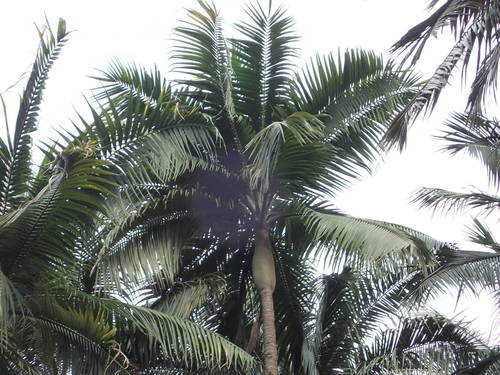
(c) mauroguanandi, some rights reserved (CC BY)
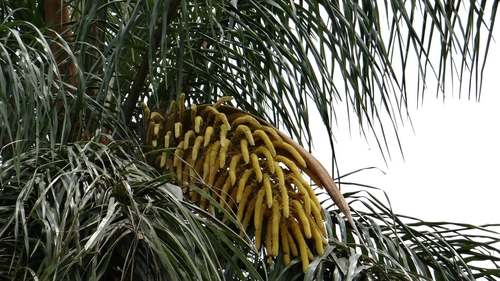
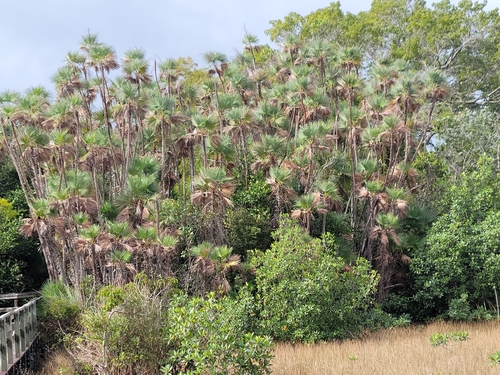
(c) Aurelio Molina Hernández., some rights reserved (CC BY-NC), uploaded by Aurelio Molina Hernández.
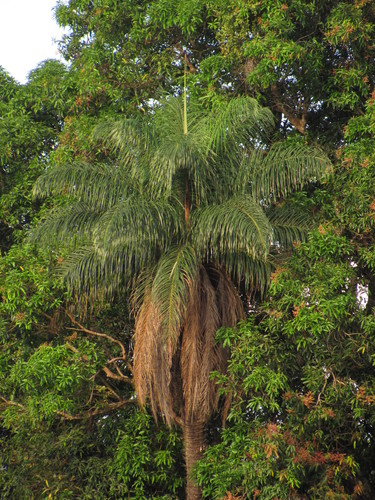
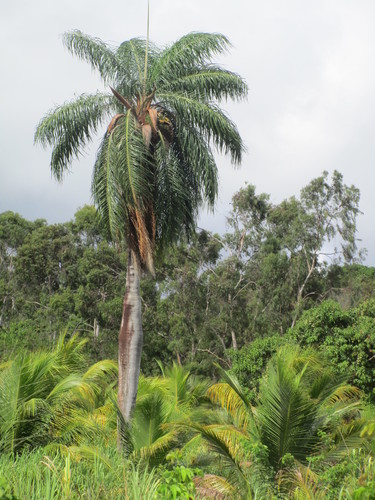
(c) Mateo Hernandez Schmidt, some rights reserved (CC BY-NC-SA), uploaded by Mateo Hernandez Schmidt
What to Eat
Edible parts: Kernels, Sap, Fruit, Nuts, Seeds, Cabbage, Young leaves, Palm heart, Oil
Starch can be obtained from the pith of the trunk and from the roots. The trunk pith can also be fermented to make an alcoholic drink. The fruit is cooked and is rich in oil, though it can be quite bitter; the yellowish pulp is fibrous, mucilaginous, and slightly sweet, and the sweet pulpy portion can be eaten raw. The fruit is consumed in times of scarcity. The seed is roasted, and a high-quality oil extracted from the seed kernel can be refined for cooking. Young leaves are cooked and eaten as a vegetable. The apical bud is eaten as a palm heart, though removing it condemns the tree to a slow death since the palm cannot produce side branches.
Where to Find It
A tropical plant. It needs well drained soil and good sun. It grows in savannah and open woodland, usually at low altitude. In Bolivia it grows to 900 m altitude. In Argentina it grows between 100-200 m above sea level. It suits hardiness zones 10-12.
Africa, Amazon, Andes, Antigua and Barbuda, Argentina, Australia, Belize, Bolivia, Brazil, Caribbean, Central America, Colombia, Costa Rica, Cuba, Dominica, East Africa, El Salvador, French Guiana, Grenada, Guatemala, Guianas, Guyana, Haiti, Honduras, Jamaica, Martinique, Mexico, Myanmar, North America, Pacific, Panama, Paraguay, Philippines, Puerto Rico, SE Asia, South America, St. Kitts and Nevis, St. Lucia, St. Vincent and Grenadines, Suriname, Tanzania, Trinidad and Tobago, Venezuela, West Indies,
How to Identify
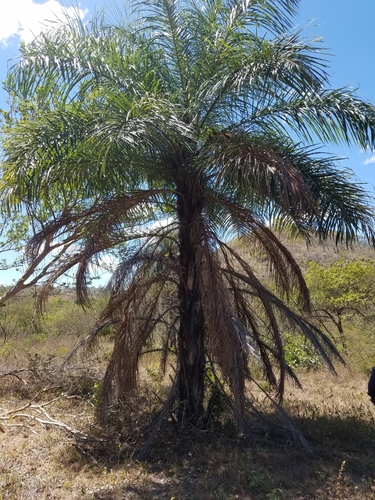
A shrub or small tree. It grows 5 m tall. There are prickles along the stem. The leaves are twice divided and there are 8-18 pairs of pinnae. There are up to 50 pairs of pinnules on each pinnae. The flowers are yellow. They are in large clusters at the ends of branches. The pods are flattened.
Nutrition Score: 46/100
| Part | Moisture | kJ | kcal | Protein | Vit A | Vit C | Iron | Zinc |
|---|---|---|---|---|---|---|---|---|
| Seed | — | — | — | — | — | — | — | — |
| Fruit | 34.3 | — | 286 | 2.76 | — | — | 0.8 | 2.2 |
| Palm heart | — | — | — | — | — | — | — | — |
| Sap | — | — | — | — | — | — | — | — |
How to Grow
Plants can be grown from seed. Seed are difficult to germinate and this is improved by soaking in warm water or cracking the seed coat. Fresh seed should be planted. Seeds may take 1 year to sprout.
Propagation: Seed is best sown as soon as it is ripe in a partially shaded position in individual containers. Germination rates are generally low and the seed may take more than a year to sprout. Some growers scarify the seed and soak it in water for several weeks to encourage germination.
Medicinal Uses
The roots are used medicinally.
Other Uses
When growing wild, the plant indicates good, fertile soils. Strips torn from the leaflets yield a useful twine, and the leaves also provide a strong, good-quality fibre used for ropes and cordage. Oil from the seed kernel can be used to make soap, as can oil extracted from the fruit pulp. The hard endocarp surrounding the seed is carved and pierced for use as rosary beads, jewellery, and buttons. The stem has a central pithy section surrounded by moderately heavy, hard, and very durable outer wood used locally as beams and laths in rural construction.
Wikipedia
Source ↗Acrocomia aculeata is a species of palm native to the Neotropics.
Production
Seedlings grow quickly and spines soon appear. The kernel contains 58% fat.
Other Information
It is cultivated for its fruit. The fruit are especially eaten by children.
Notes
There are 2 Acrocomia species. This is a very variable species and may be one or 26 species. It has antihypovitaminosis A properties.
Names & Synonyms
Acrocome, Amankayo, Bacaiuva, Bocaiuva, Coco, Coco-baboso, Coco-depcatarro, Corocho de Jamaica, Corojo, Corozo, Coyol baboso, Coyoli palm, Coyolipalme, Gouglou, Glouglou, Grou-grou, Huana, Macacauba, Macajuba, Macauba palm, Macauva, Maguedji, Manihua jihui, Map, Mbocaya, Mucaia, Mucaja, Mucajuba, Mucuja palm, Namogoligi, Palma de coyol, Palmeira-macauba, Panima, Paraguay palm, Shodo, Suppa palm, Totai, Tucuma, Tuk', Uba, Xodo, Ya cul
References (74)
- Balick, M.J. and Beck, H.T., (Ed.), 1990, Useful palms of the World. A Synoptic Bibliography. Colombia p 50 (As Acrocomia vinifera), 58 (As Acrocomia vinifera), 73 (As Acrocomia totai), 113 (As Acrocomia totai), 163 (As Acrocomia sclerocarpa), 208 (As Acrocomia sclerocarpa), 295, 387 (As Acrocomia totai), 388 (As Acrocomia totai), 394 (As Acrocomia mexicana), 429 (As Acrocomia sclerocarpa), 556 (As Acrocomia mexicana), 561 (As Acrocomia antioquensis, Acrocomia ierensis and Acrocomia totai), 562 (As Acrocomia sclerocarpa), 598, 647, 658 (As Acrocomia belizensis, Acrocomia mexicana and Acrocomia vinifera), 659,
- Biocyclopedia Edible Plant Species biocyclopedia.org (As Acrocomia lasiospatha and others)
- Bircher, A. G. & Bircher, W. H., 2000, Encyclopedia of Fruit Trees and Edible Flowering Plants in Egypt and the Subtropics. AUC Press. p 7 (As Acrocomia antiquioensis and others)
- Blomberry, A. & Rodd, T., 1982, Palms. An informative practical guide. Angus & Robertson. p 43 (As Acrocomia media and Acrocomia totai)
- Bortolotto, I. M., et al, 2015, Knowledge and use of wild edible plants in rural communities along Paraguay River, Pantanal, Brazil. Journal or Ethnobiology and Ethnomedicine. 11:46
- Bortolotto, I. M., et al, 2018, Lista preliminar das plantas alimenticias nativas de Mato Grosso do Sul, Brasil. Iheringia, Serie Botanica, Porto Alegre, 73 (supl.):101-116
- Burkill, I.H., 1966, A Dictionary of the Economic Products of the Malay Peninsula. Ministry of Agriculture and Cooperatives, Kuala Lumpur, Malaysia. Vol 1 (A-H) p 39 (As Acrocomia sclerocarpa)
- Chizmar Fernandez, C., et al, 2009, Plantas comestibles de Centroamerica. Instituto de Biodiversidad, Costa Rica. p 66
- D'Ambrosio, U., & Puri, R. K., 2016, Foodways in transition: food plants, diet and local perceptions of change in a Costa Rican Ngäbe community. Journal of Ethnobiology and Ethnomedicine (2016) 12:3 p 22
- Etherington, K., & Imwold, D., (Eds), 2001, Botanica's Trees & Shrubs. The illustrated A-Z of over 8500 trees and shrubs. Random House, Australia. p 75
- Etkin, N.L. (Ed.), 1994, Eating on the Wild Side, Univ. of Arizona. p 135 (As Acrocomia sclerocarpa)
- Facciola, S., 1998, Cornucopia 2: a Source Book of Edible Plants. Kampong Publications, p 26 (Also as Acrocomia mexicana and Acrocomia sclerocarpa and Acrocomia totai)
- Fagg, C. W. et al, 2015, Useful Brazilian plants listed in the manuscripts and publications of the Scottish medic and naturalist George Gardner (1812–1849). Journal of Ethnopharmacology 161 (2015) 18–29
- Gibbons, M., 2003, A pocket guide to Palms. Chartwell Books. p 29
- Grandtner, M. M., 2008, World Dictionary of Trees. Wood and Forest Science Department. Laval University, Quebec, Qc Canada. (Internet database http://www.WDT.QC.ca)
- Grandtner, M. M. & Chevrette, J.,2013, Dictionary of Trees, Volume 2: South America: Nomenclature, Taxonomy and Ecology. Academic Press p 11
- Haynes, J., & McLaughlin, J., 2000, Edible palms and Their Uses. University of Florida Fact sheet MCDE-00-50-1 p 2
- Hedrick, U.P., 1919, (Ed.), Sturtevant's edible plants of the world. p 24 (As Acrocomia lasiospatha, Acrocomia mexicana, Acrocomia sclerocarpa)
- Heindorf, C., 2011, Analysis of the Agrobiodiversity of Home Gardens in the Tropical Regions of Mexico. M.Sc. thesis. Cologne University of Applied Sciences. (As Acrocomia mexicana)
- Henderson, A., Galeano, G and Bernal, R., 1995, Field Guide to the Palms of the Americas. Princeton. p 166
- Hist. nat. palm. 3:286. 1845
- Hunter, D., et al, 2019, The potential of neglected and underutilized species for improving diets and nutrition. Planta (2019) 250:709-729
- INFOODS:FAO/INFOODS Databases (Also as Acrocomia mokayayba)
- Jamaica: A country report to the FAO International Technical Conference on Plant Genetic Resources for Food and Culture. 2008 (As Acrocomia spinosa)
- James, A., 2009, Notes on the Uses of Dominica's Native Palms. Palms, Vol. 53(2): p 62
- Janick, J. & Paul, R. E. (Eds.), 2008, The Encyclopedia of Fruit & Nuts. CABI p 83
- Johnson, D.V., 1998, Tropical palms. Non-wood Forest products 10. FAO Rome. p 90
- Jones, D.L., 1994, Palms throughout the World. Smithtonian Institution, Washington. p 55, 56, 58
- Jones, D.L., 2000, Palms of Australia 3rd edition. Reed/New Holland. p 112
- Jones, D.L., 2000, Palms of Australia 3rd edition. Reed/New Holland. p 112 (As Acrocomia media)
- Kermath, B. M., et al, 2014, Food Plants in the Americas: A survey of the domesticated, cultivated and wild plants used for Human food in North, Central and South America and the Caribbean. On line draft. p 19
- Kiple, K.F. & Ornelas, K.C., (eds), 2000, The Cambridge World History of Food. CUP p 1805
- Kujawska, M. & Luczaj, L., 2015, Wild Edible Plants Used by the Polish Community in Misiones, Argentina. Human Ecology 43:855-869
- Lentz, D. L., 1986, Ethnobotany of the Jicaque of Honduras. Economic Botany 40(2):210-219 (As Acrocomia mexicana)
- Lentz, D. L., 1993, Medicinal and Other Economic Plants of the Paya of Honduras. Economic Botany, Vol. 47, No. 4, pp. 358-370 (As Acrocomia mexicana)
- Leticia, Z., et al, 2015, Do Socioeconomic characteristics explain the knowledge and use of native food plants in semiarid environments in Northeastern Brazil? Journal of Arid Environments 115:53-61
- Lopez-Diago, D. & Garcia, N., 2021, Wild edible fruits of Colombia. Biota ColomBiana 22 (2) p 30
- Lorenzi, H., 2002, Brazilian Trees. A Guide to the Identification and Cultivation of Brazilian Native Trees. Vol. 01 Nova Odessa, SP, Instituto Plantarum p 288
- Lorenzi, H., Bacher, L., Lacerda, M. & Sartori, S., 2006, Brazilian Fruits & Cultivated Exotics. Sao Paulo, Instituto Plantarum de Estuados da Flora Ltda. p 62
- Mapes, C. & Basurto, F., 2016, Biodiversity and Edible Plants of Mexico. Chapter 5 in R. Lira, et al. (eds.), Ethnobotany of Mexico, Ethnobiology, Springer. p 102 (As Acrocomia mexicana)
- Marcia, M. J., et al, 2011, Palm Uses in Northwestern South America: A Quantitative Review. Bot. Rev. (2011) 77:462-570
- Martin, F.W. & Ruberte, R.M., 1979, Edible Leaves of the Tropics. Antillian College Press, Mayaguez, Puerto Rico. p 96, 209 (As Acrocomia sclerocarpa)
- Martins, R. C., et al, 2014, Use and Diversity of Palm (Arecaceae) Resources in Central Western Brazil. The Scientific World Journal.. Volume 2014, Article ID 942043
- Menninger, E.A., 1977, Edible Nuts of the World. Horticultural Books. Florida p 124 (As Acrocomia media)
- Menninger, E.A., 1977, Edible Nuts of the World. Horticultural Books. Florida p 124 (Also as Acrocomia totai)
- Miguel, E., et al, 1989, A checklist of the cultivated plants of Cuba. Kulturpflanze 37. 1989, 211-357
- Mutchnick, P. A. and McCarthy, B. C., 1997, An Ethnobotanical Analysis of the Tree Species Common to the Subtropical Moist Forests of the Peten, Guatemala. Economic Botany, Vol. 51, No. 2, pp. 158-183 (As Acrocomia mexicana)
- Nascimento, V. T. D., et al, 2013, Knowledge and Use of Wild Food Plants in Areas of Dry Seasonal Forests in Brazil. Ecology of Food and Nutrition, 52:317–343 (As Acrocomia sclerocarpa)
- NYBG herbarium "edible"
- Oliviera V. B., et al, 2012, Native foods from Brazilian biodiversity as a source of bioactive compounds. Food Research International 48 (2012) 170-179
- Paniagua Zambrana, N. Y., et al, 2017, Traditional knowledge hiding in plain sight - twenty-first century ethnobotany of the Chacobo in Beni, Bolivia. Journal of Ethnobiology and Ethnomedicine (2017) 13:57
- Plants of Haiti Smithsonian Institute http://botany.si.edu
- Paz, F. S., et al, 2021, Edible Fruit Plant Species in the Amazon Forest Rely Mostly on Bees and Beetles as Pollinators. Journal of Economic Entomology, XX(XX), 2021, 1–13 (As Acrocomia sclerocarpa Mart.)
- Piedra-Malagón, E. M. et al, 2022, Edible native plants of the Gulf of Mexico Province. Biodiversity Data Journal 10: e80565 p 11
- Riffle, R.L. & Craft, P., 2003, An Encyclopedia of Cultivated Palms. Timber Press. p 21, 22, 243
- Roa, J. A. G. & Boada, D. S. G., 2018, Fundación para el Fortalecimiento de la Fruticultura y Plantas Alimenticias no Convencionales en Colombia.
- Rodriguez-Amaya, D. B., 1999, Carotenoides y Prepracion de Alimentos. University Estadual de Campinas, Brasil, Ph.D. thesis. p 25 (As Acrocomia makayayba)
- Scarpa, G. F., 2009, Wild food plants used by the indigenous peoples of South American Gran Chaco: A general synopsis and intercultural comparison. Journal of Applied Botany and Food Quality 83:90-101
- Schmedia-Hirschmann, G., 1994, Plants resources Used by the Ayoreo of the Paraguayan Chaco. Economic Botany Vol. 48. No. 3. pp. 252-258
- Segura, S. et al, 2018, The edible fruit species in Mexico. Genet Resour Crop Evol (2018) 65:1767–1793 (Also as Acrocomia mexicana)
- Standley, P. & Steyermark, J., 1958, Flora of Guatemala. Fieldiana: Botany, Volume 24 part 1 p 347 (As Acrocomia mexicana)
- Steggerda, M., Some Ethnological Data Concerning One Hundred Yucatan Plants. Smithsonian Institution Anthropological Papers, No. 29 (As Acrocomia mexicana)
- TodaFruta.com.br (As Acrocomia totai)
- Turreira-Garcia, N., et al, 2015, Wild edible plant knowledge, distribution and transmission: a case study of the Achi Mayans of Guatemala. Journal of Ethnobiology and Ethnomedicine. 11:52
- USDA, ARS, National Genetic Resources Program. Germplasm Resources Information Network - (GRIN). [Online Database] National Germplasm Resources Laboratory, Beltsville, Maryland. Available: www.ars-grin.gov/cgi-bin/npgs/html/econ.pl (10 April 2000)
- Usher, G., 1974, A Dictionary of Plants Used by Man. Constable. p 19 (As Acrocomia mexicana and Acrocomia totai)
- Vasquez, Roberto Ch. & Coimbra, German S., 1996, Frutas Silvestres Comestibles de Santa Cruz. p 152
- Vazquez-Garcia. V., 2008, Gender, ethnicity, and economic status in plant management: Uncultivated edible plants among the Nahuas and Popolucas of veracruz, Mexico. Agriculture and Human Values 25: 65-77 (As Acrocomia mexicana)
- Villachica, H., (Ed.), 1996, Frutales Y hortalizas promisorios de la Amazonia. FAO, Lima. p 261 (As Acrocomia totai)
- Wickens, G.E., 1995, Edible Nuts. FAO Non-wood forest products. FAO, Rome. p161 (Also as Acrocomia totai)
- Wiersema, J. H. & Leon, B., 2013, World Economic Plants. A Standard Reference CRC Press. 2nd Ed. p 15
- World Checklist of Useful Plant Species 2020. Royal Botanic Gardens, Kew
- Zambrana, P, et al, 2017, Traditional knowledge hiding in plain sight – twenty-first century ethnobotany of the Chácobo in Beni, Bolivia. Journal of Ethnobiology and Ethnomedicine (2017) 13:57
- Zuchowski W., 2007, Tropical Plants of Costa Rica. A Zona Tropical Publication, Comstock Publishing. p 380