Ceanothus americanus
Linn.
New Jersey tea, Red root, Jersey-tea ceanothus, Mountainsweet, Wild snowball
(c) Mark Kluge, some rights reserved (CC BY-NC), uploaded by Mark Kluge

(c) Douglas Goldman, some rights reserved (CC BY-SA)

(c) Douglas Goldman, some rights reserved (CC BY-SA)
What to Eat
Edible parts: Leaves - tea
A refreshing and stimulating tea can be made from the dried leaves, and it serves as a good substitute for conventional tea, though it contains no caffeine. Leaves are gathered when the plant is in full bloom and dried in the shade before use.
Where to Find It
It is a temperate plant. It needs well-drained soil. It can tolerate poor soils but not alkaline conditions. It suits hardiness zones 7-9.
Australia, Canada, North America, USA,
How to Identify
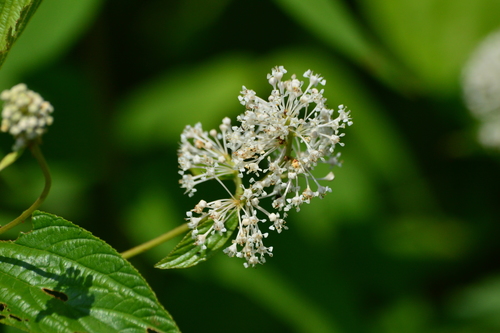
A small deciduous shrub. It grows 0.6-1 m high and spreads 45 cm wide. The roots are tough and dark red. The leaves are slender and oval. They are 10 cm long. The flowers are white in dense panicles. The fruit is a triangle shaped seed pod.
How to Grow
Prefers a warm sunny position but tolerates light shade. Tolerates some lime, but will not succeed on shallow chalk. Another report says that it dislikes alkaline soils, though succeeds in poor dry conditions. Plants dislike root disturbance, they should be planted out into their permanent positions whilst still small. Dislikes heavy pruning, it is best not to cut out any wood thicker than a pencil. Any pruning is best carried out in the spring. Fast growing, it flowers well when young, often in its second year from seed. Hybridizes freely with other members of this genus. Some members of this genus have a symbiotic relationship with certain soil micro-organisms, these form nodules on the roots of the plants and fix atmospheric nitrogen. Some of this nitrogen is utilized by the growing plant but some can also be used by other plants growing nearby.
Propagation: Sow seed as soon as it is ripe in a cold frame. Stored seed should be pre-soaked for 12 hours in warm water and then given 1–3 months of stratification at 1°C; germination usually takes 1–2 months at 20°C. One approach recommends boiling water treatment, or heating the seed in 4 times its volume of sand at 90–120°C for 4–5 minutes, followed by a 12-hour soak in warm water before sowing. Seed is notably long-lived — stored for 15 years in an airtight dry container at 1–5°C, it shows little loss of viability. Because the seed is ejected forcefully from its capsule when ripe, it must be collected just before dehiscence or it becomes difficult to extract and rarely germinates well. Prick seedlings into individual pots as soon as they are large enough to handle and grow them on under glass for at least their first winter before planting out in late spring or early summer. Cuttings of half-ripe wood, taken at a node, can be struck in a frame in July or August. Cuttings of mature wood from the current year's growth, 7–12 cm with a heel, can be taken in October in a cold frame. The roots are brittle, so pot up callused cuttings in spring just before the roots break. A good percentage of cuttings can be expected to succeed.
Medicinal Uses
North American Indians used the roots and root bark of New Jersey tea extensively to treat fevers and mucous membrane complaints such as catarrh and sore throats. Today the roots are valued for their astringent, expectorant, and antispasmodic actions, and are used to treat asthma, bronchitis, whooping cough, dysentery, tonsillitis, and haemorrhoids. The roots and root bark contain 8% tannin and are antispasmodic, antisyphilitic, strongly astringent, expectorant, haemostatic, and sedative. They stimulate the lymphatic system, and an alkaloid present in the roots produces a mild hypotensive effect. A decoction of the bark is applied as a skin wash for cancer and venereal sores; the powdered bark has also been dusted directly onto sores. Roots are harvested in autumn or spring when their red colour is deepest, then dried for later use.
Other Uses
A green dye is obtained from the flowers, a cinnamon-coloured dye from the whole plant, and a red dye from the root. The flowers are rich in saponins and, when crushed and mixed with water, produce an excellent lather that makes an effective and gentle soap suitable for washing the body or cleaning clothes. The flowers can be used directly as a body wash by rubbing the wet blossoms over the skin, and they leave a pleasant fragrance behind. North American Indian women made particular use of the flowers as a body wash in preparation for marriage.
Wikipedia
Source ↗Ceanothus americanus is a species of Ceanothus shrub native to North America. Common names include New Jersey tea, Jersey tea ceanothus, variations of red root (red-root; redroot), mountain sweet (mountain-sweet; mountainsweet), and wild snowball. New Jersey tea was a name coined during the American Revolution, because its leaves were used as a substitute for imported tea.
Production
The leaves are gathered while the plant is in full bloom. They are then dried in the shade.
Notes
There are about 55 Ceanothus species. The roots are used in medicine. The leaves are caffeine free.
Names & Synonyms
Mountainsweet, Wild snowball
References (18)
- Beckstrom-Sternberg, Stephen M., and James A. Duke. "The Foodplant Database." http://probe.nalusda.gov:8300/cgi-bin/browse/foodplantdb.(ACEDB version 4.0 - data version July 1994)
- Bodkin, F., 1991, Encyclopedia Botanica. Cornstalk publishing, p 229
- Bremness, L., 1994, Herbs. Collins Eyewitness Handbooks. Harper Collins. p 97
- Brown, D., 2002, The Royal Horticultural Society encyclopedia of Herbs and their uses. DK Books. p 158
- Cundall, P., (ed.), 2004, Gardening Australia: flora: the gardener's bible. ABC Books. p 346
- Elias, T.S. & Dykeman P.A., 1990, Edible Wild Plants. A North American Field guide. Sterling, New York p 176
- Esperanca, M. J., 1988. Surviving in the wild. A glance at the wild plants and their uses. Vol. 2. p 110
- Etherington, K., & Imwold, D., (Eds), 2001, Botanica's Trees & Shrubs. The illustrated A-Z of over 8500 trees and shrubs. Random House, Australia. p 192
- Facciola, S., 1998, Cornucopia 2: a Source Book of Edible Plants. Kampong Publications, p 190
- Hedrick, U.P., 1919, (Ed.), Sturtevant's edible plants of the world. p 176
- Hibbert, M., 2002, The Aussie Plant Finder 2002, Florilegium. p 62
- MacKinnon, A., et al, 2009, Edible & Medicinal Plants of Canada. Lone Pine. p 148
- Jackes, D. A., Edible Forest Gardens
- Saunders, C.F., 1948, Edible and Useful Wild Plants. Dover. New York. p 143
- Sp. pl. 1:195. 1753
- Tozer, F., 2007, The Uses of Wild Plants. Green Man Publishing. p 60
- Wiersema, J. H. & Leon, B., 2013, World Economic Plants. A Standard Reference CRC Press. 2nd Ed. p 154
- World Checklist of Useful Plant Species 2020. Royal Botanic Gardens, Kew