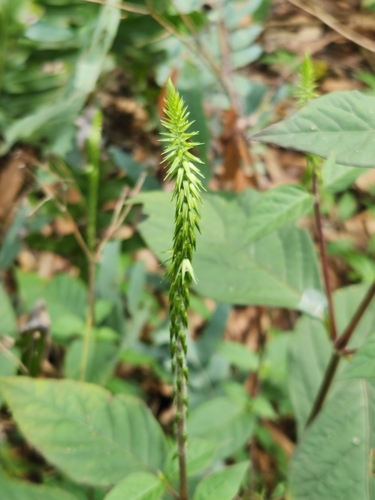
Celosia argentea
Linn.
Lagos spinach, Quail grass, Cock’s comb
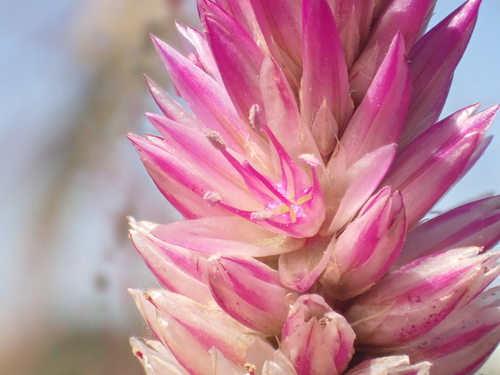
no rights reserved, uploaded by 葉子
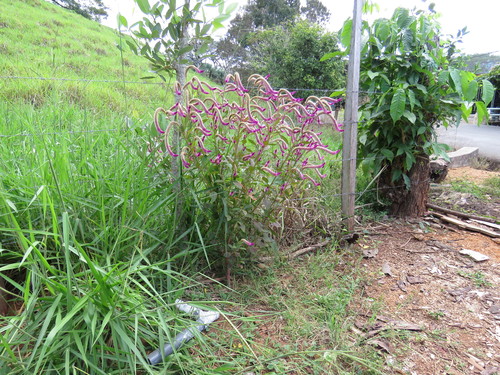
(c) mkkennedy, some rights reserved (CC BY-NC)
What to Eat
Edible parts: Leaves, Seeds - oil, Vegetable, Flowers, Tea
The tender leaves and young flowers are cooked and eaten as a vegetable, best consumed before flowering; dried leaves can be added to wheat flour or used in soups, sauces, and stews as a flavoring. Seeds can be pressed to extract an edible oil. The red flowers are used to color lamb stew and in pan-fried cakes. The plant is an important, nutritious vegetable sold year-round in markets.
Where to Find It
It is a tropical plant. It grows well in the lowlands humid forest zone. It suits damp humid places and is often on clayey soil. The plant is widespread as a wild plant at low altitudes. It grows up to 1700 m in Ethiopia. Temperatures between 25-30°C at night and 30-35°C in the day are best. It needs good sunlight and does best in soils with high organic matter. It can grow in light shade and in dry conditions. In Nepal it grows up to 1600 m altitude. It can grow in arid places. In Yunnan. In Sichuan.
Africa, Angola, Argentina, Asia, Australia, Bangladesh, Benin, Bhutan, Brazil, Burkina Faso, Cambodia, Cameroon, Caribbean, Central Africa, Central African Republic, CAR, Central Asia, Chad, China, Congo DR, Côte d'Ivoire, Cuba, Dominica, Dominican Republic, East Africa, Ecuador, Eritrea, Ethiopia, Europe, Fiji, France, Gabon, Gambia, Ghana, Guiana, Guianas, Guinea, Guinée, Guinea-Bissau, Guyana, Haiti, Hawaii, Himalayas, India, Indochina, Indonesia, Italy, Ivory Coast, Jamaica, Japan, Kenya, Korea, Laos, Liberia, Madagascar, Malawi, Malaysia, Maldives, Marquesas, Mediterranean, Middle East, Mozambique, Myanmar, Nauru, Nepal, Niger, Nigeria, Northeastern India, Oman, Pacific, Pakistan, Papua New Guinea, PNG, Paraguay, Philippines, Russia, Sahel, Samoa, Sao Tome and Principe, SE Asia, Senegal, Sierra Leone, Sikkim, Slovenia, Solomon Islands, Somalia, South Africa, South America, Southern Africa, Sri Lanka, Sudan, Suriname, Taiwan, Tajikistan, Tanzania, Thailand, Togo, Tuvalu, Uganda, USA, Vietnam, Wallis and Futuna, West Africa, West Indies*, Yemen, Zambia,
How to Identify
An erect short lived annual herb up to 1 m tall. The leaves are alternate and light green. They are 2 cm wide and 6 cm long. They are dark green and longer on flowering shoots. The flower spike grows on the end of the main stem and is red or purple. It is 20 cm long. The seeds are small (1 mm across). Two kinds occur as red and green forms.
Nutrition Score: 48/100
| Part | Moisture | kJ | kcal | Protein | Vit A | Vit C | Iron | Zinc |
|---|---|---|---|---|---|---|---|---|
| Leaves | 84 | 185 | 44 | 4.7 | — | 33 | 7.8 | — |
| Seeds - oil | — | — | — | — | — | — | — | — |
How to Grow
The plant can be grown by seeds. The seeds are very small so can be mixed with sand to allow more even sowing. These plants are often grown just as ornamentals. The seed are broadcast then mulched with dry grass, which is removed once the seeds have germinated. Seedlings do not transplant easily. They can be transplanted after 2-3 weeks. It is good for intercropping amongst other vegetables.
Propagation: Seed - sow in situ. Germination should take place within 5 - 7 days.
Medicinal Uses
The leaves, which are rich in iron, are traditionally used to treat anemia. The leaves contain nitre which makes them diuretic.
Wikipedia
Source ↗Celosia argentea, commonly known as the plumed cockscomb or silver cock's comb, is a herbaceous plant of tropical origin in the family Amaranthaceae from tropical Africa. The plant is known for its very bright colors. In India and China it is known as a troublesome weed.
Production
Harvesting of leaves can commence about 4-5 weeks after planting. Tops can be cut off over a period of 3-5 months. It grows slowly at first, therefore repeated picking of tips gives better production than harvesting whole small plants.
Other Information
It is an important and nutritious vegetable. It is sold year round in markets. It is cultivated. Grown as an ornamental in Papua New Guinea, but not often used as a food.
Notes
Leaves contain nitre which makes them diuretic. There are about 40-50 Celosia species. The leaves are rich in iron and therefore good for anaemia.
Names & Synonyms
Adefo, Aem, Alefo, Anandasoa, Anne soppu, Avunvo, Ayinkpinnan, Bayam ekor belanda, Bayam ekur kuching, Bayam merah, Borocho, Bostan afras, Chare maguri, Chinese Cock’s Comb, Dedogime, Dhura dru, Ekaliyo, Foxtail amaranth, Garka, Gurugu, Guruvu kura, Horbaita, Huldi murga, Jengger ayam, Ji guan hua, Kanju, Kima arxa, Kodijuttutotakura, Kokan, Koontha, Kukudda, Kunjru, Kurada, Kurdu, Kyet-mauk, Kyet -monk, Lagos spinach, Lahenga, Lal murga, Lal murghka, Lambadi, Lapadi, Lasor, Leheti sak, Lemdi, Lunadalandala, Maendeurami, Makhumaa, Mamiratsy, Mawal, Mayura-shikha, Mesor, Mora shikha, Morogful shak, Morogihutishak, Ninga, Niu mu wo, Nyaayu, Panchechettu, Pannae, Pannai, Pila murghka, Pile murghka, Safed murga-ka-phul, Saigatya, Salara, Sankokolo, Sarpankha, Sarwari, Sawari, Shelar, Sifaid murgha, Silairi, Silgizara, Siliari sag, Siliyari, Silver and red foxtail, Silwari, Sirgit ara, Sirmali, Soko pupa, Sokoyokoto, Soman, Somon, Srebrna celozija, Suggi sak, Surli, Surwari, Suwari, Swet morog, Swetmurga, Taji khoros, Tambadi, Tchokoyokoto, Tetekpkpo, Tinonyawouti, Tipekenonte, Torcha, Torchata, Vitunna, Zo-ci
References (145)
- Abbiw, D.K., 1990, Useful Plants of Ghana. West African uses of wild and cultivated plants. Intermediate Technology Publications and the Royal Botanic Gardens, Kew. p 40
- Achigan-Dako, E, et al (Eds), 2009, Catalogue of Traditional Vegetables in Benin. International Foundation for Science.
- Addis, G., et al, 2013, Dietary values of wild and semi-wild edible plants in Southern Ethiopia. African Journal of Food, Agriculture, Nutrition and Development. 13(2) (Recalculated from dmb)
- Addis, G., Asfaw, Z & Woldu, Z., 2013, Ethnobotany of Wild and Semi-wild Edible Plants of Konso Ethnic Community, South Ethiopia. Ethnobotany Research and Applications. 11:121-141
- Addis, G., et al, 2013, The Role of Wild and Semi-wild Edible Plants in Household Food Sovereignty in Hamer and Konso Communities, South Ethiopia. Ethnobotany Research & Applications. 11:251-271
- Adebooye, O. C. et al, 2005, Seed constraint to cultivation and productivity of African indigenous leaf vegetables. African Journal of Biotechnology 4(13) pp 1480-1484 (As Celosia cristata)
- Altschul, S.V.R., 1973, Drugs and Foods from Little-known Plants. Notes in Harvard University Herbaria. Harvard Univ. Press. Massachusetts. no. 888, 889 (Also as Celosia cristata)
- Ambasta S.P. (Ed.), 2000, The Useful Plants of India. CSIR India. p 113, p 114 (As Celosia cristata)
- Ara, R. I. T., 2015, Leafy Vegetables in Bangladesh. Photon eBooks. p 20 (As Celosia cristata)
- Bandyopadhyay, S. et al, 2009, Wild edible plants of Koch Bihar district, West Bengal. Natural Products Radiance 8(1) 64-72
- Barua, U., et al, 2007, Wild edible plants of Majuli island and Darrang districts of Assam. Indian Journal of Traditional Knowledge 6(1) pp 191-194
- Bhogaonkar, P. Y. & Devarkar, V. D., 2018, Inventory for ethnovegetable knowledge of the tribals of Satpura hill area-Melghat, Dist. Amravati (India), Plantae Scientia, 2018; Vol. 01 Issue 01: 01-08
- Bodkin, F., 1991, Encyclopedia Botanica. Cornstalk publishing, p 233 (Also as Celosia cristata)
- Boedecker, J., et al, 2014, Dietary contribution of Wild Edible Plants to women’s diets in the buffer zone around the Lama forest, Benin – an underutilized potential. Food Sec. 6:833–849
- Borrell, O.W., 1989, An Annotated Checklist of the Flora of Kairiru Island, New Guinea. Marcellin College, Victoria Australia. p 47
- Brickell, C. (Ed.), 1999, The Royal Horticultural Society A-Z Encyclopedia of Garden Plants. Convent Garden Books. p 243
- Burkill, H. M., 1985, The useful plants of west tropical Africa, Vol. 1. Kew.
- Burkill, I.H., 1966, A Dictionary of the Economic Products of the Malay Peninsula. Ministry of Agriculture and Cooperatives, Kuala Lumpur, Malaysia. Vol 1 (A-H) p 512 (Also as Celosia cristata)
- Burnie, G. (Ed.), 2003, Annuals and Bulbs. The Gardener's Handbooks. Fog City Press. p 137
- Busson, 1965,
- Catarino, L., et al, 2016, Ecological data in support of an analysis of Guinea-Bissau's medicinal flora. Data in Brief 7 (2016):1078-1097
- Chandrakumar, P., et al, 2015, Ethnobotanical studies of wild edible plants of Gond, Halba and Kawar tribes of Salekasa Taluka, Gondia District, Maharashtra State, India. International Research Journal of Pharmacy 6(8)
- Chauhan, S. H., et al, 2018, Consumption patterns of wild edibles by the Vasavas: a case study from Gujarat, India. Journal of Ethnobiology and Ethnomedicine (2018) 14:5
- Chowdery, T., et al, 2014, Wild edible plants of Uttar Dinajpur District, West Bengal. Life Science Leaflets. 47:pp 20-36 http://lifesciencesleaflets.ning.com
- Chowdhury, M. & Mukherjee, R., 2012, Wild Edible Plants Consumed by Local Communities of Maldah of West Bengal, India. Indian J.Sci.Res.3(2) : 163-170
- Codjia, J. T. C., et al, 2003, Diversity and local valorisation of vegetal edible products in Benin. Cahiers Agricultures 12:1-12
- Cundall, P., (ed.), 2004, Gardening Australia: flora: the gardener's bible. ABC Books. p 352
- Dalziel, J. M., 1937, The Useful plants of west tropical Africa. Crown Agents for the Colonies London.
- Dansi, A., et al, 2008, Traditional leafy vegetables and their use in the Benin Republic. Genet Resour Crop Evol (2008) 55:1239–1256
- Datar, M. N. & Upadhye, A. S., 2015, Forest foods of Northern Western Ghats: Mode of Consumption, Nutrition, and Availability. Asian Agri-History Vol. 19, No. 4, 2015 (293–316)
- Denton, O.A., 2004. Celosia argentea L. [Internet] Record from Protabase. Grubben, G.J.H. & Denton, O.A. (Editors). PROTA (Plant Resources of Tropical Africa), Wageningen, Netherlands. < http://database.prota.org/search.htm>. Accessed 14 October 2009.
- Devarkar, V. D., et al, 2011, Dietary and Medicinal Significance of Wild Vegetables from Osmanabad Region, Maharashtra (India). Life sciences Leaflets 11:317-332.
- Dey, A. & Mukhererjee, A., 2015, Living and Survival Amidst Hunger: Wild Edible Botanicals as a Prime Forest Productivity in the Rural Purulia District, West Bengal, India from Colonial to Present. Research Journal of Forestry 9(3): 71-86
- Dhyani, S.K., & Sharma, R.V., 1987, Exploration of Socio-economic plant resources of Vyasi Valley in Tehri Garwhal. J. Econ. Tax. Bot. Vol. 9 No. 2 pp 299-310
- Dobriyal, M. J. R. & Dobriyal, R., 2014, Non Wood Forest Produce an Option for Ethnic Food and Nutritional Security in India. Int. J. of Usuf. Mngt. 15(1):17-37
- Duguma, H. T., 2020, Wild Edible Plant Nutritional Contribution and Consumer Perception in Ethiopia. Hindawi International Journal of Food Science Volume 2020, Article ID 2958623, 16 pages
- Epenhuijsen C.W. van., 1974, Growing Native vegetables in Nigeria. FAO Rome, p 47
- Facciola, S., 1998, Cornucopia 2: a Source Book of Edible Plants. Kampong Publications, p 9, (As Celosia argentea f. cristata)
- FAO, 1988, Traditional Food Plants, FAO Food and Nutrition Paper 42. FAO Rome p 168
- Flora of Solomon Islands
- Fowler, D. G., 2007, Zambian Plants: Their Vernacular Names and Uses. Kew. p 7
- Fox, F. W. & Young, M. E. N., 1982, Food from the Veld. Delta Books. p 70
- French, B.R., 1986, Food Plants of Papua New Guinea, A Compendium. Asia Pacific Science Foundation p 78
- French, B.R., 2010, Food Plants of Solomon Islands. A Compendium. Food Plants International Inc. p 307
- GAMMIE (Also as Celosia cristata)
- Goode, P., 1989, Edible Plants of Uganda. FAO p 30
- Grivetti, L. E., 1980, Agricultural development: present and potential role of edible wild plants. Part 2: Sub-Saharan Africa, Report to the Department of State Agency for International Development. p 29
- Grubben, G. J. H. and Denton, O. A. (eds), 2004, Plant Resources of Tropical Africa 2. Vegetables. PROTA, Wageningen, Netherlands. p 167
- GUPTA & KANODIA
- Hani Medicine of Xishuangbanna, 1999, p 91(As Celosia cristata)
- Harisha, R. P. & Padmavathy, S., 2013, Knowledge and Use of Wild Edible Plants in Two Communities in Malai Madeshwara Hills, Southern India. International Journal of Botany 9(2): 64-72.
- Harter, J.(Ed.), 1988, Plants. 2400 copyright free illustrations. Dover p 16.11, 16.13 (As Celosia cristata)
- Hedrick, U.P., 1919, (Ed.), Sturtevant's edible plants of the world. p 177
- Henty, E.E., & Pritchard, G.S., 1973, Weeds of New Guinea and their control. Botany Bulletin No 7, Division of Botany, Lae, PNG. p 59
- Hide, R., et al, 1979, A checklist of some plants in the territory of the Sinasina Nimai (Simbai Province, Papua New Guinea), with notes on their uses. Department Anthropology, University of Aukland
- HOOPER (Also as Celosia cristata)
- Hossain, U. & Rahman, A., 2018, Study and quantitative analysis of wild vegetable floral diversity available in Barisal district, Bangladesh. Asian J. Med. Biol. Res. 2018, 4 (4), 362-371 (As Celosia cristata)
- Hu, Shiu-ying, 2005, Food Plants of China. The Chinese University Press. p 382
- Jadhav, V. D., Mahadkar, S. D. & Valvi. S. R., 2011, Documentation and ethnobotanical survey of wild edible plants from Kolhapur district. Recent Research in Science and Technology 3(12): 58-63
- Jardin, C., 1970, List of Foods Used In Africa, FAO Nutrition Information Document Series No 2.p 65 (Also as Celosia cristata)
- Kanis, A in Womersley, J.S., (Ed), 1978, Handbooks of the Flora of Papua New Guinea. Melbourne University Press. Vol 1. p 30
- Kar, A., et al, 2013, Wild Edible Plant Resources used by the Mizos of Mizoram, India. Kathmandu University Journal of Science, Engineering and Technology. Vol. 9, No. 1, July, 2013, 106-126
- Kays, S. J., and Dias, J. C. S., 1995, Common Names of Commercially Cultivated Vegetables of the World in 15 languages. Economic Botany, Vol. 49, No. 2, pp. 115-152 (As Celosia cristata)
- Kim, H. & Song, M., 2013, Ethnobotanical analysis for traditional knowledge of wild edible plants in North Jeolla Province (Korea). Genetic. Resour. Crop Evol. (2013) 60:1571-1585
- Kiran, K. C., et al, 2019, Diversity and Seasonal Availability of Potential Wild Edible Plants from Vidarbha Region of Maharashtra State, India. Int.J.Curr.Microbiol.App.Sci (2019) 8(2): 1434-1446
- Kumar, G. M. P & Nagayya, W., et al, 2016, Nutritional Analysis of Edible Wild Plants use by Hakki Pikki Tribes of Hassan District, Karnataka, India, Int J Pharm Pharm Sci, Vol 8, Issue 8, 390-393
- Kumar, S. A., Manus, D. & Mallika, M., 2018, Impact of non-timber forest products on Forest and in Livelihood Economy of the People of Adjoining Areas of Jalpaiguri Forest Division, West Bengal, India. Int. J. of Life Sciences, 2018; 6 (2):365-385
- Kuvar, S. D. & Shinde, R. D., 2019, Wild Edible Plants used by Kokni Tribe of Nasik District, Maharashtra. Journal of Global Biosciences. Volume 8, Number 2, 2019, pp. 5936-5945
- Latham, P., 2004, Useful Plants of Bas-Congo province. Salvation Army & DFID p 73
- Lautenschläger, T., et al, 2018, First large-scale ethnobotanical survey in the province of Uíge, northern Angola. Journal of Ethnobiology and Ethnomedicine (2018) 14:51
- Leach, G. J., 1988, Bush Food Plants of the Blackwater and Karawari Rivers Area, East Sepik Province, Papua New Guinea. Science in New Guinea 14(2). p 100
- Li, D. et al, 2017, Ethnobotanical survey of herbal tea plants from the traditional markets in Chaoshan, China. Journal of Ethnopharmacology. 205 (2017) 195-206
- Liu, Yi-tao, & Long, Chun-Lin, 2002, Studies on Edible Flowers Consumed by Ethnic Groups in Yunnan. Acta Botanica Yunnanica. 24(1):41-56
- Llamas, K.A., 2003, Tropical Flowering Plants. Timber Press. p 52
- Lulekal, E., et al, 2011, Wild edible plants in Ethiopia: a review on their potential to combat food insecurity. Afrika Focus - Vol. 24, No 2. pp 71-121
- Macmillan, H.F. (Revised Barlow, H.S., et al), 1991, Tropical Planting and Gardening. Sixth edition. Malayan Nature Society. Kuala Lumpur. p 356
- Maheshwari, J.K., & Singh, J.P., 1984, Contribution to the Ethnobotany of Bhoxa Tribe of Bijnor and Pauri Garhwal Districts, U.P. J. Econ. Tax. Bot. Vol.5. No.2 pp 253-
- Manandhar, N.P., 2002, Plants and People of Nepal. Timber Press. Portland, Oregon. p 144
- Marandi, R. R. & Britto, S. J., 2015, Medicinal Properties of Edible Weeds of Crop Fields and Wild plants Eaten by Oraon Tribals of Latehar District, Jharkhand. International Journal of Life Science and Pharma Research. Vo. 5. (2) April 2015 (Also as Celosia cristata)
- Martin, F.W. & Ruberte, R.M., 1979, Edible Leaves of the Tropics. Antillian College Press, Mayaguez, Puerto Rico. p 17, 173 (Also as Celosia cristata)
- Mertz, O., Lykke, A. M., and Reenberg, A., 2001, Importance and Seasonality of Vegetable Consumption and Marketing in Burkina Faso. Economic Botany, 55(2):276-289
- Molla, A., Ethiopian Plant Names. http://www.ethiopic.com/aplants.htm
- Mot So Rau Dai an Duoc O Vietnam. Wild edible Vegetables. Ha Noi 1994, p 34
- Murtem, G. & Chaudhrey, P., 2016, An ethnobotanical note on wild edible plants of Upper Eastern Himalaya, India. Brazilian Journal of Biological Sciences, 2016, v. 3, no. 5, p. 63-81
- Mutie, F. M., et al, 2023, Important Medicinal and Food Taxa (Orders and Families) in Kenya, Based on Three Quantitative Approaches. Plants 2023, 12, 1145
- Nyadanu, D., et al, 2015, Agro-biodiversity and challenges of on-farm conservation: the case of plant genetic resources of neglected and underutilized crop species in Ghana. Genet. Resourc. Crop Evol. 62(7):
- Ochse, J.J. et al, 1931, Vegetables of the Dutch East Indies. Asher reprint. p 27
- Ogle, B. M., et al, 2003, Food, Feed or Medicine: The Multiple Functions of Edible Wild Plants in Vietnam. Economic Botany 57(1): 103-117
- Omueti, O., 1980, Effects of age on Celosia cultivars. Expl. Agric. 16:279-286
- Onuminya, T. O., et al, 2017, Comparative proximate and Phytochemical Analysis of leafy vegetables in Lagos State. Nig. J. Pure and Applied Sci. Vol. 30 Issue 3: p 3097f
- Oomen, H.A.P.C., & Grubben, G.J.H., 1978, Tropical Leaf Vegetables in Human Nutrition, Communication 69, Department of Agricultural research, RTI Amsterdam, p 83, 113, 122
- Paczkowska, G. & Chapman, A.R., 2000, The Western Australian Flora. A Descriptive Catalogue. Western Australian Herbarium. p 137
- Patiri, B. & Borah, A., 2007, Wild Edible Plants of Assam. Geethaki Publishers. p 109
- Peekel, P.G., 1984, (Translation E.E.Henty), Flora of the Bismarck Archipelago for Naturalists, Division of Botany, Lae, PNG. p 164, 165
- Peters, C. R., O'Brien, E. M., and Drummond, R.B., 1992, Edible Wild plants of Sub-saharan Africa. Kew. p 47
- Pham-Hoang Ho, 1999, An Illustrated Flora of Vietnam. Nha Xuat Ban Tre. p 726
- Phon, P., 2000, Plants used in Cambodia. © Pauline Dy Phon, Phnom Penh, Cambodia. p 146
- Plants for a Future database, The Field, Penpol, Lostwithiel, Cornwall, PL22 0NG, UK. http://www.scs.leeds.ac.uk/pfaf/
- Plants of Haiti Smithsonian Institute http://botany.si.edu
- Plowes, N. J. & Taylor, F. W., 1997, The Processing of Indigenous Fruits and other Wildfoods of Southern Africa. in Smartt, L. & Haq. (Eds) Domestication, Production and Utilization of New Crops. ICUC p 187 (As Celosia argentea var. cristata)
- Powell, J.M., Ethnobotany. In Paijmans, K., 1976, New Guinea Vegetation. Australian National University Press. p 108
- Prabha, Y. P., et al, 2010, Documentation of Wild Edible Plants of Melghat Forest, Dist. Amravati, Maharashtra State, India. Ethnobotanical Leaflets 14: 751-58, 2010.
- Pradhan, R., et al, 2020, Potential Wild Edible Plants and its Significance in Livelihood of Indigenous People of Male Mahadeshwara Hills, Karnataka. Economic Affairs Vol. 64, No. 4 pp. 01-14
- Prafulla, S., 2017, Wild Food Diversity of Nawegaon-Nagzira Tiger Reserve in Gondia-Bhandara district of Maharashtra, India. Int. J. of Life Sciences, 2017, Vol. 5 (4): 620-626
- Rajkalkshmi, P. et al, 2001, Total carotenoid and beta-carotene contents of forest green leafy vegetables consumed by tribals of south India. Plant Foods for Human Nutrition 56:225-238
- Ramachandran, V. S., 2007, Wild edible plants of the Anamalais, Coimbatore district, western Ghats, Tamil Nadu. Indian Journal or Traditional Knowledge. 6(1) pp 173-176
- Rao, M. L. S., et al, 2014, Indigenous Plant Foods which are commonly consumed by the tribal communities in Dumbriguda Area of Visakhapatnam District, Andhra Pradesh, India. Biolife. Vol 2, Issue 3
- Raponda-Walker, A & Sillans, R., 1961, Les Plantes Utiles du Gabon. Editions Paul Lechevalier, Paris. p 49 (Also as Celosia cristata)
- Rasingam, L., 2012, Ethnobotanical studies on the wild edible plants of Irula tribes of Pillur Valley, Coimbatore district, Tamil Nadu, India. Asian Pacific Journal of Tropical Biomedicine. (2012) S1493-S1497
- READ
- Reddy, B. M., 2012, Wild edible plants of Chandrapur district, Maharashtra, India. Indian Journal of Natural Products and Resources. 3(1) pp 110-117
- Royal Botanic Gardens, Kew (1999). Survey of Economic Plants for Arid and Semi-Arid Lands (SEPASAL) database. Published on the Internet; http://www.rbgkew.org.uk/ceb/sepasal/internet [Accessed 24th March 2011]
- Rubaihayo, E. B., Conservation and use of traditional vegetables in Uganda. Bioversity International.
- Ruffo, C. K., Birnie, A. & Tengnas, B., 2002, Edible Wild Plants of Tanzania. RELMA p 194
- Sadhale, A., et al, 1991, Ethnobotanical studies of sacred grove at Ajiwali, Pune district. J. Econ. Tax. Bot. Vol. 15 No. 1 pp 167-172
- SAXENA
- Segnon, A. C. & Achigan-Dako, E. G., 2014, Comparative analysis of diversity and utilization of edible plants in arid and semi-arid areas in Benin. Journal of Ethnobiology and Ethnomedicine 2014, 10:80
- SHANKARNARAYAN & SAXENA
- SHORTT (As Celosia cristata)
- Singh, H.B., Arora R.K.,1978, Wild edible Plants of India. Indian Council of Agricultural Research, New Delhi. p 21
- Sinha, R. & Lakra, V., 2007, Edible weeds of tribals in Jharkhand, Orissa and West Bengal. Indian Journal of Traditional Knowledge 6(1) January 2007 pp 217-222
- Smith, A.C., 1981, Flora Vitiensis Nova, Lawaii, Kuai, Hawaii, Volume 2 p 284
- Sp. pl. 1:205. 1753 (Also as Celosia cristata)
- Staples, G.W. and Herbst, D.R., 2005, A tropical Garden Flora. Bishop Museum Press, Honolulu, Hawaii. p 101, 102 (Also as Celosia cristata)
- Sujanapal, P., & Sankaran, K. V., 2016, Common Plants of Maldives. FAO & Kerala FRI, p 77
- Termote, C., et al, 2014, Assessing the potential of wild foods to reduce the cost of a nutritionally adequate diet: An example from eastern Baringo District, Kenya. Food and Nutrition Bulletin, vol. 35, no. 4
- Thaman, R. R, 2016, The flora of Tuvalu. Atoll Research Bulletin No. 611. Smithsonian Institute p 62
- Thiselton-Dywer, W.T., (Ed.), 1913, Flora of Tropical Africa. Vol VI-section 1. Reeve, p 18
- Tindall, H.D., & Williams, J.T., 1977, Tropical Vegetables and their Genetic Resources, International Board for Plant Genetic Resources, Rome, p 101
- Tindall, H.D., 1983, Vegetables in the tropics. Macmillan p. 42
- Torre, de la L., et al, 2008, Enciclopedia de las Plantas Útiles del Ecuador. Herbario QCA. Pontificia Universidad Católica del Ecuador. p 155
- Ulian, T., et al, 2020, Unlocking plant resources to support food security and promote sustainable agriculture. Plants, People, Planet. 2020;2:421–445.
- Valder, P., 1999, The Garden Plants of China. Florilegium. p 355 (As Celosia cristata)
- Vartak, V.D. and Kulkarni, D.K., 1987, Monsoon wild leafy vegetables from hilly regions of Pune and neighbouring districts, Maharashtra state. J. Econ. Tax. Bot. Vol. 11 No. 2 pp 331-335
- Wang, J. et al, 2013, A Study on the Utilization of Wild Plants for Food in Liangshan Yi Autonomous Prefecture. Plant Diversity and Resources. 35(4): 416-471
- Wang, J., et al, 2020, An ethnobotanical survey of wild edible plants used by the Yi people of Liangshan Prefecture, Sichuan Province, China. Journal of Ethnobiology and Ethnomedicine 16:10
- WATT (Also as Celosia cristata)
- Wiersema, J. H. & Leon, B., 2013, World Economic Plants. A Standard Reference CRC Press. 2nd Ed. p 156
- Wijayakusuma, H.M.H., et al, 1996, Tanaman Berkhasiat Obat Di Indonesia. Pustaka Kartini. p 67 (As Celosia cristata)
- Williamson, J., 2005, Useful Plants of Malawi. 3rd. Edition. Mdadzi Book Trust. p 61
- Wiriadinata, H., Ethnobotany of Economic Plants in the Baliem Valley, Jayawijaya, Irian Jaya, Indonesian Institute of Science, Bogor, Indonesia
- World Checklist of Useful Plant Species 2020. Royal Botanic Gardens, Kew
- Xu, You-Kai, et al, 2004, Wild Vegetable Resources and Market Survey in Xishuangbanna, Southwest China. Economic Botany. 58(4): 647-667.
- Zeven, A. C. & de West, J. M. J., 1982, Dictionary of cultivated plants and their regions of diversity. Wageningen. p 71
- Zon, A.P.M. van der, Grubben, G.J.H., 1976, Les legumes-feuilles spontanes et cultives du Sud-Dahomey, Communication 65, Royal Tropical Institute, Amsterdam, p 41