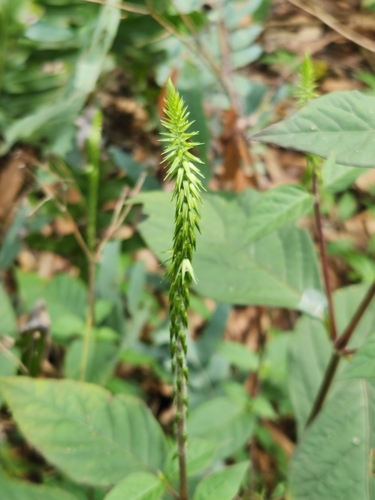
Celosia trigyna
L.
Silver spinach

(c) i_c_riddell, some rights reserved (CC BY), uploaded by i_c_riddell

(c) Bart Wursten, some rights reserved (CC BY-NC), uploaded by Bart Wursten

(c) Duncan McKenzie, some rights reserved (CC BY-NC), uploaded by Duncan McKenzie
What to Eat
Edible parts: Leaves, Flowers, Seeds, Vegetable
During drought, woolflower has been used as a source of food. The leaves are boiled like cabbage, and is known as torchata. It is also eaten as a vegetable in Africa.
Where to Find It
A tropical plant. It grows in tropical Africa. It grows in lowlands and highlands. It is often along the coast but grows from sea level to 1,960 m above sea level. It can grow in arid places. It needs a rainfall or up to 2,500 mm and an average temperature of 25-30°C. It cannot tolerate a temperature below 15°C. It is best on fertile, well drained soils.
Africa, Angola, Arabia, Benin, Botswana, Burkina Faso, Burundi, Cameroon, Canary Islands, Cape Verde, Central Africa, Central African Republic, CAR, Chad, Comoros, Congo DR, Côte d'Ivoire, East Africa, Equatorial-Guinea, Eritrea, Eswatini, Ethiopia, Gabon, Gambia, Ghana, Guinea, Guinée, Guinea-Bissau, Ivory Coast, Kenya, Liberia, Madagascar, Malawi, Mali, Mauritius, Middle East, Mozambique, Namibia, Niger, Nigeria, Reunion, Rwanda, Sahel, Saudi Arabia, Senegal, Seychelles, Sierra Leone, Somalia, South Africa, Southern Africa, South Sudan, Sudan, Swaziland, Tanzania, Togo, Uganda, USA, West Africa, Yemen, Zambia, Zimbabwe, Zululand,
How to Identify
A herb. It is branched and straggling. It grows 25-120 cm tall. The leaves are alternate. The lower leaves have long leaf stalks. The leaves are oval and about 8 cm long. The plant looks like Amaranthus hybridus until it starts to flower. Where the leaf stalk joins the stem there is a pair of small moon-shaped leaflets that lie around the stem. The small flowers are crowded together in separate clusters. They are 5-10 cm long. They are white or silvery. The fruit is a capsule which is almost round and has several seeds.
Nutrition Score: 45/100
| Part | Moisture | kJ | kcal | Protein | Vit A | Vit C | Iron | Zinc |
|---|---|---|---|---|---|---|---|---|
| Leaves | 89 | 139 | 33 | 2.7 | 1925 | 10 | 5 | — |
| Flowers | — | — | — | — | — | — | — | — |
| Seeds | — | — | — | — | — | — | — | — |
How to Grow
Plants are grown by seeds. Seeds germinate in 4-5 days. It grows for 90-120 days. Because the seeds are small they are best mixed with sand to give a more even distribution.
Propagation: Seed - sow in situ. The seed germinates freely 4 - 5 days after sowing.
Medicinal Uses
The plant is used in traditional medicine. Research has shown anthelmintic properties in humans and methanol extracts of the whole plant have shown acaricidal properties. The plant is used in Africa to treat pustular skin eruptions, heart complaints and tapeworm. The pulped leaves are used to treat costal pains, chest troubles, stomach-ache and urethral disorders. The leaves and flowers are used to treat diarrhoea. The plant is included in several medicinal preparations used to treat women’s disorders and diseases, including ovarian troubles and excessive menstruation.
Wikipedia
Source ↗Celosia trigyna is a plant species commonly known as woolflower for its curious flowers.
Production
Plants can be uprooted and harvested or leaves removed. Harvests of 4-5 t/ha can be achieved from weekly harvests over 2 months. Plants can be dried in the sun and and stored for 6 months. In humid areas leaves are available throughout the year.
Other Information
It is popular in Nigeria. It is usually eaten at home and not sold in markets. In some places it is sold in local markets. It is cultivated.
Notes
There are about 40-50 Celosia species.
Names & Synonyms
Adjeanwofoo, Agnogn, Ajefowo, Akelio, Ananakondro, Bel bella, Bongi, Bore-bore, Boroboro, Bwache, Chala cha nkhwale, Chinkanya, Dagada, Djehoundje, Djendje, Ekeliiton, Gbonkefru, Iphouphou, Iphowuphowu, Kalyababungu, Kaphikaulesi, Karyababunga, Kisandi, Lifweni likomi, Lihuluka, Mchicha pori, Mfungu, Mongyedi, Mundawarara, Nafanafa, Ndewele, Ngengutu, Nyasungwi, Piwejeya, Salimba, Sangan'akoholahy, Saza, Tchobodoue, Torchata, Torketa, Tsalambi, Umpema, Welbete, Woolflower, Zaza
References (63)
- Achigan-Dako, E, et al (Eds), 2009, Catalogue of Traditional Vegetables in Benin. International Foundation for Science.
- Addis, G., Asfaw, Z & Woldu, Z., 2013, Ethnobotany of Wild and Semi-wild Edible Plants of Konso Ethnic Community, South Ethiopia. Ethnobotany Research and Applications. 11:121-141
- Addis, G., et al, 2013, The Role of Wild and Semi-wild Edible Plants in Household Food Sovereignty in Hamer and Konso Communities, South Ethiopia. Ethnobotany Research & Applications. 11:251-271
- Awas, T., 1997, A Study on the Ecology and Ethnobotany of Non-cultivated Food Plants and Wild Relatives of Cultivated crops in Gambella Region, Southwestern Ethiopia. Addis Ababa University. p 36
- Belem, M., et al, 2017, Strategy of Conservation and Protection of Wild Edible Plants Diversity in Burkina Faso. ANADOLU 27 (2) 2017, 82- 90
- Boedecker, J., et al, 2014, Dietary contribution of Wild Edible Plants to women’s diets in the buffer zone around the Lama forest, Benin – an underutilized potential. Food Sec. 6:833–849 (As Celosia laxa)
- Burkill, H. M., 1985, The useful plants of west tropical Africa, Vol. 1. Kew.
- Codjia, J. T. C., et al, 2003, Diversity and local valorisation of vegetal edible products in Benin. Cahiers Agricultures 12:1-12 (Also as Celosia laxa)
- Dansi, A., et al, 2008, Traditional leafy vegetables and their use in the Benin Republic. Genet Resour Crop Evol (2008) 55:1239–1256
- Denton, O.A., 2004. Celosia trigyna L. [Internet] Record from Protabase. Grubben, G.J.H. & Denton, O.A. (Editors). PROTA (Plant Resources of Tropical Africa / Ressources végétales de l’Afrique tropicale), Wageningen, Netherlands. < http://database.prota.org/search.htm>. Accessed 14 October 2009.
- Duarte, M. C., et al, 2022, Diversity of Useful Plants in Cabo Verde Islands: A Biogeographic and Conservation Perspective. Plants 2022, 11, 1313 p 4
- Epenhuijsen C.W. van., 1974, Growing Native vegetables in Nigeria. FAO Rome, p 51
- Facciola, S., 1998, Cornucopia 2: a Source Book of Edible Plants. Kampong Publications, p 9
- Fowler, D. G., 2007, Zambian Plants: Their Vernacular Names and Uses. Kew. p 7
- Fox, F. W. & Young, M. E. N., 1982, Food from the Veld. Delta Books. p 70
- Gallagher, D. E., 2010, Farming beyond the escarpment: Society, Environment, and Mobility in Precolonial Southeastern Burkina Faso. PhD University of Michigan.
- Grivetti, L. E., 1980, Agricultural development: present and potential role of edible wild plants. Part 2: Sub-Saharan Africa, Report to the Department of State Agency for International Development. p 29 (Also as Celosia laxa)
- Grubben, G. J. H. and Denton, O. A. (eds), 2004, Plant Resources of Tropical Africa 2. Vegetables. PROTA, Wageningen, Netherlands. p 171
- Hedrick, U.P., 1919, (Ed.), Sturtevant's edible plants of the world. p 177
- HELY-HUTCHINSON,
- Jardin, C., 1970, List of Foods Used In Africa, FAO Nutrition Information Document Series No 2.p 65 (Also as Celosia laxa)
- Lautenschläger, T., et al, 2018, First large-scale ethnobotanical survey in the province of Uíge, northern Angola. Journal of Ethnobiology and Ethnomedicine (2018) 14:51
- Liengola, I. B., 2001, A contribution to the study of native edible plants by the Turumbu and Lokele of the Tshopo District, Province Orientale, D. R. Congo. Syst. Geogr. Pl. 71:687-698
- Long, C., 2005, Swaziland's Flora - siSwati names and Uses http://www.sntc.org.sz/flora/
- Lyimo, M., et al, 2003, Identification and nutrient composition of indigenous vegetables of Tanzania. Plant Foods for Human Nutrition. 58: 85-92
- Malaisse, F., 1997, Se nourrir en floret claire africaine. Approche ecologique et nutritionnelle. CTA., p 59
- Malaisse, F., 2010, How to live and survive in Zambezian open forest (Miombo Ecoregion). Les Presses Agronomiques de Gembloux.
- Mant. pl. 2:212. 1771
- Martin, F.W. & Ruberte, R.M., 1979, Edible Leaves of the Tropics. Antillian College Press, Mayaguez, Puerto Rico. p 173 (Also as Celosia laxa)
- Masters, T., 2021, Traditional food plants of the upper Aswa River catchment of northern Uganda—a cultural crossroads. Journal of Ethnobiology and Ethnomedicine (2021) 17:24
- Mertz, O., Lykke, A. M., and Reenberg, A., 2001, Importance and Seasonality of Vegetable Consumption and Marketing in Burkina Faso. Economic Botany, 55(2):276-289
- Molla, A., Ethiopian Plant Names. http://www.ethiopic.com/aplants.htm
- Maroyi, A., 2011, The Gathering and Consumption of Wild Edible Plants in Nhema Communal Area, Midlands Province, Zimbabwe. Ecology of Food and Nutrition 50:6, 506-525
- Maroyi, A., 2013, Use of weeds as traditional vegetables in Shurugwi District, Zimbabwe. Journal of Ethnobiology and Ethnomedicine 9:60
- Mpasiwakomu, R. A., 2017, The Diversity and Utilization of Wild Edible and Medicinal Plant Species found in Uvinza Miombo Woodlands, Tanzania. M. Sc. thesis University of Tanzania.
- Msola, D. K., 2007, The role of Wild Foods in Household Income and Food Security in Mufundi District, Tanzania. Morogoro, Tanzania. p 46
- Msuya, T. S., et al, 2010, Availability, Preference and Consumption of Indigenous Foods in the Eastern Arc Mountains, Tanzania, Ecology of Food and Nutrition, 49:3, 208-227
- Mutie, F. M., et al, 2023, Important Medicinal and Food Taxa (Orders and Families) in Kenya, Based on Three Quantitative Approaches. Plants 2023, 12, 1145
- Peters, C. R., O'Brien, E. M., and Drummond, R.B., 1992, Edible Wild plants of Sub-saharan Africa. Kew. p 47
- Pickering, H., & Roe, E., 2009, Wild Flowers of the Victoria Falls Area. Helen Pickering, London. p 22
- Plowes, N. J. & Taylor, F. W., 1997, The Processing of Indigenous Fruits and other Wildfoods of Southern Africa. in Smartt, L. & Haq. (Eds) Domestication, Production and Utilization of New Crops. ICUC p 187
- Raponda-Walker, A & Sillans, R., 1961, Les Plantes Utiles du Gabon. Editions Paul Lechevalier, Paris. p 50 (Also as Celosia laxa)
- Razanameharizaka, J., et al, 2022, Catalogue Legumes Traditionnels de Madagascar. Université d’Antananarivo, Antananarivo (101), Madagascar. Vol. 1. p 16
- Royal Botanic Gardens, Kew (1999). Survey of Economic Plants for Arid and Semi-Arid Lands (SEPASAL) database. Published on the Internet; http://www.rbgkew.org.uk/ceb/sepasal/internet [Accessed 24th March 2011]
- Ruffo, C. K., Birnie, A. & Tengnas, B., 2002, Edible Wild Plants of Tanzania. RELMA p 194
- Ruiters-Welcome, A. K., 2019, Food plants of southern Africa. Ph.D. thesis. Univ. of Johannesburg p 11
- Segnon, A. C. & Achigan-Dako, E. G., 2014, Comparative analysis of diversity and utilization of edible plants in arid and semi-arid areas in Benin. Journal of Ethnobiology and Ethnomedicine 2014, 10:80
- Seidemann J., 2005, World Spice Plants. Economic Usage, Botany, Taxonomy. Springer. p 90
- Swaziland's Flora Database http://www.sntc.org.sz/flora
- Termote, C., et al, 2011, Eating from the wild: Turumbu, Mbole and Bali traditional knowledge of non-cultivated edible plants, District Tshopo, DRCongo, Gen Resourc Crop Evol. 58:585-618
- Termote, C., 2012, Wild edible plant use in Tshopo District, Democratic Republic of Congo. Universiteit Gent. p 69
- Thiselton-Dywer, W.T., (Ed.), 1913, Flora of Tropical Africa. Vol VI-section 1. Reeve, p 20
- Thiselton-Dywer, W.T., (Ed.), 1913, Flora of Tropical Africa. Vol VI-section 1. Reeve, p 18 (As Celosia laxa)
- Tindall, H.D., 1983, Vegetables in the tropics. Macmillan p. 45
- Vainio-Mattila, K., 2000, Wild vegetables used by the Sambaa in the Usumbara Mountains, NE Tanzania. Ann. Bot. Fennici 37:57-67
- Vernon, R., 1983, Field Guide to Important Arable Weeds of Zambia. Dept of Agriculture, Chilanga, Zambia. p 28
- Welcome, A. K. & Van Wyk, B.-E., 2019, An inventory and analysis of the food plants of southern Africa. South African Journal of Botany 122 (2019) 136–179
- Williamson, J., 2005, Useful Plants of Malawi. 3rd. Edition. Mdadzi Book Trust. p 61
- World Checklist of Useful Plant Species 2020. Royal Botanic Gardens, Kew
- Yamada, T., 1999, A report of the Ethnobotany of the Nyindu in the Eastern part of the former Zaire. African Study Monographs 20(1):1-72
- Yimer, A., et al, 2021, Ethnobotanical study of wild edible plants used by Meinit Ethnic Community at Bench-Maji Zone, Southwest Ethiopia. Research Square. p 5
- Zeven, A. C. & de West, J. M. J., 1982, Dictionary of cultivated plants and their regions of diversity. Wageningen. p 122
- Zon, A.P.M. van der, Grubben, G.J.H., 1976, Les legumes-feuilles spontanes et cultives du Sud-Dahomey, Communication 65, Royal Tropical Institute, Amsterdam, p 45, p 43, 44 (Also as Celosia laxa)