Acacia terminalis
(Salisb.) J. F. Macbr.
Sunshine wattle
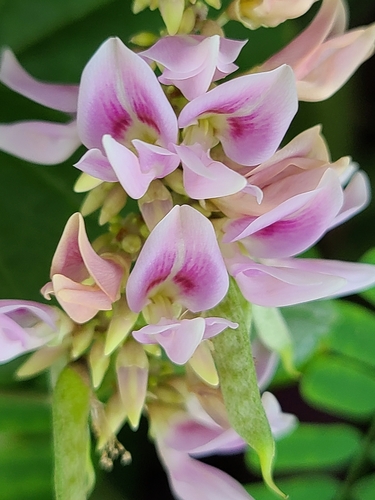
no rights reserved, uploaded by Vale Jenny Conolly

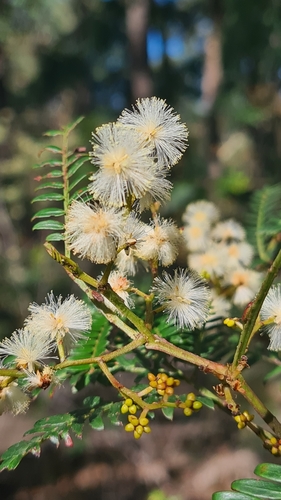
(c) Thomas Mesaglio, some rights reserved (CC BY), uploaded by Thomas Mesaglio

(c) Mike Young, some rights reserved (CC BY-SA)
What to Eat
Edible parts: Seeds
The seeds are eaten.
Where to Find It
It is a temperate plant. Arboretum Tasmania.
Australia*, Tasmania,
How to Identify
A shrub or small tree. It grows 5 m tall. There are prickles along the stem. The leaves are twice divided and there are 8-18 pairs of pinnae. There are up to 50 pairs of pinnules on each pinnae. The flowers are yellow. They are in large clusters at the ends of branches. The pods are flattened.
Wikipedia
Source ↗Acacia terminalis (sunshine wattle) is a shrub or small tree to 6 m in height. It is an Australian native whose range extends through New South Wales, Victoria and Tasmania. Common names are cedar wattle (also used of Acacia elata), elata wattle, mountain hickory (also used of Acacia obliquinervia) and peppermint-tree wattle. Four subspecies have been recognised, although there are additional hybrids, especially around Sydney: A. terminalis subsp. angustifolia A. terminalis subsp. aurea A. terminalis subsp. longiaxialis A. terminalis subsp. terminalis: listed as an endangered species under the Commonwealth Environment Protection and Biodiversity Conservation Act 1999. It is rare and confined to the Eastern suburbs of Sydney, between Cronulla and Manly. It differs from the other forms of the species in being hairier, and having thicker peduncles and wider seed pods.
Notes
There are about 1,350 Acacia species. Over 1,000 occur in Australia. Listed as Acacia maritima by Noetling, F., 1910, The Food of the Tasmanian Aborigines. Pap. & Proc. Roy Soc. Tasmania p 292 - probably incorrectly. Also as Mimosaceae.
Names & Synonyms
References (2)
- Cherikoff V. & Isaacs, J., The Bush Food Handbook. How to gather, grow, process and cook Australian Wild Foods. Ti Tree Press, Australia p 47 (As Acacia maritima)
- World Checklist of Useful Plant Species 2020. Royal Botanic Gardens, Kew