Alstonia macrophylla
Wall. ex G. Don
Match stick tree
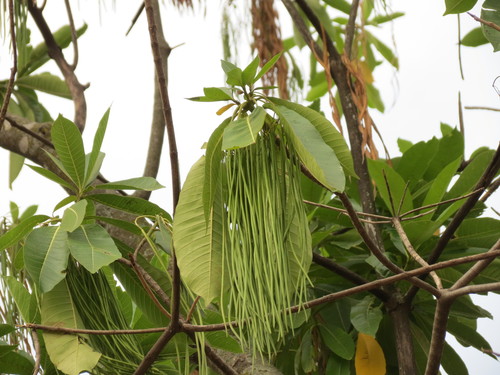
no rights reserved, uploaded by Ajit Ampalakkad

(c) Joe MDO, some rights reserved (CC BY-NC), uploaded by Joe MDO

(c) Dmitry Kutcherov, some rights reserved (CC BY-NC), uploaded by Dmitry Kutcherov
What to Eat
Edible parts: Root - flavouring, Bark - drink
The root is roasted and used as a flavouring. The bark is scraped and used with water as a drink.
Where to Find It
It is a tropical plant. In Indonesia it grows up to 1,500 m above sea level. In Yunnan.
Africa, Asia, China, Hawaii, India, Indochina, Indonesia, Malaysia, Pacific, Papua New Guinea, PNG, Philippines, SE Asia, Sri Lanka, Thailand, Vietnam,
How to Identify
A tree. It grows 20 m tall. The bark is smooth. The branches are angled. The leaves are in rings of 3 or 4. They are 10-53 cm long by 4-19 cm wide. They are hairy underneath. The flowers are at the ends of branches.
How to Grow
Plants can be grown by seeds.
Medicinal Uses
The bark, in the form of a powder, decoction, infusion, tincture or wine preparation, is used as an antiamoebic, anticholeric, antidysenteric, antimalarial, antiperiodic, emmenagogue, febrifuge, tonic and a vulnerary. The scraped bark is mixed with water and drunk, as well as used as a wash on the forehead, in order to relieve a headache. The powdered bark, mixed with water, is used against skin diseases.. A decoction of the young leaves is drunk to cure lung and ear congestions.
Other Uses
The wood is used as hard alstonia. It is used for construction purposes, furniture and flooring.
Wikipedia
Source ↗Alstonia macrophylla, the hard alstonia, hard milkwood or big-leaved macrophyllum, is a species of plant in the family Apocynaceae.
Names & Synonyms
Ajooras, Pohon pulai daun lebar, Poole batoo
References (6)
- Lim, T. K., 2015, Edible Medicinal and Non Medicinal Plants. Volume 9, Modified Stems, Roots, Bulbs. Springer p 7
- Uphof, 1968,
- Seidemann J., 2005, World Spice Plants. Economic Usage, Botany, Taxonomy. Springer. p 31 (As Alstonia acuminata)
- Slik, F., www.asianplant.net
- Sukarya, D. G., (Ed.) 2013, 3,500 Plant Species of the Botanic Gardens of Indonesia. LIPI p 123
- World Checklist of Useful Plant Species 2020. Royal Botanic Gardens, Kew


