Fibraurea recisa
Pierre
Tall woody vine
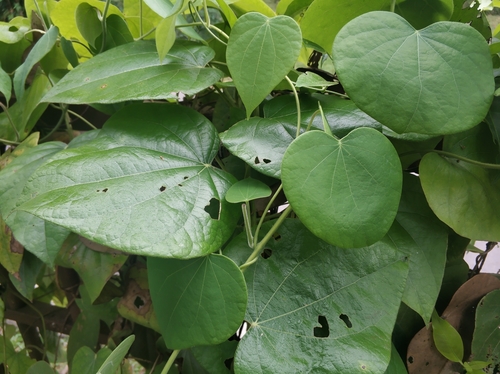
(c) 刘光裕 Liu Guangyu, some rights reserved (CC BY-NC), uploaded by 刘光裕 Liu Guangyu
What to Eat
Edible parts: Root - flavouring
The root is used as a flavouring.
Where to Find It
It is a tropical plant. In Yunnan.
Asia, Cambodia, China, Indochina, Laos, SE Asia, Vietnam,
How to Identify
A woody vine. The roots and stem have yellow wood. The leaf stalks is long and swollen at both ends. The leaves are oval and have veins spreading out like fingers on a hand. The flowering shoots are often on the older leafless stems. Male and female flowers are separate. There are 1-3 fleshy fruit in a group. They are orange to yellow.
Medicinal Uses
A decoction of the roots is used in the treatment of a range of conditions including ophthalmia, furunculosis, prurigo, enteritis, gastritis, cystitis, dysentery and fever. The powdered roots, combined with alum, are applied topically in the treatment of purulent otitis. The roots and stems are harvested in autumn, then after being well washed are cut into suitable sizes and dried in the sun or in dryers The roots yield several alkaloids, including palmatine, jatrorrhizine, columbamine, and berberine
Other Uses
The wood is bright yellw.
Names & Synonyms
Day namhoang nhuom
References (1)
- Seidemann J., 2005, World Spice Plants. Economic Usage, Botany, Taxonomy. Springer. p 156


