Ledebouria revoluta
(L.f.) Jessop
South Indian squill

iNaturalist · cc-by-sa
(c) Eugene Hahndiek, some rights reserved (CC BY-SA), uploaded by Eugene Hahndiek
(c) Eugene Hahndiek, some rights reserved (CC BY-SA), uploaded by Eugene Hahndiek

iNaturalist · cc-by-nc
(c) Jan-Hendrik Keet, some rights reserved (CC BY-NC), uploaded by Jan-Hendrik Keet
(c) Jan-Hendrik Keet, some rights reserved (CC BY-NC), uploaded by Jan-Hendrik Keet
iNaturalist · cc-by-nc
(c) Sharon Louw, some rights reserved (CC BY-NC), uploaded by Sharon Louw
(c) Sharon Louw, some rights reserved (CC BY-NC), uploaded by Sharon Louw
What to Eat
Edible parts: Bulb
The bulbs are eaten and are a significant occasional food in Mozambique.
Where to Find It
It is a subtropical plant.
Africa, Asia, Botswana, East Africa, India, Mozambique, South Africa, Southern Africa,
Countries: United Arab Emirates, Afghanistan, Armenia, Angola, Azerbaijan, Bangladesh, Burkina Faso, Bahrain, Burundi, Benin, Brunei, Bhutan, Botswana, Congo (DRC), Central African Republic, Congo (Republic), Cote d'Ivoire, Cameroon, China, Cape Verde, Djibouti, Algeria, Egypt, Eritrea, Ethiopia, Gabon, Georgia, Ghana, Gambia, Guinea, Equatorial Guinea, Guinea-Bissau, Indonesia, Israel, India, Iraq, Iran, Jordan, Japan, Kenya, Kyrgyzstan, Cambodia, Comoros, North Korea, South Korea, Kuwait, Kazakhstan, Laos, Lebanon, Sri Lanka, Liberia, Lesotho, Libya, Morocco, Madagascar, Mali, Myanmar, Mongolia, Mauritania, Mauritius, Maldives, Malawi, Malaysia, Mozambique, Namibia, Niger, Nigeria, Nepal, Oman, Philippines, Pakistan, Qatar, Rwanda, Saudi Arabia, Seychelles, Sudan, Singapore, Sierra Leone, Senegal, Somalia, South Sudan, Sao Tome & Principe, Syria, Eswatini, Chad, Togo, Thailand, Tajikistan, Timor-Leste, Turkmenistan, Tunisia, Turkey, Taiwan, Tanzania, Uganda, Uzbekistan, Vietnam, Yemen, South Africa, Zambia, Zimbabwe
How to Identify
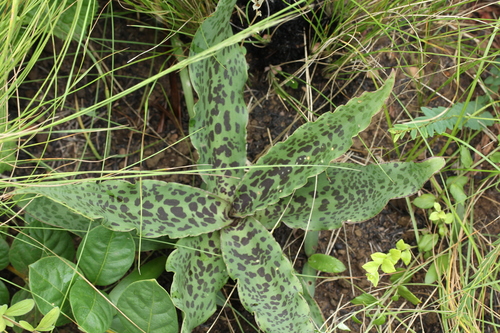
A herb. It is a bulb plant. The bulbs are 2.5-7.5 cm long. It grows 20 cm tall. The leaves are narrowly sword shaped. There are 4-8 leaves that can be 15 cm long by 3 cm wide. The flowering shoots can be 3-25 cm long and the flowers are greenish to pink or purple.
Nutrition Score: 37/100
| Part | Moisture | kJ | kcal | Protein | Vit A | Vit C | Iron | Zinc |
|---|---|---|---|---|---|---|---|---|
| Bulb | 77.3 | 333 | 80 | 1.7 | — | 9.4 | 0.8 | 1 |
Wikipedia
Source ↗Ledebouria revoluta, the south Indian squill, is a flowering plant species in the genus Ledebouria found in Southern Africa and India.
Other Information
It is a significant occasional food in Mozambique.
Notes
Also put in the family Hyacinthaceae.
Names & Synonyms
Lissungunha
Barnardia indica WightDrimia acuminata Lodd.Drimia bifolia (Hochst. ex A. Rich.) Schweinf.Eratobotrys bifolia Hochst. ex A. Rich.Hyacinthus revolutus L.f.Lachenalia lanceifolia Jacq.Ledebouria sikenbergeri (Deflers) SpetaScilla hyacinthina (Roth) J. F. Macbr.and many others
References (5)
- Albano, et al, 1998, (As Scilla hyacinthina)
- Kiran, K. C., et al, 2019, Diversity and Seasonal Availability of Potential Wild Edible Plants from Vidarbha Region of Maharashtra State, India. Int.J.Curr.Microbiol.App.Sci (2019) 8(2): 1434-1446 (As Scilla hyacinthina)
- Ruiters-Welcome, A. K., 2019, Food plants of southern Africa. Ph.D. thesis. Univ. of Johannesburg p 65
- Wehmeyer, A. S, 1986, Edible Wild Plants of Southern Africa. Data on the Nutrient Contents of over 300 species
- Welcome, A. K. & Van Wyk, B.-E., 2019, An inventory and analysis of the food plants of southern Africa. South African Journal of Botany 122 (2019) 136–179