Aralia armata
(Wall. ex G. Don) Seem.
Spiny vegetable
(c) JODY HSIEH, some rights reserved (CC BY-NC), uploaded by JODY HSIEH
(c) JODY HSIEH, some rights reserved (CC BY-NC), uploaded by JODY HSIEH
(c) JODY HSIEH, some rights reserved (CC BY-NC), uploaded by JODY HSIEH
What to Eat
Edible parts: Leaves, Vegetable, Flowers, Fruit
The young leaves are boiled and eaten, used to flavour meat and fish, and are sold in local markets. The young unopened flowers are cooked and eaten, and the fruit can be eaten.
Where to Find It
It is a tropical plant. In Vietnam it grows in the highlands. In southern China it grows in valleys and on the edges of forests below 1,600 m above sea level. In Yunnan.
Asia, China, Himalayas, India, Indochina, Malaysia, Myanmar, Northeastern India, SE Asia, Thailand, Vietnam,
How to Identify
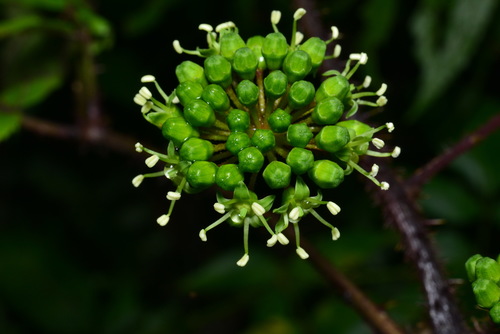
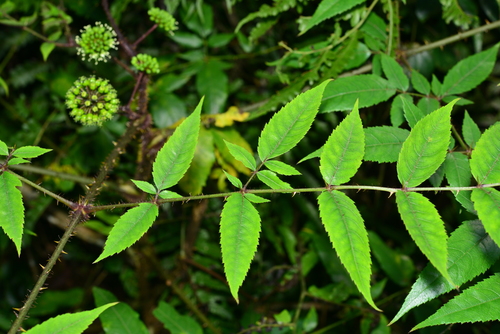
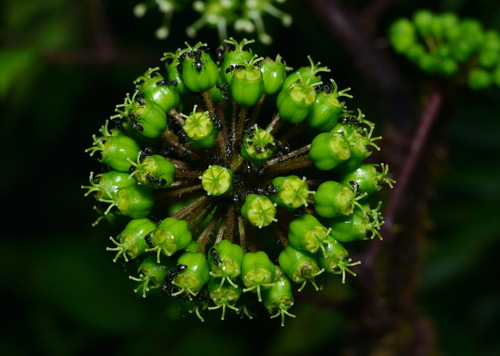
A shrub. It grows 1-2 m tall. The stems are thin and have curved spines. The branches are drooping. The leaves are twice divided into leaflets along the stalk. The smaller sections have 9-10 leaflets that are egg shaped. They are 4-8 cm long and 2-3 cm wide. There are small spines on the veins. The flowers are small and yellow-green on long stalks. The fruit are round and fleshy and black.
Other Information
Leaves are sold in local markets.
Names & Synonyms
Ci bao cai, Cuong, Dinh lang gai, Don chau chau, Dong gong lu, Lingdon, Naosek nambi, Pa dan, Tataterang, Tengnang, Thang ao, Turei, Saifok
References (12)
- Cao, Y., et al, 2020, Ethnobotanical study on wild edible plants used by three trans-boundary ethnic groups in Jiangcheng County, Pu’er, Southwest China. Journal of Ethnobiology and Ethnomedicine (2020) 16:66
- Ethnobotany of Karbis. Chapter 4 in p 107
- Ghorbani, A., et al, 2012, A comparison of the wild food plant use knowledge of ethnic minorities in Naban River Watershed Nature Reserve, Yunnan, SW China. Journal of Ethnobiology and Ethnomedicine; 8:17
- Medhi, P. & Borthakur, S. K., 2012, Phytoresources from North Cachur Hills of Assam -3: Edible plants sold at Hflong market. Indian Journal or Natural Products and Resources. 3(1) pp 84-109 (Has Aralia montana as a synonym)
- Medhi, P. & Borthakur, S. K., 2013, Wild edible plants sold by the Zeme Nagas at the makeshift market of Mahur, Dima Hasao district of Assam. Pleione 7(1): 84 - 93. 2013.
- Medhi, P., Sarma, A and Borthakur, S. K., 2014, Wild edible plants from the Dima Hasao district of Assam, India. Pleione 8(1): 133-148
- Meitei, L. R., et al, 2022, An ethnobotanical study on the wild edible plants used by forest dwellers in Yangoupokpi Lokchao Wildlife Sanctuary, Manipur, India. Ethnobotany Research and Application 23:15
- Murtem, G. & Chaudhrey, P., 2016, An ethnobotanical note on wild edible plants of Upper Eastern Himalaya, India. Brazilian Journal of Biological Sciences, 2016, v. 3, no. 5, p. 63-81
- Tanaka, Y. & Van Ke, N., 2007, Edible Wild Plants of Vietnam: The bountiful garden. Orchid books. p 32
- Taram, M., et al, 2018, Wild Food Plant Resources of Komkar Adi Tribe of Upper Siang District in Arunachal Pradesh, India. Bulletin of Arunachal Forest Research, Vol. 33(2), 27-35
- Teron, R. & Borthakur, S. K., 2016, Edible Medicines: An Exploration of Medicinal Plants in Dietary Practices of Karbi Tribal Population of Assam, Northeast India. In Mondal, N. & Sen, J.(Ed.) Nutrition and Health among tribal populations of India. p 149
- Xu, You-Kai, et al, 2004, Wild Vegetable Resources and Market Survey in Xishuangbanna, Southwest China. Economic Botany. 58(4): 647-667.


