Aralia continentalis
Kitag.
Manchurian spikenard

(c) MP Zhou, some rights reserved (CC BY-NC), uploaded by MP Zhou

(c) Kim, Hyun-tae, some rights reserved (CC BY-NC), uploaded by Kim, Hyun-tae
(c) V.S. Volkotrub, some rights reserved (CC BY-NC), uploaded by V.S. Volkotrub
What to Eat
Edible parts: Leaves, Root, Stem
Edible Parts: Leaves Root Shoots Stem Edible Uses: The following uses are for the closely related A. cordata. It is quite possible that they also apply to this species. Shoots - cooked or raw. They can be up to 1.5 metres long and have a mild and agreeable flavour. They are usually blanched and are crisp and tender with a unique lemon-like flavour. They can be sliced and added to salads, soups etc. The shoots contain about 1.1% protein, 0.42% fat, 0.8% soluble carbohydrate, 0.55% ash. Root - cooked. Used like scorzonera.
Where to Find It
A cool temperate plant. It suits sun of light shade. It is best in rich soil. It grows in forests and grasslands between 800-3,200 m above sea level in north China. In Sichuan.
Asia, Australia, China, Himalayas, Korea, Russia, Siberia, Tibet,
How to Identify
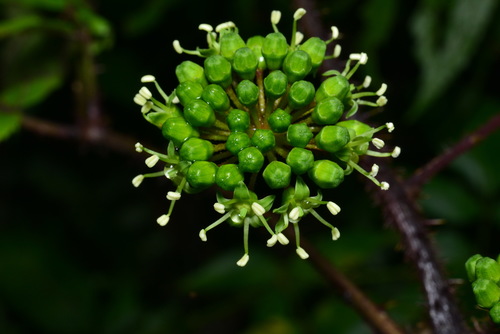
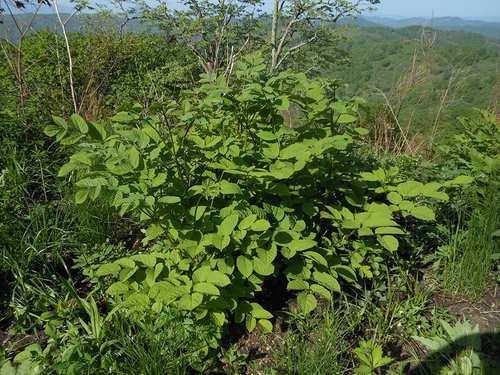
A shrub. It grows 2 m tall. The leaves are large and compound. They are rich glossy green. The flowers are small and in showy balls. These develop black fruit.
How to Grow
Prefers a deep moderately fertile moisture-retentive well-drained loam and a semi-shady position. Requires a sheltered position. Plants are hardier when grown in poorer soils. This species is not hardy in the colder areas of the country, it tolerates temperatures down to between -5 and -10°c. The young growth in spring, even on mature plants, is frost-tender and so it is best to grow the plants in a position sheltered from the early morning sun. This species is closely related to A. cordata.
Propagation: Seed - best sown as soon as ripe in a cold frame. Stored seed requires 3 - 5 months of cold stratification. Germination usually takes place within 1 - 4 months at 20°c. When large enough to handle, prick the seedlings out into individual pots and grow them on in light shade in a greenhouse for at least their first winter. Once the plants are 25cm or more tall, they can be planted out into their permanent positions, late spring or early summer being the best time to do this. Root cuttings 8cm long, December in a cold frame. Store the roots upside down in sand and pot up in March/April. High percentage. Division of suckers in late winter. Very easy, the suckers can be planted out direct into their permanent positions if required.
Medicinal Uses
None known
Other Uses
None known Special Uses
Wikipedia
A perennial herb reaching 2 m (6 ft 7 in) tall, hardy to UK zone 8 and frost-tender. Hermaphroditic flowers pollinated by bees bloom July to August. Adapts to light sandy, medium loamy, and heavy clay soils with good drainage and poor nutrition. Tolerates mildly acidic, neutral, and basic soils, growing in full to semi-shade and preferring moist conditions.
Notes
There are about 40-55 Aralia species.
Names & Synonyms
Dokhwal, Dong bei tu dang gui, Trangdureup
References (8)
- Bot. Mag. (Tokyo) 49:228. 1935
- Hibbert, M., 2002, The Aussie Plant Finder 2002, Florilegium. p 31
- Kim, H. & Song, M., 2013, Ethnobotanical analysis for traditional knowledge of wild edible plants in North Jeolla Province (Korea). Genetic. Resour. Crop Evol. (2013) 60:1571-1585 (As Aralia cordata var. continentalis)
- Ong, H. G., et al, 2015, Ethnobotany of the wild edible plants gathered in Ulleung Island, South Korea. Genet Resourc Crop Evol. Springer (As Aralia cordata var. continentalis)
- Plants for a Future database, The Field, Penpol, Lostwithiel, Cornwall, PL22 0NG, UK. http://www.scs.leeds.ac.uk/pfaf/
- Ryan, S., 2008, Dicksonia. Rare Plants Manual. Hyland House. p 95
- Wiersema, J. H. & Leon, B., 2013, World Economic Plants. A Standard Reference CRC Press. 2nd Ed. p 63
- World Checklist of Useful Plant Species 2020. Royal Botanic Gardens, Kew