Dichondra microcalyx
(Hallier f.) Fabris
ConvolvulaceaeLeaves
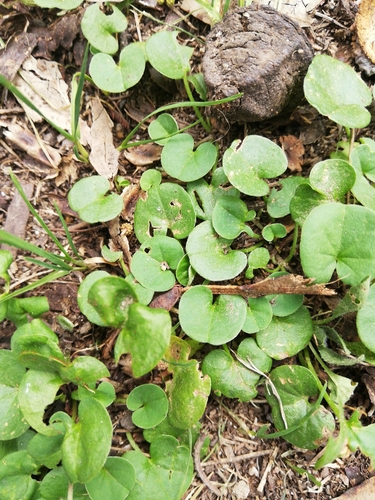
iNaturalist · cc-by-nc
(c) Ana Gabriela Del Hierro Calvachi, some rights reserved (CC BY-NC), uploaded by Ana Gabriela Del Hierro Calvachi
(c) Ana Gabriela Del Hierro Calvachi, some rights reserved (CC BY-NC), uploaded by Ana Gabriela Del Hierro Calvachi
What to Eat
Edible parts: Leaves, Vegetable
The leaves are eaten both cooked and fresh as a vegetable.
Where to Find It
It is a subtropical plant. In Argentina it grows from sea level to 900 m above sea level. In Yunnan.
Argentina*, Asia, Chile, China, Paraguay, South America, Uruguay,
Countries: United Arab Emirates, Afghanistan, Armenia, Argentina, Azerbaijan, Bangladesh, Bahrain, Brunei, Bolivia, Brazil, Bhutan, Chile, China, Colombia, Ecuador, Georgia, French Guiana, Guyana, Indonesia, Israel, India, Iraq, Iran, Jordan, Japan, Kyrgyzstan, Cambodia, North Korea, South Korea, Kuwait, Kazakhstan, Laos, Lebanon, Sri Lanka, Myanmar, Mongolia, Maldives, Malaysia, Nepal, Oman, Peru, Philippines, Pakistan, Paraguay, Qatar, Saudi Arabia, Singapore, Suriname, Syria, Thailand, Tajikistan, Timor-Leste, Turkmenistan, Turkey, Taiwan, Uruguay, Uzbekistan, Venezuela, Vietnam, Yemen
How to Identify
A herb. It keeps growing from year to year. The leaves are almost round and 1-2.5 cm long by 1.3 cm wide. They are heart shaped at the base.
Wikipedia
Source ↗Dichondra microcalyx, the mouse ear (Spanish: oreja de ratón), is a species of plant in the family Convolvulaceae.
Production
The leaves are available all year round.
Other Information
Leaves are sold in markets.
Notes
Not in the Flora of China.
Names & Synonyms
Dagu, Mijiupami, Panuo
Dichondra micrantha Meissn.Dichondra parvifolia Meissn.Dichondra repens J. R. Forst. & G. Forst.Dichondra repens var. microcalyx Hallier f.Dichondra repens var. microcalyx Buck
References (1)
- Xu, You-Kai, et al, 2004, Wild Vegetable Resources and Market Survey in Xishuangbanna, Southwest China. Economic Botany. 58(4): 647-667. (As Dichondra repens)


