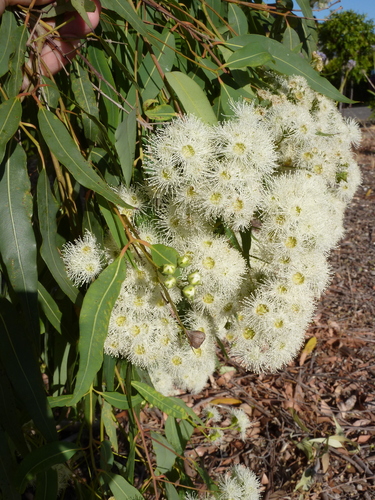
Eugenia roxburghii
DC.
Roxburgh's cherry

(c) Dinesh Valke, some rights reserved (CC BY-SA)
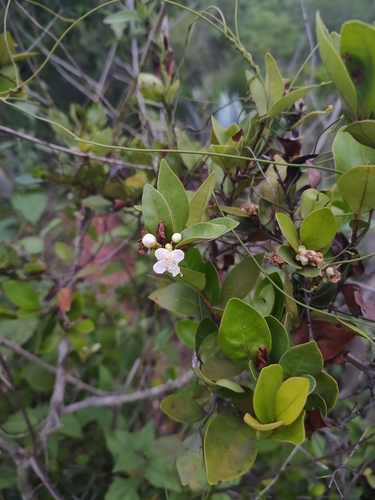
(c) Srichakra Pranav Tamarapalli, some rights reserved (CC BY-SA)

Wikimedia Commons - Lalithamba from India
What to Eat
Edible parts: Fruit
The ripe fruit are eaten fresh.
Where to Find It
It is a subtropical plant.
Asia, Bangladesh, Cambodia, India, Indochina, Northeastern India, SE Asia, Sri Lanka, Vietnam,
How to Identify
A large shrub or small tree. It grows 1-8 m tall. The leaves are oval or sword shaped. They are 7 cm long by 3 cm wide. The flowers are 7 mm across. There are 2 or 3 flowers together in the axils of leaves. The petals are white. The fruit is a berry that is orange or red.
Nutrition Score: 11/100
| Part | Moisture | kJ | kcal | Protein | Vit A | Vit C | Iron | Zinc |
|---|---|---|---|---|---|---|---|---|
| Fruit | 66.3 | — | — | 0.7 | — | 18.5 | — | — |
Wikipedia
Source ↗Eugenia roxburghii (commonly known as Roxburgh's Cherry) is a species of plant in the family Myrtaceae which is native to India and Sri Lanka. It is a 5 metres (16 ft) tall tree with round, rough, brown branches. Leaves are shiny green in color which are oppositely arranged. Flowers are white in color and have four-petals. Fruit is a deep orange-colored berry. Flowering starts on March and ends with late April.
Production
In Kerala it was flowering and fruiting in March and April.
Other Information
It is a cultivated plant.
Names & Synonyms
Harch, Haroh, Hijli jam, Jangmi reng reng, Lukluki-jam, Menadi, Misi-ia-thep, Pring uel, Sagarabatua, Thingsenti, Unchana
References (10)
- Ambasta, S.P. (Ed.), 2000, The Useful Plants of India. CSIR India. p 613 (As Syzygium bracteatum)
- Cengel, D. J. & Dany, C., (Eds), 2016, Integrating Forest Biodiversity Resource Management and Sustainable Community Livelihood Development in the Preah Vihear Protected Forest. International Tropical Timber Organization p 121 (As Syzygium bracteatum)
- Ethnobotany of Karbis. Chapter 4 in p 104 (As Eugenia bracteata Roxb.)
- Jeeva, S., 2009, Horticultural potential of wild edible fruits used by the Khasi tribes of Meghalaya. Journal or Horticulture and Forestry Vol. 1(9) pp. 182-192 (As Eugenia bracteata)
- Mahapatra, A. K., et al, 2012, Nutrient Analysis of some selected wild edible fruits of deciduous forests of India. Advance Journal of Food Science and Technology 4(1):15-21 (As Eugenia rothii)
- Pasha, M. K. & Uddin, S. B., 2019, Minor Edible Fruits of Bangladesh. Bangladesh J. Plant Taxon. 26(2): 299–313
- Phon, P., 2000, Plants used in Cambodia. © Pauline Dy Phon, Phnom Penh, Cambodia. p 577 (As Syzygium bracteatum)
- Sawian, J. T., et al, 2007, Wild edible plants of Meghalaya, North-east India. Natural Product Radiance Vol. 6(5): p 416 (As Eugenia bracteata)
- Singh, V. B., et al, (Ed.) Horticulture for Sustainable Income and Environmental Protection. Vol. 1 p 220
- Wild edible plants of Himachal Pradesh (As Syzygium ruscifolium)