Lactarius repraesentaneus
Britzelm.
Northern milkcap, Northern bearded milkcap
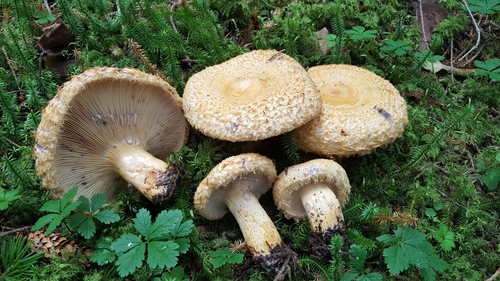
(c) noah_siegel, some rights reserved (CC BY-NC-SA), uploaded by noah_siegel

(c) tombigelow, some rights reserved (CC BY-NC)

(c) tombigelow, some rights reserved (CC BY-NC)
What to Eat
Edible parts: Mushroom, Fungus, Caution, Medicine
CAUTION
Known Hazards
Where to Find It
It is a temperate plant.
Britain, Canada, Czech Republic, Europe, France, North America, Sweden, Switzerland,
How to Identify
A temperate mushroom in the Russulaceae family.
Medicinal Uses
Has traditional medicinal uses.
Wikipedia
Source ↗Lactarius repraesentaneus, commonly known as the purple-staining bearded milkcap, the northern bearded milkcap, or the northern milkcap, is a species of fungus in the family Russulaceae. Distinguishing features of its fruit body include the large orange-yellow cap up to 18 cm (7.1 in) wide, cream to pale yellow gills, and a yellow coarsely-pitted stem that is up to 12 cm (4.7 in) long and 3 cm (1.2 in) thick. Cut fruit bodies ooze a white latex that will stain mushroom tissue lilac to purple. The species has a northerly distribution, being found in temperate regions of North America and Europe. It is associated with spruce trees. The mushroom is poisonous, its consumption causing stomach aches. It has antibiotic activity against Staphylococcus aureus and contains chemicals that can modify the growth of plants.
References (2)
- Boa, E. R., Wild edible fungi and their importance to people. FAO Non Wood Forest Products Booklet 17
- Li, H., et al, 2020, Reviewing the world’s edible mushroom species: A new evidence-based classification system. Compr Rev Food Sci Food Saf. 2021;20:1982–2014.


