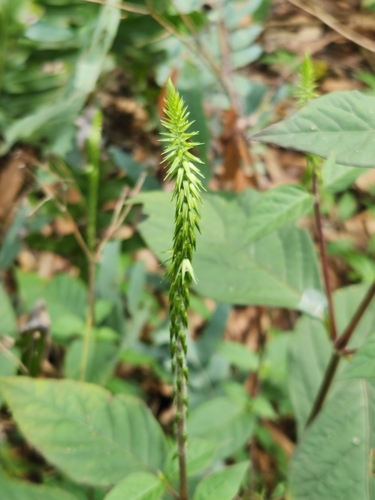
Centrostachys aquatica
(R. Br.) Wallich ex Moq.

Wikimedia Commons - drawing: Govindoo

Wikimedia Commons - Endlicher, Stephan
What to Eat
Edible parts: Leaves
The leaves are edible.
Where to Find It
A tropical plant. It grows in water. In Sichuan and Yunnan.
Africa, Asia, Australia, Bangladesh, Benin, Botswana, Burkina Faso, Burundi, Cambodia, Cameroon, Central Africa, China, Congo DR, East Africa, Ethiopia, Hawaii, India, Indochina, Indonesia, Japan, Kenya, Korea, Laos, Mozambique, Myanmar, Nigeria, Pacific, Philippines, Russia, SE Asia, Senegal, Siberia, Sri Lanka, South Sudan, Taiwan, Tanzania, Thailand, Tibet, Uganda, USA, Vietnam, West Africa, Zambia, Zimbabwe,
How to Identify
A herb that grows in water. The stems have grooves. The leaves are thin and opposite. They are diamond shaped. They are red above and purple underneath. They taper at the base to a short leaf stalk. The flowers are in small spikes at the tips. The spikes emerge above the water and are white and hairy.
How to Grow
It can be grown from stem cuttings.
Medicinal Uses
The plant is used as medicine.
Notes
It is used as medicine.
Names & Synonyms
References (5)
- A. L. P. P. de Candolle, Prodr. 13(2):321. 1849 (As (R. Br.) Moq.)
- Dansi, A., et al, 2008, Traditional leafy vegetables and their use in the Benin Republic. Genet Resour Crop Evol (2008) 55:1239–1256
- Dansi, A., et al, 2009, Traditional leafy vegetables in Benin: folk nomenclature, species under threat and domestication. Acta Bot. Gallica 156(2), 183-199
- Staples, G.W. and Herbst, D.R., 2005, A tropical Garden Flora. Bishop Museum Press, Honolulu, Hawaii. p 103
- Zon, A.P.M. van der, Grubben, G.J.H., 1976, Les legumes-feuilles spontanes et cultives du Sud-Dahomey, Communication 65, Royal Tropical Institute, Amsterdam, p 46