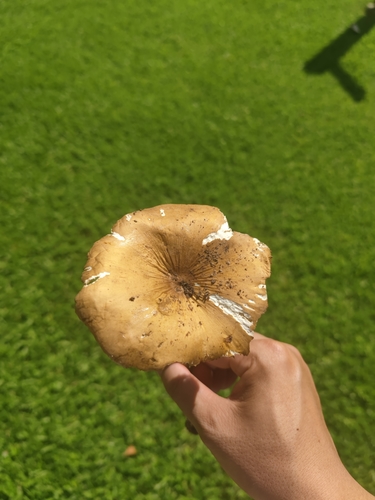
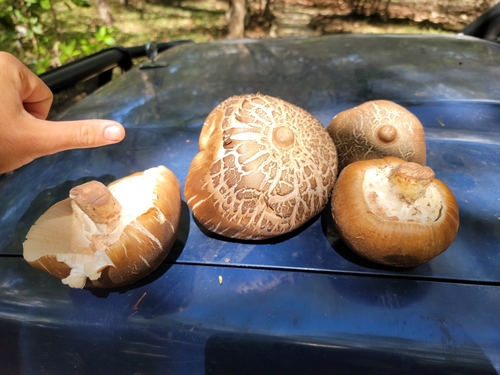
Termitomyces heimii
Natarajan
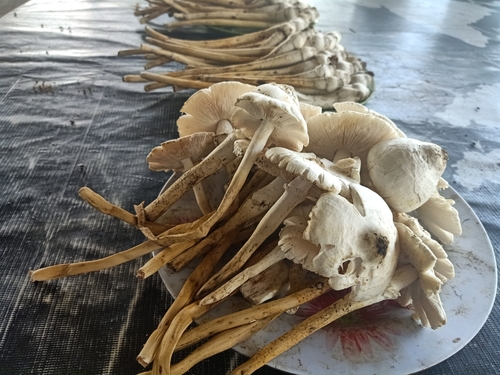
(c) Ong Jyh Seng, some rights reserved (CC BY-SA), uploaded by Ong Jyh Seng

(c) Borja Rodríguez-de-Francisco, some rights reserved (CC BY-NC)
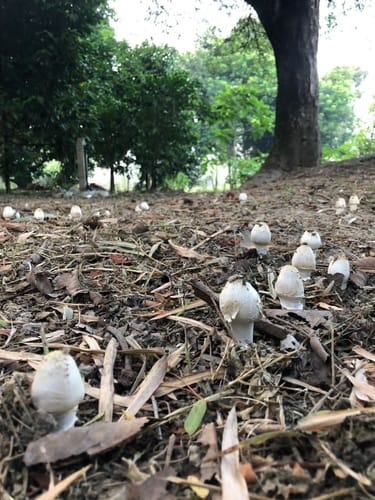
(c) aizat_othman, some rights reserved (CC BY-NC)
What to Eat
Edible parts: Mushroom, Fungus
Termitomyces heimii is considered to be one of the most sought-after wild mushrooms. It is mainly collected and sold in India, China, Malaysia and Nepal.
Where to Find It
It grows on termite mounds.
Asia, China, Himalayas, India, Laos, Malaysia, Nepal, Pakistan, SE Asia, Thailand,
How to Identify
A mushroom. It grows on buried termite mounds. The fruiting bodies occur in clumps.
Wikipedia
Source ↗Termitomyces heimii is a species of agaric fungus in the family Lyophyllaceae. It has symbiotic relationship with termites. Described as new to science in 1979, it is found in India. The specific epithet heimii honors French mycologist Roger Heim. The fruit bodies (mushrooms) produced by the fungus are edible.
Other Information
It is prized in Thailand as a delicacy. It is sold in local markets.
Notes
Also put in the family Agaricaceae.
Names & Synonyms
Anas sati, Cendawan busut, Het pouak
References (7)
- Abdullah, F. & Rusea, G., 2009, Documentation of inherited knowledge on wild edible fungi from Malaysia. Blumea 54, 35-38
- Boa, E. R., 2004, Wild edible fungi and their importance to people. FAO Non Wood Forest Products Booklet 17
- Christensen, M., et al, 2008, Collection and Use of Wild Edible Fungi in Nepal. Economic Botany, 62(1), 2008, pp. 12–23
- Luczaj, L., et al, 2021, Wild food plants and fungi sold in the markets of Luang Prabang, Lao PDR. Journal of Ethnobiology and Ethnomedicine (2021) 17:6
- Prafulla, S., 2017, Wild Food Diversity of Nawegaon-Nagzira Tiger Reserve in Gondia-Bhandara district of Maharashtra, India. Int. J. of Life Sciences, 2017, Vol. 5 (4): 620-626
- Semwal, K. C., et al, 2014, Edible mushrooms of the Northwestern Himalaya, India: a study of indigenous knowledge, distribution and diversity. Mycosphere 5(3): 440–461
- Thatoi, H. & Singdevsachan, S. K., 2014, Diversity, nutritional composition and medicinal potential of Indian mushrooms: A review. African Journal of Biotechnology 13(4): 523-545