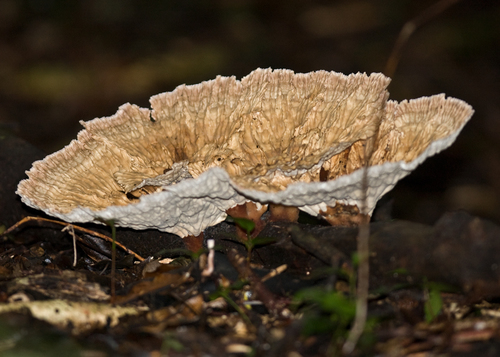
Trametes versicolor
(L.) Lloyd
Many-colored polypore

no rights reserved, uploaded by Ken Kneidel

(c) kcook, some rights reserved (CC BY-NC)
What to Eat
Edible parts: Mushroom, Fungus
Trametes versicolor is considered too tough to eat, but can be prepared in many ways, such as teas and powders. It has been most notably consumed in China for thousands of years under the name "Yunzhi" (Chinese: 云芝). The species may be used in traditional Chinese medicine or other herbalism practices. Although polysaccharide-K is approved in Japan as an adjuvant therapy in cancer treatment, neither the extract nor the mushroom preparation is approved or used in the United States for any clinical condition. It is commonly marketed as a dietary supplement for various health benefits, but lacks sufficient scientific evidence for safety or effectiveness, and quality can vary due to inconsistent processing and labeling.
Where to Find It
It is a temperate plant.
Asia, China, Europe, Finland, Russia,
How to Identify
A mushroom.
Wikipedia
Source ↗Trametes versicolor – also known as Coriolus versicolor and Polyporus versicolor – is a common polypore mushroom found throughout the world. Owing to its shape being similar to that of a wild turkey's tail feathers, T. versicolor is most commonly referred to as turkey tail. Although polysaccharide-K, an extract of T. versicolor, is approved in Japan as an adjuvant therapy in cancer treatment, it is not approved in the United States for treatment of cancer or any clinical condition. Extracts of turkey tail or the mushroom itself are commonly marketed as a dietary supplement for various health benefits, but there is no good scientific evidence for safety or effectiveness, and quality can vary due to inconsistent processing and labeling.
Notes
It probably has medicinal value.
Names & Synonyms
Yunzhi
References (3)
- Boa, E. R., 2004, Wild edible fungi and their importance to people. FAO Non Wood Forest Products Booklet 17
- Hall, I. R., et al, 2003, Edible and Poisonous Mushrooms of the World. Timber Press. p 316
- Li, H., et al, 2020, Reviewing the world’s edible mushroom species: A new evidence-based classification system. Compr Rev Food Sci Food Saf. 2021;20:1982–2014.