Cephalotaxus sinensis
(Rehder & E. H. Wilson) H. L. Li
Chinese plum yew

(c) Ed Dolphin, some rights reserved (CC BY-NC)

(c) Blake, some rights reserved (CC BY-NC)
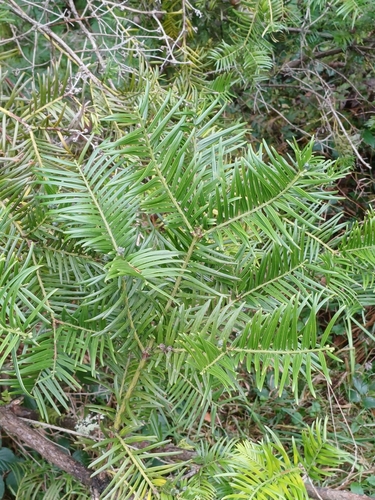
(c) Ed Dolphin, some rights reserved (CC BY-NC)
What to Eat
Edible parts: Fruit, Seeds
The fruit is fairly large, approximately 25mm x 17mm. No further details are available, though the plant is closely related to C. harringtonia, whose fruit is edible raw when fully ripe. The fruit does not always ripen in Britain; before full ripeness it has a strongly unpleasant resinous flavour that coats the mouth and can persist for hours. The seed of this species is also likely to be edible, though more research is needed.
Where to Find It
It is a warm temperate to subtropical plant. It grows in mountain conifer forest between 600-3,000 m in China. In XTBG Yunnan.
Asia, China, Taiwan,
How to Identify
A shrub or small tree. It can grow to 12 m tall. The trunk can be 1.2 m across.
How to Grow
Propagation: Seed is best sown as soon as it is ripe in a cold frame, where it should germinate the following spring. A hard seedcoat can delay germination, particularly if seed is not sown fresh. Stored seed should be cold-stratified before sowing in a cold frame in spring; germination can take 18 months or more. Prick out seedlings as soon as they are large enough to handle and grow on under cover for at least their first winter. Plant out in late spring after the last expected frosts. Greenwood cuttings of terminal shoots can be taken in August or September in a humid cold frame, though this method is difficult.
Medicinal Uses
Extracts from the plant have shown anticancer activity. The branches, roots, leaves and seeds are a source of numerous alkaloids used in the treatment of leukaemia and lymphosarcoma.
Other Uses
Very tolerant of pruning, this plant makes an excellent hedge in shady positions. The wood is used to make furniture, farm implements, crafts and utensils.
Wikipedia
Source ↗Cephalotaxus sinensis is a species of coniferous shrub or small tree in the family Taxaceae. It is native to central and southern China. Some botanists consider Cephalotaxus koreana and C. sinensis to be synonymous with Cephalotaxus harringtonii.
Production
Flowering occurs in March to June and seeds mature in July to November.
Notes
There are about 10 Cephalotaxus species. Also put in the family Cephalotaxaceae.
Names & Synonyms
Baigeiguo, Bizishu, Shuibai, Shui bai zi, Sunguo
References (4)
- Kang, Y., et al, 2012, Wild food plants and wild edible fungi in two valleys on the Qinling Mountains (Shaanxi, central China) Journal of Ethnobiology and Ethnomedicine; 9:26
- Kang, Y., et al, 2014, Wild food plants used by the Tibetans of Gongba Valley (Zouqu country, Gansu, China) Journal of Ethnobiology and Ethnomedicine 10:20
- Lloydia 16(3):162. 1953
- Plants for a Future database, The Field, Penpol, Lostwithiel, Cornwall, PL22 0NG, UK. http://www.scs.leeds.ac.uk/pfaf/
More from Taxaceae


