Cereus hexagonus
(L.) Mill.
Columnar cactus

(c) Mateo Hernandez Schmidt, some rights reserved (CC BY-NC-SA), uploaded by Mateo Hernandez Schmidt

(c) ryanhudgins1, some rights reserved (CC BY-NC)
What to Eat
Edible parts: Fruit, Stems
Fruit - raw, dried or made into a juice. It can be used to make preserves. The red, ovoid fruit can be 5.5 - 13cm long with a white or pinkish pulp. Young stems are sometimes cooked and used as a vegetable.
Where to Find It
A tropical plant. They must have acid soil. It grows in savannah.
Andes, Asia, Brazil*, Caribbean, Central America, Colombia, Cuba, Dominican Republic, Ecuador, French Guiana, Galapagos, Guadeloupe, Guianas, Guyana, Indonesia, Jamaica, Puerto Rico, SE Asia, South America*, Suriname, Trinidad and Tobago, Venezuela, West Indies,
How to Identify
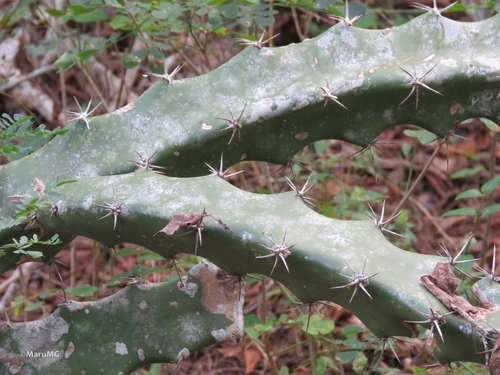
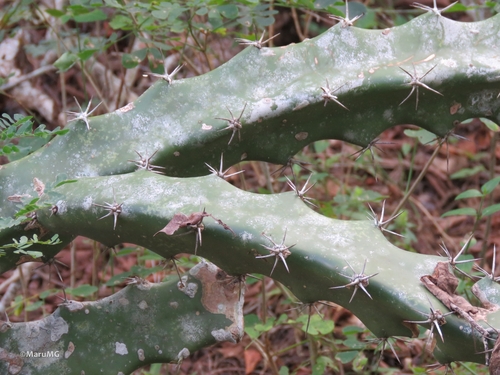
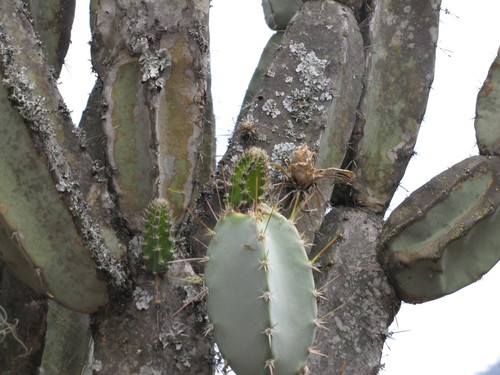
A columnar or tree like cactus. It can grow 6-10 m tall. The trunk can be 25 cm across. It has a few stout jointed branches. These usually have 6 sharp angles. The ribs bear clusters of several brown spines. The flowers are large and white and flower at night. The fruit are pale red and have a thick rind. The pulp is white or pink and it has black seeds.
How to Grow
Cereus hexagonus is a plant of drier areas in the tropics and has a high water use efficiency. It also adapts well to moist environments and is often grown as an ornamental in gardens in French Guyana. Succeeds in full sun and in light shade. Prefers a pH lower than 6. Plants flower overnight.
Propagation: Seed - Cuttings
Wikipedia
Source ↗Cereus hexagonus or lady of the night cactus is a species of columnar cactus found in northern South America.
Notes
There are 34-40 Cereus species.
Names & Synonyms
Blue cereus, Cacto columnar, Cierge pascal, Kaktus ratu malam, Pitahaya, Queen of the night
References (16)
- Anderson, E.F., 2001, The Cactus Family, Timber Press. p 144
- Facciola, S., 1998, Cornucopia 2: a Source Book of Edible Plants. Kampong Publications, p 63
- Fouqué, A. 1972. Espèces fruitières d'Amérique tropicale. Institut français de recherches fruitierès outre-me
- Gard. dict. ed. 8: Cereus no. 1. 1768
- Grandtner, M. M. & Chevrette, J., 2013, Dictionary of Trees, Volume 2: South America: Nomenclature, Taxonomy and Ecology. Academic Press p 118
- INFOODSUpdatedFGU-list.xls
- Kunkel,
- Le Bellec, F et V. Renard. 1997. Le grand livre des fruits tropicaux. Orphie ed.
- Little, E. L., et al, 1974, Trees of Puerto Rico and the Virgin Islands. USDA Handbook 449. Forestry Service. p 600
- Lopez-Diago, D. & Garcia, N., 2021, Wild edible fruits of Colombia. Biota ColomBiana 22 (2) p 34
- Martin, F. W., et al, 1987, Perennial Edible Fruits of the Tropics. USDA Handbook 642 p 86
- Miguel, E., et al, 1989, A checklist of the cultivated plants of Cuba. Kulturpflanze 37. 1989, 211-357
- Reis, S. V. and Lipp, F. L., 1982, New Plant Sources for Drugs and Foods from the New York Botanical Garden herbarium. Harvard. p 200
- Roa, J. A. G. & Boada, D. S. G., 2018, Fundación para el Fortalecimiento de la Fruticultura y Plantas Alimenticias no Convencionales en Colombia.
- Sukarya, D. G., (Ed.) 2013, 3,500 Plant Species of the Botanic Gardens of Indonesia. LIPI p 1006
- Torre, de la, L., et al, 2008, Enciclopedia de las Plantas Útiles del Ecuador. Herbario QCA. Pontificia Universidad Católica del Ecuador. p 267