Ceropegia candelabrum
L.
Candlestick ceropegia
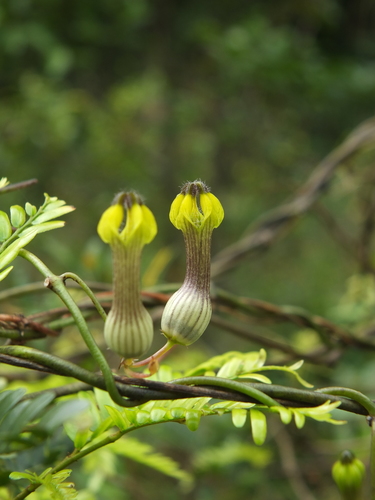
(c) Siddarth Machado, some rights reserved (CC BY), uploaded by Siddarth Machado
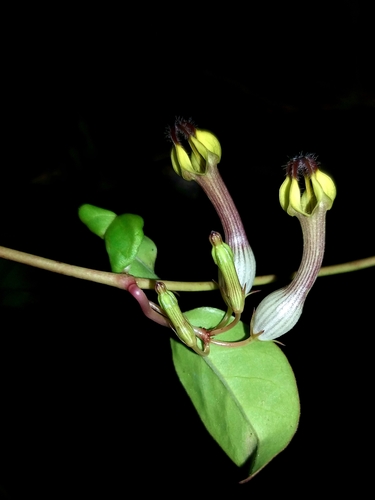
(c) CHIRANJEEVI P, some rights reserved (CC BY-NC)
What to Eat
Edible parts: Tubers, Leaves, Root
The tubers are eaten raw or roasted and are also used in fermented drinks. The leaves are eaten as a pot herb.
Where to Find It
It is a tropical plant. Rajasthan. It grows in scrub forest.
Asia, India,
How to Identify
A climbing herb. It grow 30-100 cm long. It has tuberous roots. The tubers are 3-4 cm across and flattened from the top. The leaves are narrowly oval or oblong and arranged opposite. They are 5-10 cm long. The flowers are white to yellow and 2-3 cm long. The flower tube is swollen at the base. The seed pods are 10 cm long.
Wikipedia
Source ↗Ceropegia candelabrum is the type species in its genus of plants, belonging the subfamily Asclepiadoideae. The Latin specific epithet candelabrum is derived from the candelabra-like appearance of the inflorescences.
Notes
There are about 160-200 Ceropegia species. Previously in Asclepiadaceae.
Names & Synonyms
Guttalu, Hadula, Kanda ganapa, Kanwel, Khadula, Manchi mandai, Nattunattuvallinattunattuvalli, Nijota-njodien-vali, Pataal mul, Patala-tumbi
References (9)
- Ambasta, S.P. (Ed.), 2000, The Useful Plants of India. CSIR India. p 118 (As Ceropegia tuberosa)
- Hedrick, U.P., 1919, (Ed.), Sturtevant's edible plants of the world. p 182 (As Ceropegia tuberosa)
- Kumar, G.M., & Shiddamallayya, N., 2014, Documentation of Wild Plant Tubers as Food Resources in Hassan District, Karnataka, International Journal of Applied Biology and Pharmaceutical Technology. 5(2) p 90 (As Ceropegia tuberosa)
- Lim, T. K., 2015, Edible Medicinal and Non Medicinal Plants. Volume 9, Modified Stems, Roots, Bulbs. Springer p 23
- Misra, R. C., et al, 2013, Genetic resources of wild tuberous food plants traditionally used in Similipal Biosphere Reserve, Odisha, India. Genetic Resources and Crop Evolution. Vol. 60 No. 2. Springer (As var. tuberosa)
- Reddy, K.R., 1989, Additional Notes on the Wild Edible Plants of India. J. Econ. Tax. Bot. Vol. 13 No. 1 pp 125-127 (As Ceropegia tuberosa)
- Samydurai, P., et al, 2012, Wild habits of Kolli Hills being staple food of inhabitant tribes of eastern Ghats, Tamil Nadu, India. Indian Journal of Natural Products and Resources. 3(3) September 2012 pp 432-437 (As Ceropegia tuberosa)
- SHANKARNARAYAN & SAXENA. (As Ceropegia tuberosa)
- Singh, H.B., Arora R.K.,1978, Wild edible Plants of India. Indian Council of Agricultural Research, New Delhi. p 11 (As Ceropegia tuberosa)


