Cornus schindleri
Wangerin
CornaceaeSeeds/Nuts
wikimedia · cc-by
Wikimedia Commons - Yong Ge, Houyuan Lu, Can Wang & Xing Gao
Wikimedia Commons - Yong Ge, Houyuan Lu, Can Wang & Xing Gao

gbif · cc0
President and Fellows of Harvard College
President and Fellows of Harvard College
What to Eat
Edible parts: Seeds - oil
Oil is extracted from the seeds.
Where to Find It
It is a subtropical plant. It grows in forests between 1,100-3,200 m above sea level. It grows in Sichuan and Yunnan in China. It suits hardiness zone 5.
Asia, China, Tibet,
Countries: United Arab Emirates, Afghanistan, Armenia, Azerbaijan, Bangladesh, Bahrain, Brunei, Bhutan, China, Georgia, Indonesia, Israel, India, Iraq, Iran, Jordan, Japan, Kyrgyzstan, Cambodia, North Korea, South Korea, Kuwait, Kazakhstan, Laos, Lebanon, Sri Lanka, Myanmar, Mongolia, Maldives, Malaysia, Nepal, Oman, Philippines, Pakistan, Qatar, Saudi Arabia, Singapore, Syria, Thailand, Tajikistan, Timor-Leste, Turkmenistan, Turkey, Taiwan, Uzbekistan, Vietnam, Yemen
How to Identify
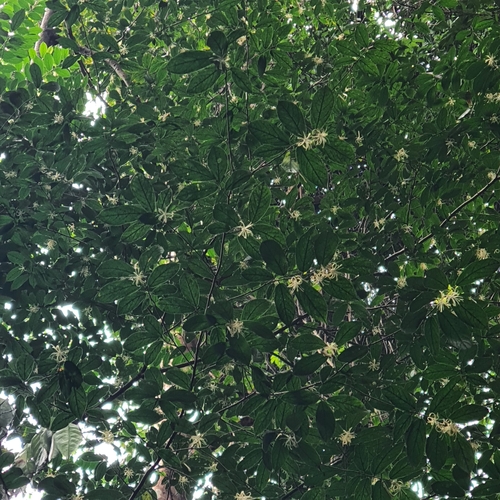
A shrub or small tree. It grows 2-8 m tall. The young branches are 4 angled. The leaves are opposite and light green underneath. They are oval and 4-11 cm long by 3-7 cm wide. The flowers are in groups 6-10 cm wide. They have yellow to brown hairs. The flowers are white. The fruit are purpkish black and 4-6 mm across.
Production
In Yunnan the fruit are available in August and September.
Names & Synonyms
Saisaizi
References (2)
- Ju, Y., et al, 2013, Eating from the wild: diversity of wild edible plants used by Tibetans in Shangri-la region, Yunnan, China, Journal of Ethnobiology and Ethno medicine 9:28
- Plants for a Future database, The Field, Penpol, Lostwithiel, Cornwall, PL22 0NG, UK. http://www.scs.leeds.ac.uk/pfaf/ (As Cornus monbeigii)