Malus rockii
Rehder

(c) 刘光裕 Liu Guangyu, some rights reserved (CC BY-NC), uploaded by 刘光裕 Liu Guangyu
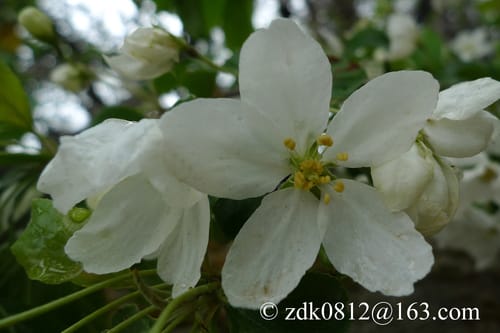
(c) zdk0812, some rights reserved (CC BY-NC)
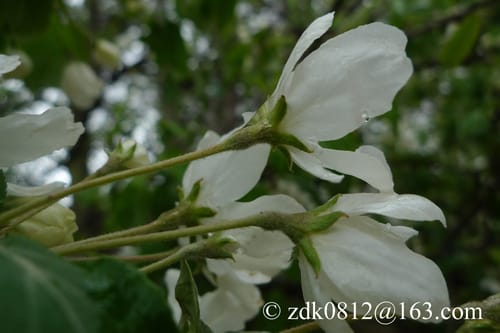
(c) zdk0812, some rights reserved (CC BY-NC)
What to Eat
Edible parts: Fruit
The fruits are eaten raw.
Where to Find It
It is a temperate plant. It grows in mixed forests between 2,400-3,800 m above sea level. It grows in Sichuan and Yunnan in China.
Asia, Bhutan, China, Himalayas, Nepal,Tibet,
How to Identify
A tree. It grows 8-10 m tall. Branches hang down. Young branches are dark brown. The leaves are oval and 6-12 cm long by 4-7 cm wide. There are irregular teeth along the edge. There are 4-8 flowers in a group. The petals are white. The fruit are oval and red. They are 1-2 cm across.
Wikipedia
Source ↗Malus rockii is a crabapple species in the family Rosaceae. It is native to China and Bhutan. Some subspecies of the Siberian crab apple (Malus baccata) are considered synonymous with this species.
Production
In Yunnan fruit are harvested in September.
Names & Synonyms
Jangali syau, Shanjinzi, Tangli
References (8)
- Flora of China @ efloras.org Volume 9
- Geng, Y., et al, 2016, Traditional knowledge and its transmission of wild edibles used by the Naxi in Baidi Village, northwest Yunnan province. Journal of Ethnobiology and Ethnomedicine. 12:10
- Ju, Y., et al, 2013, Eating from the wild: diversity of wild edible plants used by Tibetans in Shangri-la region, Yunnan, China, Journal of Ethnobiology and Ethno medicine 9:28
- Karki, S., et al, 2017, Minor Fruits in Nepal: Utilization and Conservation Efforts. Proceedings of 2nd National Workshop on CUAPGR, 2017. (As Malus baccata var. himalaica)
- Wiersema, J. H. & Leon, B., 2013, World Economic Plants. A Standard Reference CRC Press. 2nd Ed. p 428 (As Malus baccata var. himalaica)
- Zhang, L. et al, 2013, An Ethnobotanical Study of Traditional Edible Plants Used by Naxi People in Northwestern Yunnan, China. - A Case Study in Wenhai Village. Plant Diversity and Resources. p 484
- Zhang, L., et al, 2015, Ethnobotanical survey of medicinal dietary plants used by the Naxi People in Lijiang Area, Northwest Yunnan, China. Journal of Ethnobiology and Ethnomedicine (2015) 11:40
- Zhang, L., et al, 2016, Ethnobotanical study of traditional edible plants used by the Naxi people during droughts. Journal of Ethnobiology and Ethnomedicine. 12:39
More from Rosaceae


