Photinia glomerata
Rehder & E. H. Wilson
RosaceaeFruit
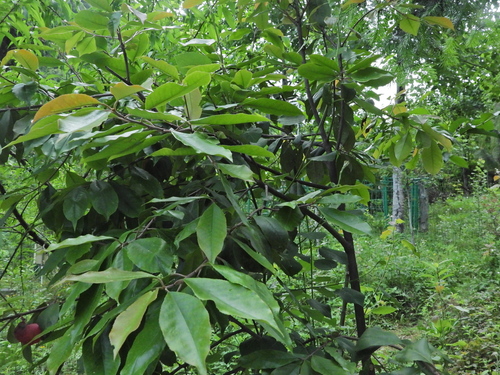
iNaturalist · cc-by-nc
(c) Lukasz Madrzynski 孟巨石, some rights reserved (CC BY-NC), uploaded by Lukasz Madrzynski 孟巨石
(c) Lukasz Madrzynski 孟巨石, some rights reserved (CC BY-NC), uploaded by Lukasz Madrzynski 孟巨石

wikimedia · cc0
Wikimedia Commons - Daderot
Wikimedia Commons - Daderot
What to Eat
Edible parts: Fruit
The red fruits are eaten fresh, though consumption is only occasional.
Where to Find It
It is a temperate plant. It grows in mixed forests between 1,500-2,600 m above sea level. It grows in Sichuan and Yunnan in China.
Asia, China, Tibet,
Countries: United Arab Emirates, Afghanistan, Armenia, Azerbaijan, Bangladesh, Bahrain, Brunei, Bhutan, China, Georgia, Indonesia, Israel, India, Iraq, Iran, Jordan, Japan, Kyrgyzstan, Cambodia, North Korea, South Korea, Kuwait, Kazakhstan, Laos, Lebanon, Sri Lanka, Myanmar, Mongolia, Maldives, Malaysia, Nepal, Oman, Philippines, Pakistan, Qatar, Saudi Arabia, Singapore, Syria, Thailand, Tajikistan, Timor-Leste, Turkmenistan, Turkey, Taiwan, Uzbekistan, Vietnam, Yemen
How to Identify
A shrub or small tree. It grows 6-10 m tall. It keeps its leaves throughout the year. The leaves are oblong to sword shaped and 6-18 cm long by 3-6 cm wide. There are many flowers in a group at the ends of the branches. The flowers have a scent and the petals are white. The fruit is red and oval. It is 5-7 mm long by 3-4 mm wide.
Wikipedia
Source ↗Photinia glomerata is a species in the family Rosaceae.
Production
In Yunnan the fruit are available in September.
Other Information
Fruit are only occasionally eaten.
Names & Synonyms
Chongsi
References (2)
- Flora of China @ efloras.org Volume 9
- Ju, Y., et al, 2013, Eating from the wild: diversity of wild edible plants used by Tibetans in Shangri-la region, Yunnan, China, Journal of Ethnobiology and Ethno medicine 9:28
More from Rosaceae

Acaena anserinifolia
Bidgee widgee, Buzzy, New Zealand Bur
No photo
Acaenia anserinifolia - (J.R.Forst.&G.Forst.)Druce.
Pirri-Pirri Bur

Adenostoma sparsifolium
Red shanks, Ribbonwood

Agrimonia eupatoria
Agrimony, Salt and Pepper

Agrimonia odorata
Adour agrimony, Liver-wort

Agrimonia pilosa
Indian chestnut, Agrimony