Agave potatorum
Zucc.
Butterfly agave

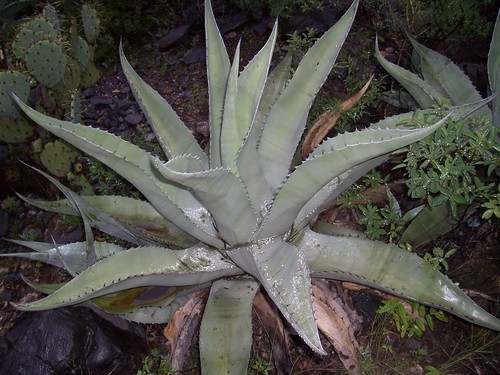
(c) Leticia Soriano Flores, some rights reserved (CC BY-NC), uploaded by Leticia Soriano Flores
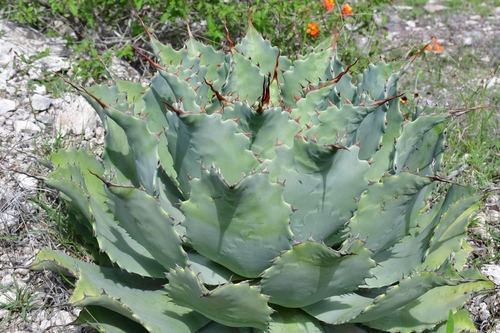
(c) Joey Santore, some rights reserved (CC BY-NC), uploaded by Joey Santore

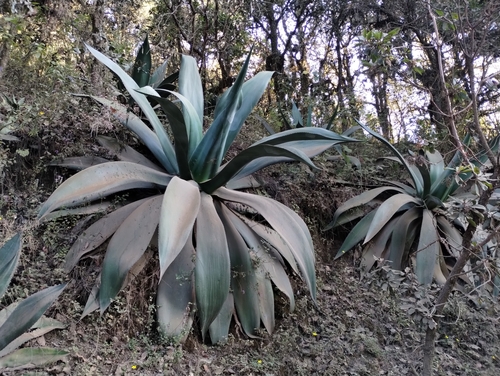
(c) Alexis López Hernández, some rights reserved (CC BY), uploaded by Alexis López Hernández
What to Eat
Edible parts: Base - drink, Stems, Leaves, Flowers
The buds are made into a drink. The stems and flower buds are boiled or roasted, often cooked with egg or hot chilli sauce. The leaf bases are baked and eaten as a sweet treat or candy.
Known Hazards
Where to Find It
It is a tropical plant. It grows in semi-arid regions between 1,200-2,250 m above sea level. It grows in areas with an areas with an annual mean temperature of 18°C. The average annual rainfall is 655 mm.
Asia, Indonesia, Mexico*, North America, SE Asia,
How to Identify
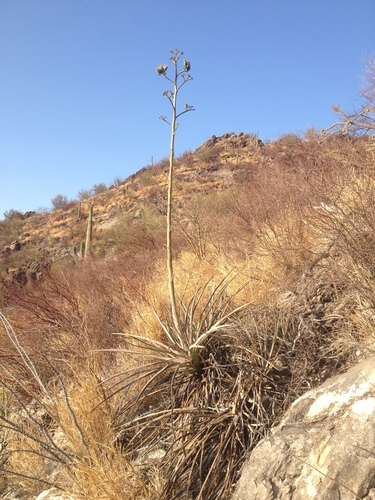
An agave. A small succulent plant. It has a short stem and can occur singly or in a clump. The leaves are succulent and in a ring. There are 30-80 leaves. They become narrow towards the base. They are curved towards the tip and are blue-green. There are spines long the edge. There is a spine at the tip. The flowering shoots are 3-6 m tall and the flowers are light green tinged with red. They have red bracts around them.
How to Grow
Plants can be grown from seeds or suckers.
Propagation: Seed - surface sow in a container in a light position. The seed usually germinates in 1 - 3 months at 15 - 20°c. Prick out the seedlings into individual pots of well-drained soil when they are large enough to handle and grow them on in a sunny position until they are at least 10cm tall before planting out. Offsets and suckers can be potted up at any time they are available. Bulbils, where produced, are an easy method of propagation. Simply pot them up and plant out at the beginning of a growing season when they are 10cm or more tall.
Medicinal Uses
The plant is used medicinally. No more information. The leaves are antiinflammatory and are used to reduce swelling.
Wikipedia
Source ↗Agave potatorum, the Verschaffelt agave, is a species of flowering plant in the family Asparagaceae. A smallish and attractive succulent perennial, it is native to partial desert areas of Mexico from Puebla south to Oaxaca. The Latin specific epithet potatorum refers to drinking and brewing. In its range, it is used extensively to make mezcal, and for this reason, it is considered to be a threatened species. This plant has gained the Royal Horticultural Society's Award of Garden Merit.
Names & Synonyms
Agave kupu-kupu, Maguey papalome
References (7)
- Arellanes, Y., et al, 2013, Influence of traditional markets on plant management in the Tehuacan Valley. Journal of Ethnobiology and Ethnomedicine 9:38
- Casas, A., et al, 2016, Ethnobotany for Sustainable Ecosystem Management: A Regional Perspective in the Tehuacán Valley. In Lira, R.,et al (eds.) Ethnobotany of Mexico. Springer Chp. 8 p 199
- Gelgado-Lemus, A., et al, 2014, Distribution, abundance and traditional management of Agave potatorum in the Tehuacan Valley, Mexico: Bases for sustainable use of non-timber forest products. Journal of Ethnobiology and Ethnomedicine 10:63
- Kermath, B. M., et al, 2014, Food Plants in the Americas: A survey of the domesticated, cultivated and wild plants used for Human food in North, Central and South America and the Caribbean. On line draft. p 31
- Rangel-Landa, S., et al, 2017, Sociocultural and ecological factors influencing management of edible and non-edible plants: the case of Ixcatlan, Mexico. Journal of Ethnobiology and Ethnomedicine. 13:59
- Sukarya, D. G., (Ed.) 2013, 3,500 Plant Species of the Botanic Gardens of Indonesia. LIPI p 997
- World Checklist of Useful Plant Species 2020. Royal Botanic Gardens, Kew