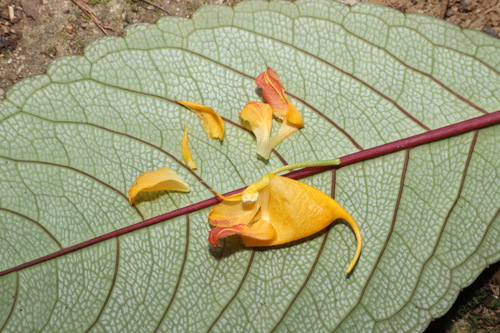
Impatiens notolopha
Maxim.
BalsaminaceaeLeaves

iNaturalist · cc-by-nc
(c) CORDENOS Thierry, some rights reserved (CC BY-NC)
(c) CORDENOS Thierry, some rights reserved (CC BY-NC)

gbif · cc-by-nc
Field Museum of Natural History - Botany Department
Field Museum of Natural History - Botany Department

gbif · cc-by-nc
Field Museum of Natural History - Botany Department
Field Museum of Natural History - Botany Department
What to Eat
Edible parts: Leaves
The leaves are eaten.
Where to Find It
It is a temperate plant. In central China it grows in moist, shaded places between 2,200-3,600 m above sea level. In Sichuan.
Asia, China,
Countries: United Arab Emirates, Afghanistan, Armenia, Azerbaijan, Bangladesh, Bahrain, Brunei, Bhutan, China, Georgia, Indonesia, Israel, India, Iraq, Iran, Jordan, Japan, Kyrgyzstan, Cambodia, North Korea, South Korea, Kuwait, Kazakhstan, Laos, Lebanon, Sri Lanka, Myanmar, Mongolia, Maldives, Malaysia, Nepal, Oman, Philippines, Pakistan, Qatar, Saudi Arabia, Singapore, Syria, Thailand, Tajikistan, Timor-Leste, Turkmenistan, Turkey, Taiwan, Uzbekistan, Vietnam, Yemen
How to Identify
A herb. It grows each year from seed. It grows 40-60 cm tall. The stem is erect and smooth. It is loosely branches in the middle. The leaves are alternate. The leaves are 3-6 cm long by 2-4 cm wide. The base is wedge shaped and there are teeth along the edge. The upper leaves do not have leaf stalks.
Names & Synonyms
Daolaonnen
References (1)
- Kang, Y., et al, 2012, Wild food plants and wild edible fungi in two valleys on the Qinling Mountains (Shaanxi, central China) Journal of Ethnobiology and Ethnomedicine; 9:26