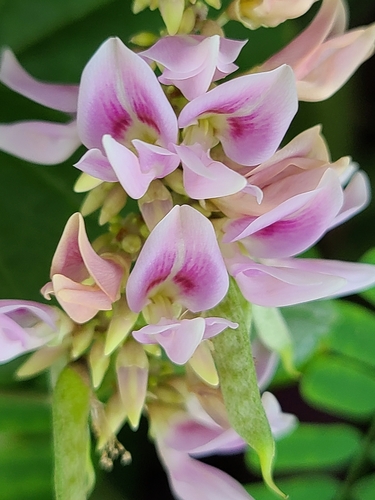
Kummerowia stipulacea
(Makim.) Makino

(c) MP Zhou, some rights reserved (CC BY-NC)

(c) MP Zhou, some rights reserved (CC BY-NC)

(c) MP Zhou, some rights reserved (CC BY-NC)
What to Eat
Edible parts: Leaves
No edible uses are known for this plant.
Where to Find It
It is a temperate plant. It grows in grasslands and sand dunes between 100-1,200 m above sea level.
Asia, China, Japan, Korea, North America, Russia, Taiwan,
How to Identify
A herb. It can lie along the ground or be erect. It has white hairs. The leaves are compound with leaflets that are broadly oval. The end leaflet is 1-2 cm long by 3-12 mm wide. The base is wedge shaped. The flowers occur as 1 or 2 in the axils of leaves. The pod is 2-3 mm long.
How to Grow
Propagation: Pre-soak seed for 24 hours in warm water, then sow in situ in late spring.
Medicinal Uses
The whole plant is used medicinally as a diuretic, to reduce fever, and to treat diarrhoea.
Other Uses
This species is widely used in North America for soil conservation and the restoration of worn-out soils. As a fast-growing annual, it produces good bulk and fixes significant amounts of atmospheric nitrogen, making it a valuable green manure and soil conditioner.
Wikipedia
Source ↗Kummerowia stipulacea is a species of flowering plant in the legume family known by the common name Korean clover. It is native to China, Japan, Korea, and Russia, and it is present in the eastern United States as an introduced species. This annual herb grows prostrate, spreading, or erect stems. It grows up to 60 centimeters tall. The leaves are made up of three oval leaflets. One to five flowers occur in the leaf axils. There are cleistogamous flowers, which self-fertilize and never open, and chasmogamous flowers, which open and receive pollen from other plants. The latter flower type is purple-blue in color. The fruit is a small legume pod containing one seed. Though it often co-occurs with its congener Kummerowia striata, it is easily identified by large papery stipules which are especially visible for young leaves. This plant was introduced to the United States when it was intentionally planted in Arlington, Virginia, by the USDA in 1919. This species and Japanese clover were used to revegetate abandoned coal mine sites. Its seed was spread to attract wildlife and as a forage for livestock. It was used to prevent erosion along roadsides. It was planted in rotation with cereal crops to enhance the soil. It persisted and spread. Today this plant grows in the wild and provides food for a number of mammal and bird species. It is also a high-quality livestock forage. The seed is still sold for planting. Three cultivars are available: "Climax", "Harbin", and "Rowan". Despite its status as a weed in some areas, it is not very aggressive and not considered a noxious weed.
Names & Synonyms
Qiabuqi
References (2)
- Kang, Y., et al, 2012, Wild food plants and wild edible fungi in two valleys on the Qinling Mountains (Shaanxi, central China) Journal of Ethnobiology and Ethnomedicine; 9:26
- Wujisguleng, W., & Khasbagen. K., 2010, An integrated assessment of wild vegetable resources in Inner Mongolian Autonomous Region, China. Journal of Ethnobiology and Ethnomedicine 6:34