Ampulloclitocybe clavipes
(Pers.) Redhead, Lutzoni, Moncalvo & Vilgalys
TricholomataceaeMushrooms

iNaturalist · cc-by-nc
(c) Christian Schwarz, some rights reserved (CC BY-NC), uploaded by Christian Schwarz
(c) Christian Schwarz, some rights reserved (CC BY-NC), uploaded by Christian Schwarz

iNaturalist · cc-by-nc
(c) Stephen Russell, some rights reserved (CC BY-NC), uploaded by Stephen Russell
(c) Stephen Russell, some rights reserved (CC BY-NC), uploaded by Stephen Russell
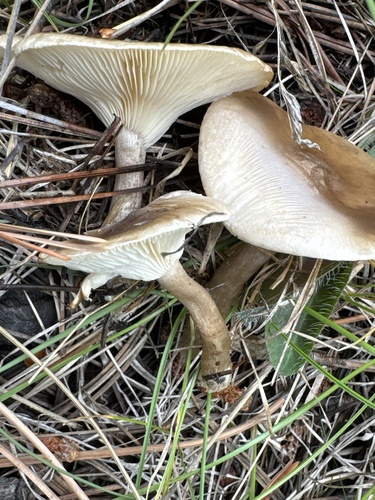
iNaturalist · cc-by-nc
(c) pinonbistro, some rights reserved (CC BY-NC), uploaded by pinonbistro
(c) pinonbistro, some rights reserved (CC BY-NC), uploaded by pinonbistro
What to Eat
Edible parts: Mushroom, Fungus
The mushroom fruiting body is eaten.
Where to Find It
It is a subtropical plant.
Mexico, North America,
Countries: Antigua & Barbuda, Barbados, Bahamas, Belize, Canada, Costa Rica, Cuba, Dominica, Dominican Republic, Grenada, Guatemala, Honduras, Haiti, Jamaica, St Kitts & Nevis, St Lucia, Mexico, Nicaragua, Panama, Puerto Rico, El Salvador, Trinidad & Tobago, United States, St Vincent
How to Identify
A subtropical fungus in the family Tricholomataceae that is sold in local markets.
Wikipedia
Source ↗Ampulloclitocybe clavipes, commonly known as the club-foot or club-footed clitocybe, is a species of gilled mushroom from Europe and North America. The grey-brown mushrooms have yellowish decurrent gills and a bulbous stalk, and are found in deciduous and conifer woodlands. While potentially edible, it resembles poisonous species and its consumption with alcohol can result in a disulfiram-like reaction.
Other Information
It is sold in local markets.
Names & Synonyms
Mantequilla y pata gorda, Tlalixtla
References (4)
- Cortes, L.E.U., et al, 2018, Ethnomycology and mushroom selling in a market from Northwest Puebla, México. Scientia Fungorum vol. 47: 47-55
- Li, H., et al, 2020, Reviewing the world’s edible mushroom species: A new evidence-based classification system. Compr Rev Food Sci Food Saf. 2021;20:1982–2014.
- Perez-Moreno, J. et al, 2008, Wild Mushroom Markets in Central Mexico and a Case Study at Ozumba. Economic Botany, 62(3), 2008, pp. 425–436
- Perez-Moreno, J., et al, 2009, Social and Biotechnological Studies of Wild Edible Mushrooms in Mexico. Acta Botanica Yunnanica Suppl. XV1: 55-61


