Chenopodium acuminatum
Willd.
Jian tou ye li
no rights reserved, uploaded by 葉子

(c) Aleksandr Ebel, some rights reserved (CC BY-NC)

(c) Aleksandr Ebel, some rights reserved (CC BY-NC)
What to Eat
Edible parts: Leaves, Seeds
The leaves can be eaten cooked and work well as a spinach substitute, with a mild flavour. Raw leaves should be eaten in small quantities only. The small black seed, about 1mm in diameter, is rich in protein and can be cooked or ground into a flour for use in bread and similar foods, though its small size makes it somewhat fiddly to work with. Before use, the seed should be soaked in water overnight and thoroughly rinsed to remove saponins.
Known Hazards
Where to Find It
It is a temperate and subtropical plant. It grows on wastelands, riverbanks, and field margins; It grows in Inner Mongolia.
Asia, China, Japan, Korea, Mongolia, SE Asia, Siberia, Taiwan, Vietnam,
How to Identify
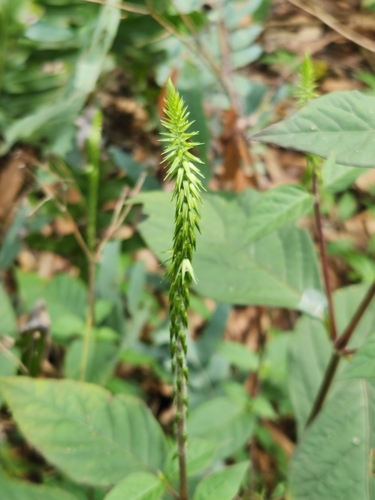
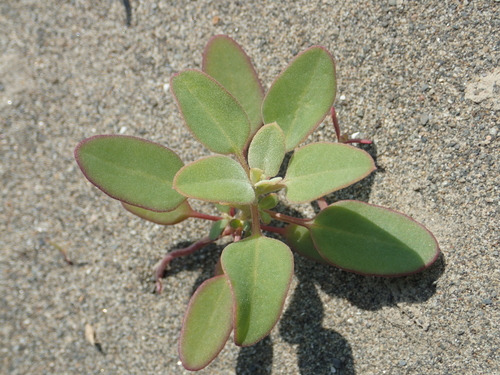
An annual herb. It grows 20-80 cm tall. The stems are erect and much branched. The leaves are narrowly oval and 2-4 cm long by 1-3 cm wide. The flowers are in round scattered groups in the upper parts of the branches. They are reddish. The seeds are black and 1 mm across.
How to Grow
We have very little information on this species and do not know how well it will grow in Britain, but it should succeed as a spring sown annual. The following notes are based on the general needs of the genus. An easily grown plant, succeeding in most soils but disliking shade. It prefers a moderately fertile soil.
Propagation: Sow seed in spring in situ. Most seed typically germinates within a few days of sowing.
Medicinal Uses
None known.
Other Uses
Gold and green dyes can be obtained from the whole plant.
Wikipedia
An annual growing to 0.6 m tall with hermaphroditic flowers wind-pollinated from July to October. Seeds ripen August to October. Grows in light sandy, medium loamy, and heavy clay soils with mildly acid to basic pH. Cannot tolerate shade and prefers moist soil.
Notes
There are about 120 Chenopodium species. They are mostly in temperate regions. Also put in the family Chenopodiaceae.
Names & Synonyms
Gurbalzin noil, Hui cai, Kinhgioi nhon, Nonin nuil
References (8)
- Ges. Naturf. Freunde Berlin Neue Schriften 2:124, t. 5, fig. 2. 1799
- https://en.wikipedia.org/wiki/List of wild edible plants in Mongolian cuisine
- Khasbagan, Hu-Yin Huai, and Sheng-Ji pei, 2000, Wild Plants in the Diet of Athorchin Mongol Herdsmen in Inner Mongolia. Economic Botany 54(4): 528-536
- Khasbagan, Yeruhan and Zhao Hui, 2011, Study on Traditional Knowledge of Wild Edible Plants Used by the Mongolians in Xilingol Typical Steppe Area. Plant Diversity and Resources. 33(2): 239-246
- Plants for a Future database, The Field, Penpol, Lostwithiel, Cornwall, PL22 0NG, UK. http://www.scs.leeds.ac.uk/pfaf/ (Also as Chenopodium virgatum)
- Sachula, et al, 2020, Wild edible plants collected and consumed by the locals in Daqinggou, Inner Mongolia, China. Journal of Ethnobiology and Ethnomedicine (2020) 16:60
- www.eFloras.org Flora of China
- Zhu Gelin (Chu Ge-ling); Steven E. Clemants, CHENOPODIACEAE [Draft], Flora of China