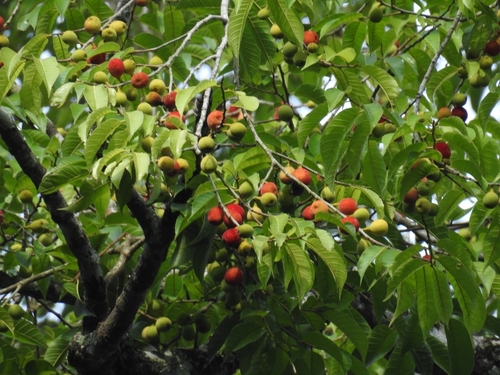
Ficus hookeriana
Corner
MoraceaeFruit

iNaturalist · cc-by-nc
(c) eec, some rights reserved (CC BY-NC), uploaded by eec
(c) eec, some rights reserved (CC BY-NC), uploaded by eec
What to Eat
Edible parts: Fruit
The fruit (figs) are edible.
Where to Find It
It is a tropical plant. In China it grows in limestone regions between 500-2,000 m above sea level.
Asia, Bhutan, China, Himalayas, India, Nepal, Northeastern India, Sikkim,
Countries: United Arab Emirates, Afghanistan, Armenia, Azerbaijan, Bangladesh, Bahrain, Brunei, Bhutan, China, Georgia, Indonesia, Israel, India, Iraq, Iran, Jordan, Japan, Kyrgyzstan, Cambodia, North Korea, South Korea, Kuwait, Kazakhstan, Laos, Lebanon, Sri Lanka, Myanmar, Mongolia, Maldives, Malaysia, Nepal, Oman, Philippines, Pakistan, Qatar, Saudi Arabia, Singapore, Syria, Thailand, Tajikistan, Timor-Leste, Turkmenistan, Turkey, Taiwan, Uzbekistan, Vietnam, Yemen
How to Identify
A fig. It is a tree. It grows 25 m tall. The trunk is 40-50 cm across. The bark is dark grey with cracks along it. The leaf blade is 10-30 cm long or longer and 8-12 cm across. They are leathery. They are a whitish green underneath and dark green on top. The figs are in the axils of leaves. They occur in pairs and are oval and 2-3 cm across by 1.5 cm wide.
Production
In southern China they flower April to October.
Names & Synonyms
Nebaro, Nebharo
Ficus hookeri Miq.
References (7)
- Dangol, D. R. et al, 2017, Wild Edible Plants in Nepal. Proceedings of 2nd National Workshop on CUAOGR, 2017.
- Flora of China @ efloras.org Volume 5
- Gautam, R. S., et al, 2020, Wild Edible Fruits of Nepal. Int. J. Appl. Sci. Biotechnol. Vol 8(3): 289-304
- Ghimeray, A. K., Lamsal, K., et al, 2010, Wild edible angiospermic plants of the Illam Hills (Eastern Nepal) and their mode of use by local community. Korean J. Pl. Taxon. 40(1)
- Sharma, G., et al, 2016, Agrobiodiversity in the Sikkim Himalaya. International Centre for Integrated Mountain Development, ICIMOD Working Paper 2016/5 p 20
- Singh, V. B., et al, (Ed.) Horticulture for Sustainable Income and Environmental Protection. Vol. 1 p 216
- Sundriyal, M., et al, 2004, Dietary Use of Wild Plant Resources in the Sikkim Himalaya, India. Economic Botany 58(4) pp 626-638 (As Ficus hookerii)