Morus indica
L.
Indian mulberry
no rights reserved, uploaded by 葉子
no rights reserved, uploaded by 葉子
no rights reserved, uploaded by 葉子
What to Eat
Edible parts: Fruit, Buds
The ripe fruit are eaten fresh and used to make jams, jellies, and drinks. The buds are used as a vegetable.
Where to Find It
It is a tropical plant.
Africa, Asia, Bangladesh, China, Colombia, East Africa, Himalayas, India, Japan, Mozambique, Myanmar, Nepal, Northeastern India, Pakistan, SE Asia, Sikkim, South America, Sri Lanka, Tanzania,
How to Identify
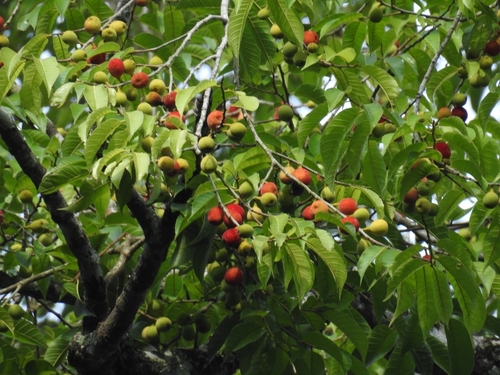
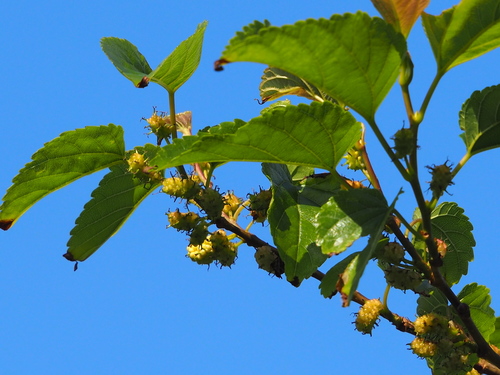
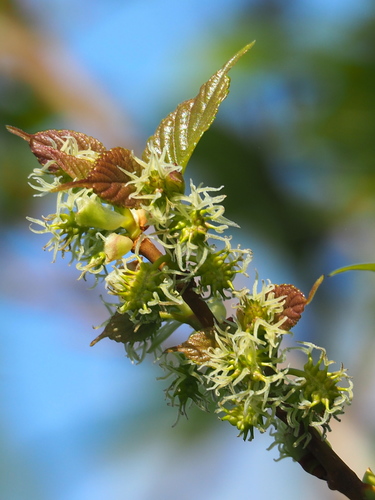
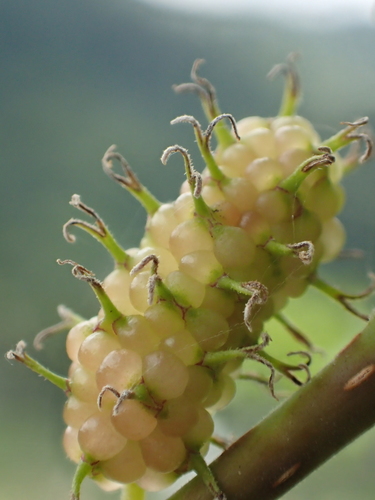
A shrub or small tree. The small branches are hairy when young. The leaves are oval and can have lobes. There are teeth along the edge. The leaves are 4-12 cm long by 3-9 cm wide. Male and female flowers are often on separate branches. The fruit are black when ripe.
Wikipedia
Source ↗Morus indica is a species of flowering plant in the mulberry family Moraceae. As with other mulberries, it is a deciduous tree. Morus indica is native to the temperate and sub-tropical Himalayan region and is currently cultivated in India, China, Japan, and East Africa.
Names & Synonyms
Deshi tut, Eidibala, Kimbu, Labri, Latek, Mawn, Mekrap-kung, Momontsungthi, Ngap-septing, Posa, Sahtoot, Sanu-kimbu, Soit, Toor toot
References (13)
- Arora, R. K., 2014, Diversity in Underutilized Plant Species - An Asia-Pacific Perspective. Bioversity International. p 78
- Dangol, D. R. et al, 2017, Wild Edible Plants in Nepal. Proceedings of 2nd National Workshop on CUAOGR, 2017.
- Ghimeray, A. K., Lamsal, K., et al, 2010, Wild edible angiospermic plants of the Illam Hills (Eastern Nepal) and their mode of use by local community. Korean J. Pl. Taxon. 40(1)
- Goode, P., 1989, Edible Plants of Uganda. FAO p 37
- Harkonen, M. & Vainio-Mattila, K., 1998, Some examples of Natural Products in the Eastern Arc Mountains. Journal of East African Natural History 87:265-278
- Mozhui, R., et al, 2011, Wild edible fruits used by the tribals of Dimapur district of Nagaland, India. Pleione 5(1): 56 - 64.
- Murtem, G. & Chaudhrey, P., 2016, An ethnobotanical note on wild edible plants of Upper Eastern Himalaya, India. Brazilian Journal of Biological Sciences, 2016, v. 3, no. 5, p. 63-81
- Pasha, M. K. & Uddin, S. B., 2019, Minor Edible Fruits of Bangladesh. Bangladesh J. Plant Taxon. 26(2): 299–313
- Roa, J. A. G. & Boada, D. S. G., 2018, Fundación para el Fortalecimiento de la Fruticultura y Plantas Alimenticias no Convencionales en Colombia.
- Savita, et al, 2006, Studies on wild edible plants of ethnic people in east Sikkim. Asian J. of Bio Sci. (2006) Vol. 1 No. 2 : 117-125
- Sher, Z., Hussain, F., & Ibrar, M., 2014, Traditional knowledge on plant resources of Ashezai and Salarzai Valleys, District Buner, Pakistan. African Journal of Plant Science. Vol. 8(1), pp. 42-53, January 2014
- Tomar, A., Kumar, A., & Dubey, K., 2002, Underutilized Wild Edible fruits of Nutritional and Medicinal Value. J. Res. Educ. Indian Med., Vol XX1
- World Checklist of Useful Plant Species 2020. Royal Botanic Gardens, Kew