Delonix decaryi
(R. Vig.) Capuron
Fengoky

(c) Guy Eric Onjalalaina, some rights reserved (CC BY-NC), uploaded by Guy Eric Onjalalaina
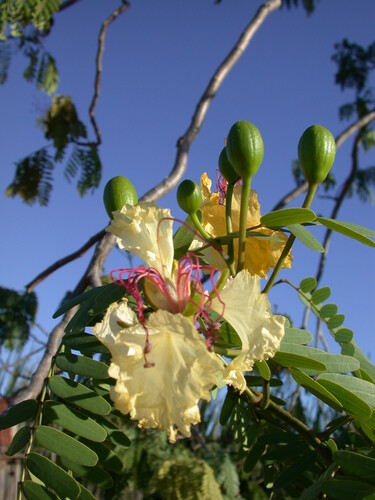
(c) Norbert Hahn, some rights reserved (CC BY-NC), uploaded by Norbert Hahn
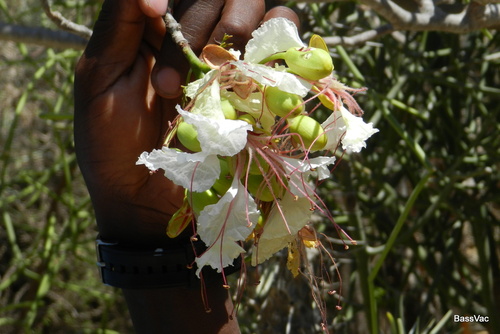
(c) gillbsydney, some rights reserved (CC BY-NC), uploaded by gillbsydney
What to Eat
Edible parts: Seeds
The unripe seeds are reported to be edible.
Known Hazards
Where to Find It
It is a tropical plant. It grows in the Malagasy spiny forest. In Townsville palmetum.
Africa, Australia, East Africa, Madagascar*,
How to Identify
A deciduous tree. It grows 3-10 m tall. The trunk is soft and the bark is flaky. The leaves are twice divided. The flowers are large and 7-8 cm across. The flowers are white. The fruit are long slender pods 35 cm long by 3.5 cm wide.
How to Grow
It can be rgown from cuttings. It is used as a living hedge.
Propagation: Seed - it has a hard seedcoat and may benefit from scarification before sowing in order to speed up and improve germination. This can usually be done by pouring a small amount of nearly boiling water on the seeds (being careful not to cook them!) and then soaking them for 12 - 24 hours in warm water. By this time they should have imbibed moisture and swollen - if they have not, then carefully make a nick in the seedcoat (being careful not to damage the embryo) and soak for a further 12 hours before sowing. Cuttings Air layering.
Medicinal Uses
A poultice of the crushed leaves is put on a baby’s head in order to harden the skull.
Other Uses
A resin obtained from the plant is used as glue for sealing canoes. Species in this genus generally have large, woody seedpods that are used locally for fuel. The pods of this species are about 35cm long and 35mm wide. The trunks are sometimes hollowed out to make canoes. Cuttings are often planted in villages as a living fence.
Wikipedia
Source ↗Delonix decaryi is a species of plant in the family Fabaceae. It is found only in Madagascar.
Notes
It is an at risk species. Also as Caesalpinaceae.
Names & Synonyms
Fengoky
References (3)
- Kew Plants of the World Online
- Rivers, M. C., 2011, Range-wide Analysis of the Spatial distribution and genetic diversity of Delonix S. L. (Leguminosae) in Madagascar Ph D Thesis University of St Andrews. p 209
- World Checklist of Useful Plant Species 2020. Royal Botanic Gardens, Kew




