Begonia chlorosticta
Sands
Silver-spotted begonia

Wikimedia Commons - 彭鏡毅 (Peng Jingyi)

Wikimedia Commons - 彭鏡毅 (Peng Jingyi)
What to Eat
Edible parts: Leaves
The leaves are edible.
Where to Find It
It is a tropical plant. It grows in Kalimantan and Sarawak. It grows in mountain forests and on rocky slopes and damp cliffs up to 1,400 m above sea level.
Asia, Indonesia, Malaysia, SE Asia,
How to Identify
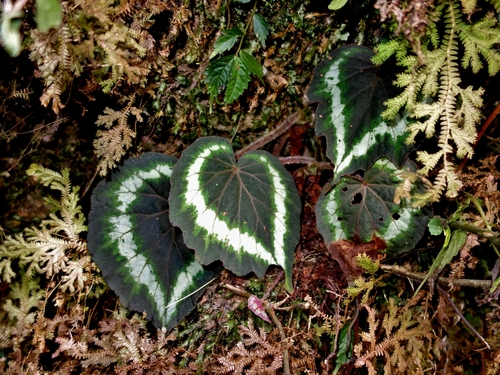
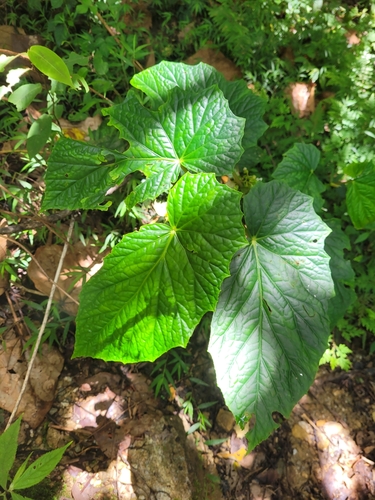
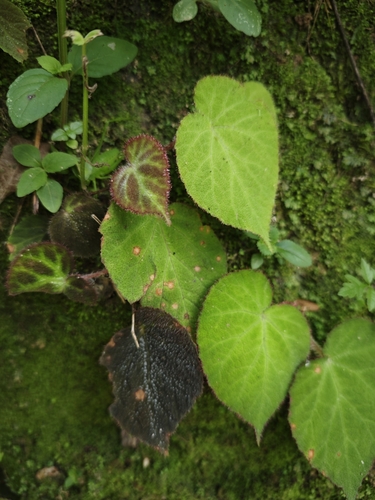
A herb. It grows 60 cm tall. The stems are erect and branched. The leaves are oval and unequal on opposite sides. They are 8-20 cm long by 6-11 cm wide. The base is heart shaped and they taper to the tip. There are teeth around the edge. The leaves are dark bronze green above with light green marks. They are red underneath. The leaf stalk is green with red marks. It is 11 cm long. The flowers are in groups in the axils of leaves or at the ends of branches. Male and female flowers are separate and male flowers are smaller. The fruit is an oval capsule 2 cm long.
Nutrition Score: 21/100
| Part | Moisture | kJ | kcal | Protein | Vit A | Vit C | Iron | Zinc |
|---|---|---|---|---|---|---|---|---|
| Leaves | 91.9 | 105 | 25 | 0.7 | — | 0.6 | 2.8 | 6.5 |
How to Grow
Plants can be grown from seeds or cuttings.
Names & Synonyms
Begonia totol perak, Riang batu
References (2)
- Hoe, V. B. & Siong, K. H., 1999, The nutritional value of indigenous fruit and vegetables in Sarawak. Asia Pacific J. Clin. Nutr. 8(1):24-31
- Sukarya, D. G., (Ed.) 2013, 3,500 Plant Species of the Botanic Gardens of Indonesia. LIPI p 1070