Dysphania cristata
(F. Muell.) Mosyakin & Clements
Crested Goosefoot

iNaturalist · cc-by
(c) Kym Nicolson, some rights reserved (CC BY), uploaded by Kym Nicolson
(c) Kym Nicolson, some rights reserved (CC BY), uploaded by Kym Nicolson
iNaturalist · cc-by-nc
(c) Richard Boon, some rights reserved (CC BY-NC), uploaded by Richard Boon
(c) Richard Boon, some rights reserved (CC BY-NC), uploaded by Richard Boon

iNaturalist · cc-by
(c) Kym Nicolson, some rights reserved (CC BY), uploaded by Kym Nicolson
(c) Kym Nicolson, some rights reserved (CC BY), uploaded by Kym Nicolson
What to Eat
Edible parts: Leaves, Seeds
The leaves and seeds are eaten.
Where to Find It
It grows in subropical and warm temperate areas. It grows in areas of low rainfall. It needs well drained soils.
Africa, Australia*, North America, South Africa, USA,
Countries: Antigua & Barbuda, Angola, Australia, Barbados, Burkina Faso, Burundi, Benin, Bahamas, Botswana, Belize, Canada, Congo (DRC), Central African Republic, Congo (Republic), Cote d'Ivoire, Cameroon, Costa Rica, Cuba, Cape Verde, Djibouti, Dominica, Dominican Republic, Algeria, Egypt, Eritrea, Ethiopia, Gabon, Grenada, Ghana, Gambia, Guinea, Equatorial Guinea, Guatemala, Guinea-Bissau, Honduras, Haiti, Jamaica, Kenya, Comoros, St Kitts & Nevis, St Lucia, Liberia, Lesotho, Libya, Morocco, Madagascar, Mali, Mauritania, Mauritius, Malawi, Mexico, Mozambique, Namibia, Niger, Nigeria, Nicaragua, Panama, Puerto Rico, Rwanda, Seychelles, Sudan, Sierra Leone, Senegal, Somalia, South Sudan, Sao Tome & Principe, El Salvador, Eswatini, Chad, Togo, Tunisia, Trinidad & Tobago, Tanzania, Uganda, United States, St Vincent, South Africa, Zambia, Zimbabwe
How to Identify
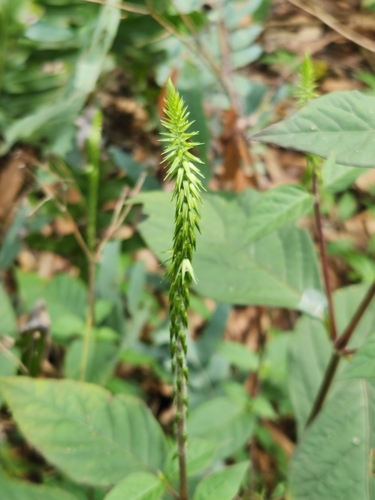
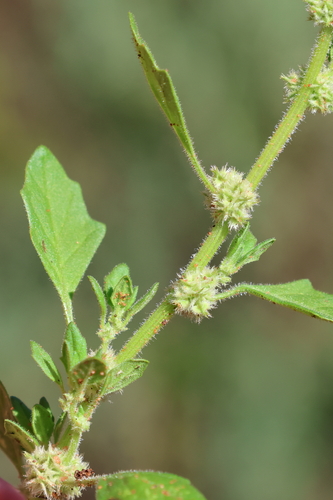
A small spreading annual herb. It grows 10-30 cm high and spreads 50-100 cm wide. It has many stems. They are hairy. The leaves are 1-2 cm long and oval with slender leaf stalks. The flowers are in small clusters in the axils of leaves. The seeds are reddish brown.
How to Grow
Plants can be grown from seed or cuttings.
Notes
There are about 100-150-250 Chenopodium species. They are mostly in temperate regions. Also put in the family Chenopodiaceae.
Names & Synonyms
Blitum cristatum F. Muell.Chenopodium cristatum (F. Muell.) F. Muell.
References (4)
- Bodkin, F., 1991, Encyclopedia Botanica. Cornstalk publishing, p 249 (As Chenopodium cristatum)
- Elliot, W.R., & Jones, D.L., 1984, Encyclopedia of Australian Plants suitable for cultivation. Vol 3. Lothian. p 24 (As Chenopodium cristatum)
- Paczkowska, G. & Chapman, A.R., 2000, The Western Australian Flora. A Descriptive Catalogue. Western Australian Herbarium. p 202 (As Chenopodium cristatum)
- Plants for a Future database, The Field, Penpol, Lostwithiel, Cornwall, PL22 0NG, UK. http://www.scs.leeds.ac.uk/pfaf/ (As Chenopodium cristatum)