Vigna stenophylla
Harms
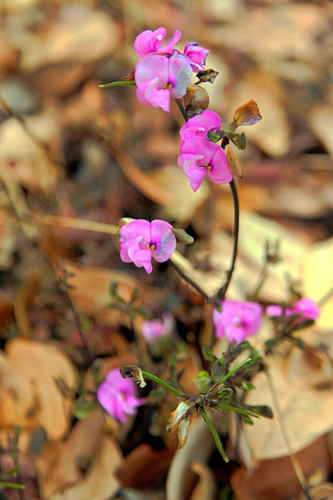
(c) Nico Vromant, some rights reserved (CC BY-NC)

(c) Kate Braun, some rights reserved (CC BY-NC)

(c) Kate Braun, some rights reserved (CC BY-NC)
What to Eat
Edible parts: Roots
Most cowpeas are grown on the African continent, particularly in Nigeria and Niger, which account for 66% of world cowpea production. The Sahel region also contains other major producers such as Burkina Faso, Ghana, Senegal, and Mali. Niger is the main exporter of cowpeas and Nigeria the main importer. Exact figures for cowpea production are hard to come up with as it is not a major export crop. Estimating world cowpea production is rather difficult, as it is usually grown in a mixture with other crops, but according to a 1997 estimate, cowpeas were cultivated on 12.5 million hectares (31 million acres) and had a worldwide production of 3 million metric tons (3,000,000 long tons; 3,300,000 short tons). While they play a key role in subsistence farming and livestock fodder, the cowpea is also seen as a major cash crop by Central and West African farmers, with an estimated 200 million people consuming cowpea on a daily basis. According to the Food and Agriculture Organization of the United Nations, as of 2012, the average cowpea yield in Western Africa was an estimated 483 kilograms per hectare (431 lb/acre), which is still 50% below the estimated potential production yield. In some tradition cropping methods, the yield can be as low as 100 kilograms per hectare (89 lb/acre). Outside Africa, the major production areas are Asia, Central America, and South America. Brazil is the world's second-leading producer of cowpea seed, accounting for 17% of annual cowpea production, although most is consumed within the country. Cowpeas are grown mostly for their edible beans, although the leaves, green seeds and pods can also be consumed, meaning the cowpea can be used as a food source before the dried peas are harvested. Like other legumes, cowpeas are cooked to make them edible, usually by boiling. Cowpeas can be prepared in stews, soups, purees, casseroles and curries. They can also be processed into a paste or flour. Chinese long beans can be eaten raw or cooked, but as they easily become waterlogged are usually sautéed, stir-fried, or deep-fried. A common snack in Africa is koki or moin-moin, where the cowpeas are mashed into a paste, mixed with spices and steamed in banana leaves. Dan wake cowpea dumplings are common in northern Nigeria and environs. They also use the cowpea paste as a supplement in infant formula when weaning babies off milk. Slaves brought to America and the West Indies cooked cowpeas much the same way as they did in Africa, although many people in the American South considered cowpeas not suitable for human consumption. A popular dish was Hoppin' John, which contained black-eyed peas cooked with rice and seasoned with pork. Over time, cowpeas became more universally accepted and now Hoppin' John is seen as a traditional Southern dish ritually served on New Year's Day.
Where to Find It
It is a tropical plant.
Africa, Burkina Faso, Cameroon, Central Africa, Nigeria, Togo, West Africa,
How to Identify
A trailing bean family plant. The tubers are spindle shaped. The flowers are bluish-purple.
Names & Synonyms
References (2)
- Dakora, F. D., 2013, Biogeographic Distribution, Nodulation and Nutritional Attributes of Underutilized Indigenous Agrican Legumes. Acta Horticulturae Number 979 Vol. 1. p 53
- Flora of West Tropical Africa. Vol 1 Part 2