Chenopodium leptophyllum
(Moq.) Nutt. ex S. Watson
Narrow leafed goosefoot

(c) Cat Chang, some rights reserved (CC BY-NC), uploaded by Cat Chang

(c) Cat Chang, some rights reserved (CC BY-NC), uploaded by Cat Chang
(c) Elsa, some rights reserved (CC BY-NC), uploaded by Elsa
What to Eat
Edible parts: Leaves, Seeds
The leaves and young shoots can be eaten raw or cooked like spinach, though raw leaves should only be eaten in small quantities due to toxicity. Fresh leaves have a slightly bitter or acrid edge; boiling reduces both bitterness and oxalates, producing a mild green vegetable. Because the leaves are narrow, large quantities must be harvested to make a meaningful serving. The seeds are the primary food resource — about 1mm in diameter, small but produced in great abundance. They can be ground into flour and mixed with wheat or other cereals for bread, or cooked into a porridge resembling miniature quinoa with a pleasant grain-like texture and subtle natural sweetness. Toasting before boiling enhances their nutty aroma. Seeds should be soaked overnight and rinsed thoroughly before use to remove saponins. Winnowing is straightforward as seed clusters dry cleanly on the plant.
Known Hazards
Where to Find It
It is a temperate plant.
Canada, Mexico, North America, USA,
How to Identify
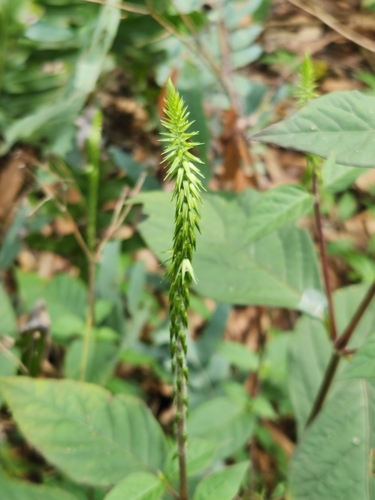
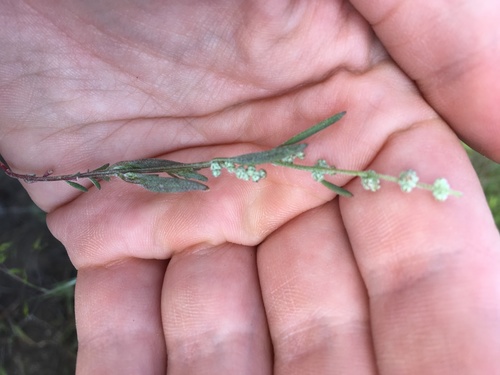
Annual herb reaching 60 cm tall and 30 cm wide. Hardy to UK zone 5. Hermaphrodite, wind-pollinated. Flowers July to October; seeds ripen August to October. Grows in light sandy, medium loamy, and heavy clay soils with mildly acid to basic pH. Requires full sun and moist soil conditions.
How to Grow
Propagation: Sow seed in spring in situ. Most of the seed usually germinates within a few days of sowing.
Medicinal Uses
None known.
Other Uses
Gold and green dyes can be obtained from the whole plant.
Wikipedia
Source ↗Chenopodium leptophyllum is a species of flowering plant in the family Amaranthaceae known by the common name narrowleaf goosefoot. It is native to much of western North America, where it is reported from Alaska to Texas and northern Mexico, and into central Canada. It can be found in many types of open habitats, often in sandy and gravelly soils, and it grows easily in disturbed areas such as roadsides.
Notes
There are about 100-150-250 Chenopodium species. They are mostly in temperate regions. Also put in the family Chenopodiaceae.
Names & Synonyms
References (6)
- Beckstrom-Sternberg, Stephen M., and James A. Duke. "The Foodplant Database." http://probe.nalusda.gov:8300/cgi-bin/browse/foodplantdb.(ACEDB version 4.0 - data version July 1994)
- Kermath, B. M., et al, 2014, Food Plants in the Americas: A survey of the domesticated, cultivated and wild plants used for Human food in North, Central and South America and the Caribbean. On line draft. p 217
- Plants for a Future database, The Field, Penpol, Lostwithiel, Cornwall, PL22 0NG, UK. http://www.scs.leeds.ac.uk/pfaf/
- Proc. Amer. Acad. Arts 9:94. 1874
- Saunders, C.F., 1948, Edible and Useful Wild Plants. Dover. New York. p 52
- Tozer, F., 2007, The Uses of Wild Plants. Green Man Publishing. p 65