Castilla ulei
Warb.
Caucho negro

(c) Anahi Cornejo E, some rights reserved (CC BY-NC)

(c) Anahi Cornejo E, some rights reserved (CC BY-NC)

(c) Anahi Cornejo E, some rights reserved (CC BY-NC)
What to Eat
Edible parts: Fruit
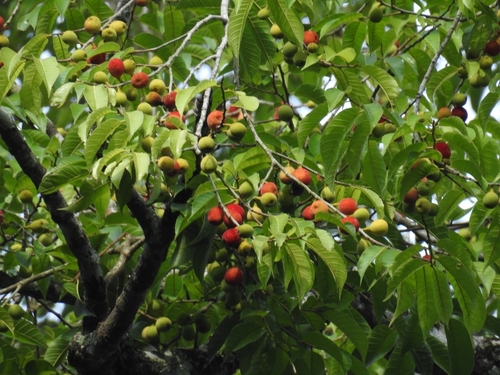
The soft, fresh pulp of the fruit is edible. Dried fruits measure 20mm long and 25mm wide, so fresh fruits will be somewhat larger.
Where to Find It
It is a tropical plant. It suits the humid tropical lowlands. It grows in clearings in the forest. It grows from sea level to 500 m above sea level.
Amazon, Bolivia, Brazil, Colombia, Ecuador, French Guiana, Peru, South America*,
How to Identify
A tree. It grows 20-40 m tall. It loses its leaves during the year. The fruit are 2 cm long by 2.5 cm wide or larger.
How to Grow
The tree has long, spreading, superficial roots. Individual plants can either produce only male flowers (dioecious) or they can produce both male and female flowers (monoecious).
Propagation: Seed
Medicinal Uses
None known
Other Uses
Members of this genus develop a relatively short taproot alongside several lateral roots that spread horizontally, often traceable for 20 to 30 metres near the soil surface, making it difficult to cultivate other crops beneath the tree. A latex extracted from the trunk yields rubber that is the most valuable of any species in this genus.
Wikipedia
Source ↗Castilla ulei is a tree in the family Moraceae, native to South America, specifically in the Amazon rainforest.
Names & Synonyms
Balata caucho, Caucho, Hebe, Hule, Monkaka, Monkame, Monkamewe, Ule, Uli, Yama caucho
References (7)
- Fern, K., 2012, Tropical Species Database http://theferns.info/tropical/
- Grandtner, M. M. & Chevrette, J., 2013, Dictionary of Trees, Volume 2: South America: Nomenclature, Taxonomy and Ecology. Academic Press p 110
- Lopez-Diago, D. & Garcia, N., 2021, Wild edible fruits of Colombia. Biota ColomBiana 22 (2) p 43
- Philips, O., 1992, The potential for harvesting fruits in tropical rainforests: new data from Amazonian Peru. Biodiversity and Conservation 2, 18-38
- Roa, J. A. G. & Boada, D. S. G., 2018, Fundación para el Fortalecimiento de la Fruticultura y Plantas Alimenticias no Convencionales en Colombia.
- Torre, de la, L., et al, 2008, Enciclopedia de las Plantas Útiles del Ecuador. Herbario QCA. Pontificia Universidad Católica del Ecuador. p 447
- www.colecionandofrutas.org