Chenopodiastrum murale
(L.) S. Fuentes, Uotila & Borch
Nettleleaf Goosefoot, Rounded-leaf fat hen
(c) Jacobo Krauel, some rights reserved (CC BY-NC), uploaded by Jacobo Krauel

(c) christopher_hohl, some rights reserved (CC BY-NC)

(c) kim gaffney-loza, some rights reserved (CC BY-NC)
What to Eat
Edible parts: Leaves, Seeds, Vegetable, Flavouring
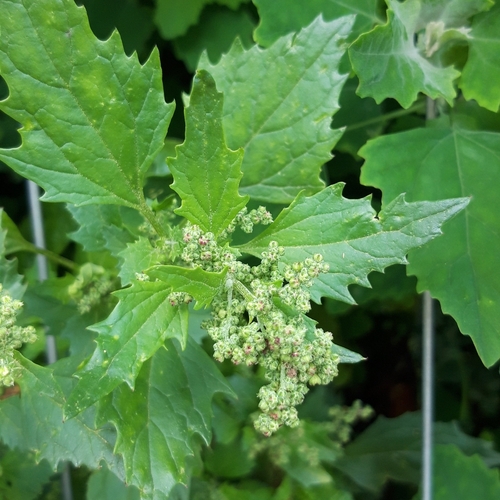
The seeds are edible, and the shoots, stalks, and leaves can be eaten as greens. The 1889 book The Useful Native Plants of Australia records that common names include "Australian spinach" and "fat-hen". It also states that it is a "pot-herb", which may be utilised in the same manner as spinach. Care should be taken not to confuse this species with black nightshades, many of which look similar when young. The leaves of Chenopodium murale have a white mealy texture, and the axils have a red streak.
Where to Find It
It grows in temperate and tropical places. It grows in most well drained soils in an open sunny position. It is drought and frost tender. In Papua New Guinea it occurs in the Eastern highlands. In Nepal it grows to about 1200 m altitude. In Bahrain it grows in sandy or gravelly soils. It can grow in salty soils. It can grow in arid places. Tasmania Herbarium.
How to Identify
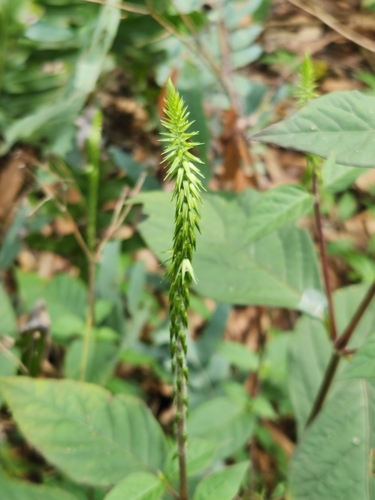
An annual plant. It grows to 20-100 cm high and spreads to 1 m across. The stem is erect and branching. The stems are green. The leaves are green and shaped like a diamond. They are 8 cm long and have saw like teeth along the edges. The leaves have pale, mealy scales. The flowers are small. They occur in clusters at the top of the plant. The ripe seeds are black.
How to Grow
Plants are sold in markets.
Wikipedia
Source ↗Chenopodiastrum murale (Syn. Chenopodium murale) is a species of plant in the family Amaranthaceae known by the common names nettle-leaved goosefoot, Australian-spinach, salt-green, and sowbane. This plant is native to Europe and parts of Asia and northern Africa, but it is widespread worldwide, particularly in tropical and subtropical areas due to the ease of it being introduced. It is a common weed of fields and roadsides.
Production
There are about 100-150-250 Chenopodium species. They are mostly in temperate regions. Also put in the family Chenopodiaceae.
Names & Synonyms
Anambodihena, Bahu, Bathoo, Bathu, Berremram, Cenizo de muro, Cenizos, Chalwairay, Chilni bhaji, Chirua bethe, Doshag, Goyalo, Green fat hen, Hediondilla, Kachiyuyo, Kalo bethe, Karnd, Karwa bathoo, Khabeetha, Khad-bathal, Kharatua, Khobaitha, Kora batoon, Koringbossie, Krund, Kurund, Lampato, Lulur, Pahade bathuwa, Quelete de Puerco, Quinoa negra, Quinguilla, Serua, Sowbane, Thor surma, Wirajuira, Yuyo, Yuyu negro
References (72)
- Abbiw, D.K., 1990, Useful Plants of Ghana. West African uses of wild and cultivated plants. Intermediate Technology Publications and the Royal Botanic Gardens, Kew. p 41 (As Chenopodium murale)
- Ajain, M., Ali, T., & Siddiqui, M.F., 2015, A Survey of Ethnobotanically Important Herbaceous Plants of Tehsil Jatoi,District Muzaffar Garh, Punjab, Pakistan. Int. J. Biol. Res., 3(2): 87-92, 2015. (As Chenopodium murale)
- Ambasta, S.P. (Ed.), 2000, The Useful Plants of India. CSIR India. p 119 (As Chenopodium murale)
- Astrada, E., et al, 2007, Ethnobotany in the Cumbres de Monterrey National Park, Nuevo Leon, Mexico. Journal of Ethnobiology and Ethnomedicine 3:8 (As Chenopodium murale)
- Beckstrom-Sternberg, Stephen M., and James A. Duke. "The Foodplant Database." http://probe.nalusda.gov:8300/cgi-bin/browse/foodplantdb.(ACEDB version 4.0 - data version July 1994) (As Chenopodium murale)
- Bidak, L. M., et al, 2015, Goods and services provided by native plants in desert ecosystems: Examples from the northwestern coastal desert of Egypt. Global Ecology and Conservation 3 (2015) 433–447 (As Chenopodium murale)
- Blamey, M and Grey-Wilson, C., 2005, Wild flowers of the Mediterranean. A & C Black London. p 39 (As Chenopodium murale)
- Blanco-Salas, J., et al, 2019, Wild Plants Potentially Used in Human Food in the Protected Area “Sierra Grande de Hornachos” of Extremadura (Spain). Sustainability 2019, 11, 456 (As Chenopodium murale)
- Bodkin, F., 1991, Encyclopedia Botanica. Cornstalk publishing, p 249 (As Chenopodium murale)
- Burkill, H. M., 1985, The useful plants of west tropical Africa, Vol. 1. Kew. (As Chenopodium murale)
- Bvenura, C. and Afolayan, A. J., 2017, Tackling food and nutrition insecurity using leafy wild vegetables: The nutritional compositions of some selected species. (As Chenopodium murale)
- Cakir, E. A., 2017, Traditional knowledge of wild edible plants of Iğdır Province (East Anatolia, Turkey). Acta Soc Bot Pol. 2017;86(4):3568.(As Chenopodium murale)
- Cordero, S. E., Abello, L. A., & Galvez, F. L., 2017, Plantas silvestres comestibles y medicinales de Chile y otras partes del mundo. CORMA p 158
- Cribb, A.B. & J.W., 1976, Wild Food in Australia, Fontana. p 118 (As Chenopodium murale)
- Curtis, W.M., 1993, The Student's Flora of Tasmania. Part 3 St David's Park Publishing, Tasmania, p 572 (As Chenopodium murale)
- Dangol, D. R. et al, 2017, Wild Edible Plants in Nepal. Proceedings of 2nd National Workshop on CUAOGR, 2017. (As Chenopodium murale)
- Dashorst, G.R.M., and Jessop, J.P., 1998, Plants of the Adelaide Plains & Hills. Botanic Gardens of Adelaide and State Herbarium. p 58 (As Chenopodium murale)
- Ekman Herbarium records Haiti (As Chenopodium murale)
- Ertug, F, Yenen Bitkiler. Resimli Türkiye Florası -I- Flora of Turkey - Ethnobotany supplement (As Chenopodium murale)
- Facciola, S., 1998, Cornucopia 2: a Source Book of Edible Plants. Kampong Publications, p 77 (As Chenopodium murale)
- Flora of Australia, Volume 4, Phytolaccaceae to Chenopodiaceae, Australian Government Publishing Service, Canberra (1984) p 139 (As Chenopodium murale)
- Flora of Australia Volume 49, Oceanic Islands 1, Australian Government Publishing Service, Canberra. (1994) p 83 (As Chenopodium murale)
- Fox, F. W. & Young, M. E. N., 1982, Food from the Veld. Delta Books. p 152 (As Chenopodium murale)
- Grivetti, L. E., 1980, Agricultural development: present and potential role of edible wild plants. Part 2: Sub-Saharan Africa, Report to the Department of State Agency for International Development. p 75 (As Chenopodium murale)
- Grubben, G. J. H. and Denton, O. A. (eds), 2004, Plant Resources of Tropical Africa 2. Vegetables. PROTA, Wageningen, Netherlands. p 179 (As Chenopodium murale)
- Hammer, K. & Spahillari, M., 1999, Crops of European origin. in Report of a networking group on minor crops. IPGRI p 44 (As Chenopodium murale)
- Hanif, U., et al, 2013, Ethnobotanical studies on some wild plants of head Qadirabad and adjoining areas, Pakistan. International Journal of Phytomedicine 5:373-377 (As Chenopodium murale)
- Harris, S., Buchanan, A., Connolly, A., 2001, One Hundred Islands: The Flora of the Outer Furneaux. Tas Govt. p 134 (As Chenopodium murale)
- Henty, E.E., 1980, Harmful Plants in Papua New Guinea. Botany Bulletin No 12. Division Botany, Lae, Papua New Guinea. p 33 (As Chenopodium murale)
- Hussey, B.M.J., Keighery, G.J., Cousens, R.D., Dodd, J., Lloyd, S.G., 1997, Western Weeds. A guide to the weeds of Western Australia. Plant Protection Society of Western Australia. p 134 (As Chenopodium murale)
- Hyde-Wyatt, B.H. & Morris D.I., 1975, Tasmanian Weed Handbook. Dept of Ag Tasmania. p 64 (As Chenopodium murale)
- Jardin, C., 1970, List of Foods Used In Africa, FAO Nutrition Information Document Series No 2.p 40, 66 (As Chenopodium murale)
- Joshi, N., et al, 2007, Traditional neglected vegetables of Nepal: Their sustainable utilization for meeting human needs. Tropentag 2007. Conference on International Agricultural Research for Development. (As Chenopodium murale)
- Kuvar, S. D. & Shinde, R. D., 2019, Wild Edible Plants used by Kokni Tribe of Nasik District, Maharashtra. Journal of Global Biosciences. Volume 8, Number 2, 2019, pp. 5936-5945 (As Chenopodium murale)
- Lazarides, M. & Hince, B., 1993, Handbook of Economic Plants of Australia, CSIRO. p 57 (As Chenopodium murale)
- Long, C., 2005, Swaziland's Flora - siSwati names and Uses http://www.sntc.org.sz/flora/ (As Chenopodium murale)
- Low, T., 1991, Wild Herbs of Australia and New Zealand. Angus & Robertson. p 47 (Drawing) (As Chenopodium murale)
- Majeed, M., et al, 2021, Gathered Wild Food Plants among Diverse Religious Groups in Jhelum District, Punjab, Pakistan. Foods 2021, 10, 594. (As Chenopodium murale)
- Magwede, K., van Wyk, B.-E., & van Wyk, A. E., 2019, An inventory of Vhavenḓa useful plants. South African Journal of Botany 122 (2019) 57–89 (As Chenopodium murale)
- Mahklouf, M. H., 2019, Ethnobotanical Study of Edible Wild Plants in Libya. European Journal of Ecology. 5(2): 30-40 (As Chenopodium murale)
- Malezas Comestibles del Cono Sur, INTA, 2009, Buernos Aires (As Chenopodium murale)
- Manandhar, N.P., 2002, Plants and People of Nepal. Timber Press. Portland, Oregon. p 149 (As Chenopodium murale)
- Martin, F.W. & Ruberte, R.M., 1979, Edible Leaves of the Tropics. Antillian College Press, Mayaguez, Puerto Rico. p 182 (As Chenopodium murale)
- Norton, J., et al, 2009, An Illustrated Checklist of the Flora of Qatar. UNESCO Office in Doha. (As Chenopodium murale)
- Okigbo, B.N., Vegetables in Tropical Africa, in Opena, R.T. & Kyomo, M.L., 1990, Vegetable Research and development in SADCC countries. Asian Vegetable Research and development Centre. Taiwan. p 38 (As Chenopodium murale)
- Özdemir, E. and Kültür, S., 2017, Wild Edible Plants of Savaştepe District (Balıkesir, Turkey), Marmara Pharm J 21/3: 578-589 (As Chenopodium murale)
- Paczkowska, G. & Chapman, A.R., 2000, The Western Australian Flora. A Descriptive Catalogue. Western Australian Herbarium. p 202 (As Chenopodium murale)
- Pardo-de-Santayana, M., et al, 2007, Traditional knowledge of wild edible plants used in the northwest of the Iberian Peninsula (Spain and Portugal): a comparative study. Journal of Ethnobiology and Ethnomedicine 2007, 3:27 (As Chenopodium murale)
- Pasta, S., et al, 2020, An Updated Checklist of the Sicilian Native Edible Plants: Preserving the Traditional Ecological Knowledge of Century-Old Agro-Pastoral Landscapes. Frontiers in Plant Science. Volume 11|Article 388
- Peters, C. R., O'Brien, E. M., and Drummond, R.B., 1992, Edible Wild plants of Sub-saharan Africa. Kew. p 82 (As Chenopodium murale)
- Phillips, D.C., 1988, Wild Flowers of Bahrain. A Field Guide to Herbs, Shrubs, and Trees. Privately published. p 97 (As Chenopodium murale)
- Plants for a Future database, The Field, Penpol, Lostwithiel, Cornwall, PL22 0NG, UK. http://www.scs.leeds.ac.uk/pfaf/ (As Chenopodium murale)
- Plants of Haiti Smithsonian Institute http://botany.si.edu (As Chenopodium murale)
- Plants of the World on line.org
- Rangel-Landa, S., et al, 2017, Sociocultural and ecological factors influencing management of edible and non-edible plants: the case of Ixcatlan, Mexico. Journal of Ethnobiology and Ethnomedicine. 13:59 (As Chenopodium murale)
- Royal Botanic Gardens, Kew (1999). Survey of Economic Plants for Arid and Semi-Arid Lands (SEPASAL) database. Published on the Internet; http://www.rbgkew.org.uk/ceb/sepasal/internet [Accessed 8th April 2011] (As Chenopodium murale)
- Ruiters-Welcome, A. K., 2019, Food plants of southern Africa. Ph.D. thesis. Univ. of Johannesburg p 11 (As Chenopodium murale)
- SAXENA, Sher, Z., Hussain, F., & Ibrar, M., 2014, Traditional knowledge on plant resources of Ashezai and Salarzai Valleys, District Buner, Pakistan. African Journal of Plant Science. Vol. 8(1), pp. 42-53, January 2014 (As Chenopodium murale)
- Singh, A. G., Panthi, M. P., & Tewari, D. D., 2012, Wild Plants Used as Vegetable in Rupandehi District of Nepal and their Ethnomedicinal Importance. J. Nat. Hist. Mus. Vol. 26, 2012, 111-125 (As Chenopodium murale)
- Singh, H.B., Arora R.K.,1978, Wild edible Plants of India. Indian Council of Agricultural Research, New Delhi. p 21 (As Chenopodium murale)
- Sp. pl. 1:219. 1753 (As Chenopodium murale)
- Swaziland's Flora Database http://www.sntc.org.sz/flora (As Chenopodium murale)
- Tardio, J., et al, 2006, Ethnobotanical review of wild edible plants in Spain. Botanical J. Linnean Soc. 152, 27-71 (As Chenopodium murale)
- Tasmanian Herbarium Vascular Plants list p 21 (As Chenopodium murale)
- Tbatou, M, et al, 2016, Wild Edible Plants traditionally used in the countryside of El Jadida, Coastal Area in the Center of Morocco. Life Sciences Leaflets 75:28-48 (As Chenopodium murale)
- Villagran, C., et al, 1999, La Tradicion Altiplanica: Estudio Etnobotanico en Los Andes de Iquique, Primera Region, Chile. Chungara, volumen 31 No. 1 pp 81-186 (As Chenopodium murale)
- Wehmeyer, A. S, 1986, Edible Wild Plants of Southern Africa. Data on the Nutrient Contents of over 300 species (As Chenopodium murale)
- Welcome, A. K. & Van Wyk, B.-E., 2019, An inventory and analysis of the food plants of southern Africa. South African Journal of Botany 122 (2019) 136–179 (As Chenopodium murale)
- Wild edible plants of Himachal Pradesh (As Chenopodium murale)
- World Checklist of Useful Plant Species 2020. Royal Botanic Gardens, Kew
- Youssef, R. S. A., 2013, Medicinal and non-medicinal uses of some plants found in the middle region of Saudi Arabia. Journal of Medicinal Plants Research. Vol. 7(34), pp. 2501-2517 (As Chenopodium murale)
- Zereen, A., et al, 2013, Ethnobotanical Studies of Wild Herbs of Central Punjab, Pakistan. Bangladesh J. Plant Taxon 20(1): 67-76 (As Chenopodium murale)