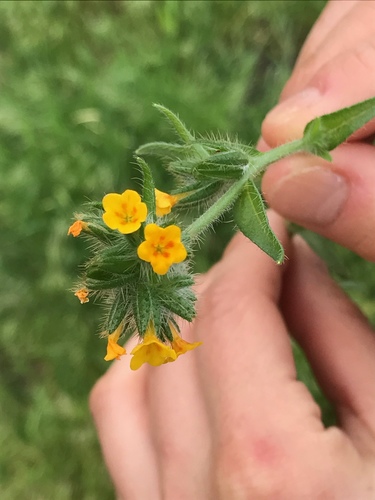
Cordia crenata
Delile
BoraginaceaeFruit

wikimedia · cc0
Wikimedia Commons - Blondeau, Alexandre; Fourier, Jean Baptiste Joseph; France.; France.; France.; Institut d'Egypte (1798-1801); Jacotin, Pierre; Jollois, Jean Baptiste Prosper; Jomard, Edme-François; Monge, Gaspard; Napoleon; Tresca, Salvadore; Villoteau, Guillaume André
Wikimedia Commons - Blondeau, Alexandre; Fourier, Jean Baptiste Joseph; France.; France.; France.; Institut d'Egypte (1798-1801); Jacotin, Pierre; Jollois, Jean Baptiste Prosper; Jomard, Edme-François; Monge, Gaspard; Napoleon; Tresca, Salvadore; Villoteau, Guillaume André

wikimedia · cc0
Wikimedia Commons - Scan by NYPL
Wikimedia Commons - Scan by NYPL

gbif · cc-by-sa
GBIF
GBIF
What to Eat
Edible parts: Fruit
Fruit - raw. In general the fruit comprises a thin to fairly thick layer of pulpy, sweetish-tasting flesh surrounding a single seed. The oblong-ovoid, orange fruit can be 13mm long and 8mm wide.
Where to Find It
It is a tropical plant.
Africa, Arabia, Asia, East Africa, Egypt, India, Iran, Kenya, Middle East,
Countries: United Arab Emirates, Afghanistan, Armenia, Angola, Azerbaijan, Bangladesh, Burkina Faso, Bahrain, Burundi, Benin, Brunei, Bhutan, Botswana, Congo (DRC), Central African Republic, Congo (Republic), Cote d'Ivoire, Cameroon, China, Cape Verde, Djibouti, Algeria, Egypt, Eritrea, Ethiopia, Gabon, Georgia, Ghana, Gambia, Guinea, Equatorial Guinea, Guinea-Bissau, Indonesia, Israel, India, Iraq, Iran, Jordan, Japan, Kenya, Kyrgyzstan, Cambodia, Comoros, North Korea, South Korea, Kuwait, Kazakhstan, Laos, Lebanon, Sri Lanka, Liberia, Lesotho, Libya, Morocco, Madagascar, Mali, Myanmar, Mongolia, Mauritania, Mauritius, Maldives, Malawi, Malaysia, Mozambique, Namibia, Niger, Nigeria, Nepal, Oman, Philippines, Pakistan, Qatar, Rwanda, Saudi Arabia, Seychelles, Sudan, Singapore, Sierra Leone, Senegal, Somalia, South Sudan, Sao Tome & Principe, Syria, Eswatini, Chad, Togo, Thailand, Tajikistan, Timor-Leste, Turkmenistan, Tunisia, Turkey, Taiwan, Tanzania, Uganda, Uzbekistan, Vietnam, Yemen, South Africa, Zambia, Zimbabwe
How to Identify
A shrub or small tree. It grows 7 m tall. Young plant parts are hairy. The leaves are oval or wedge shaped and 5-8 cm long by 3 cm wide. They are rough above and hairy underneath. Male and female flowers are on separate plants. The fruit are oval and orange and 13 mm long by 8 mm wide. There is one seed.
How to Grow
Plants can be grown by seeds.
Other Uses
The flowers are a good source of nectar for bees.
Other Information
It is cultivated.
Names & Synonyms
Cordia zedambae MartelliGerascanthus crenatus (Delile) BorhidiLithocardium crenatum Kuntze
References (4)
- Fern, K., 2012, Tropical Species Database http://theferns.info/tropical/
- INFOODS:FAO/INFOODS Databases
- Mutie, F. G., 2020, Conservation of Wild Food Plants and Their Potential for Combatting Food Insecurity in Kenya as Exemplified by the Drylands of Kitui County. Plants 2020, 9, 1017
- Mutie, F. M., et al, 2023, Important Medicinal and Food Taxa (Orders and Families) in Kenya, Based on Three Quantitative Approaches. Plants 2023, 12, 1145