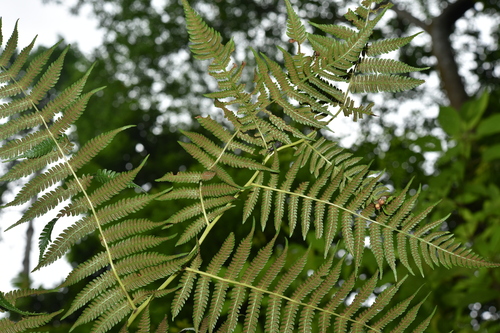
Allantodia maxima
(D. Don) Ching

MBG

Meise Botanic Garden

Meise Botanic Garden
What to Eat
Edible parts: Leaves, Fronds, Vegetable
The leaves and fronds are boiled and eaten as a vegetable. The fronds are rubbed with cloth to remove hairs, then fried or pickled. Fronds are sold in local markets.
Where to Find It
It is a tropical plant. It grows in ravines between 1,200-3,000 m above sea level.
Asia, Australia, Bhutan, China, Himalayas, India, Indochina, Indonesia, Myanmar, Nepal, New Caledonia, Northeastern India, Pakistan, Philippines, SE Asia, Sikkim, Taiwan, Vietnam,
How to Identify
A fern. It grows 1-2 m tall. The rhizome is thick and scaly. The stalks are 40-80 cm long. They are erect in tufts. The blades are 60-120 cm long by 30-60 cm wide. They are divided once or twice. There are 9-12 leaflets 15-30 cm long.
Other Information
Fronds are sold in local markets.
Notes
Also put in the family Woodsiaceae.
Names & Synonyms
Cha-kawk, Khasrod, Lengadu, Neuro, Sanq hav dal laiv
References (8)
- Chettri, S., et al, 2018, Nutrient and Elemental Composition of Wild Edible Ferns of the Himalaya. American Fern Journal 108(3):95–106 (As Diplazium maximum)
- Joshi, N., et al, 2007, Traditional neglected vegetables of Nepal: Their sustainable utilization for meeting human needs. Tropentag 2007. Conference on International Agricultural Research for Development. (As Diplazium maximum)
- Kar, A., et al, 2013, Wild Edible Plant Resources used by the Mizos of Mizoram, India. Kathmandu University Journal of Science, Engineering and Technology. Vol. 9, No. 1, July, 2013, 106-126 (As Diplazium maximum)
- Masoodi, H. U. R. & Sundriyal, R. C., 2020, Richness of non-timber forest products in Himalayan communities—diversity, distribution, use pattern and conservation status. Journal of Ethnobiology and Ethnomedicine 16:56 (As Diplazium maximum)
- Ojha, R. & Devkota, H. P., 2021, Edible and Medicinal Pteridophytes of Nepal: A Review. Ethnobotany Research & Applications 22:16 (As Diplazium maximum)
- Rana, D., et al, 2019, Ethnobotanical knowledge among the semi-pastoral Gujjar tribe in the high altitude (Adhwari’s) of Churah subdivision, district Chamba, Western Himalaya. Journal of Ethnobiology and Ethnomedicine (2019) 15:10 (As Diplazium maximum)
- Thakur, D., et al, 2017, Why they eat, what they eat: patterns of wild edible plants consumption in a tribal area of Western Himalaya. Journal of Ethnobiology and Ethnomedicine (2017) 13:70 (As Diplazium maximum)
- Tsherig, K., 2012, Edible Wild Plants of Bhutan and their contribution to Food and Nutrition Security. Ministry of Ag. and Forests, Bhutan. www.fao.org (As Diplazium maximum)