Wrightia arborea
(Dennst.) Mabb.
Woolly dyeing rosebay

(c) Dinesh Valke, some rights reserved (CC BY-NC-SA)
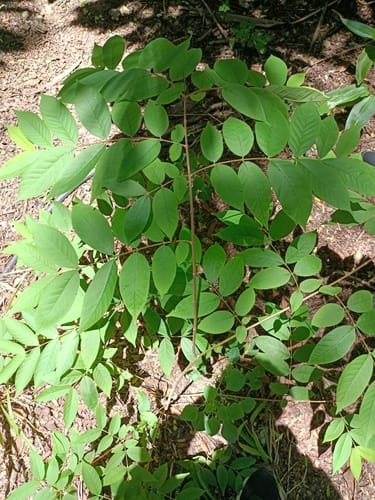
(c) thananthon, some rights reserved (CC BY-NC)
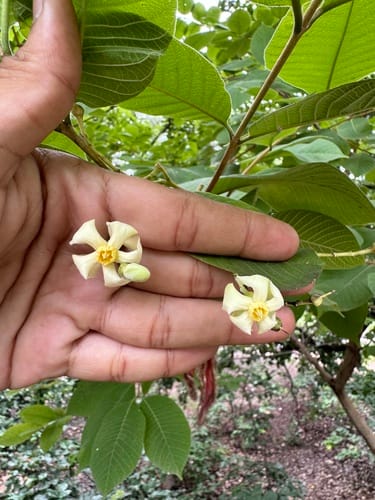
(c) Shivam Bhatt, some rights reserved (CC BY-NC-SA)
What to Eat
Edible parts: Leaves, Fruit
The young tender leaves are boiled and eaten, and the fruit are eaten raw.
Where to Find It
It is a tropical plant. It grows in deciduous or mixed forests and along stream banks between 200-1,500 m above sea level in southern China.
Asia, Cambodia, China, Himalayas, India, Indochina, Laos, Malaysia, Myanmar, Northeastern India, SE Asia, Sri Lanka, Thailand, Vietnam,
How to Identify
A tree. It grows 20 m tall. The branches are grey and hairy. The leaves are oval and 6-18 cm long by 3-9 cm wide. The flowers are pink or yellow. The fruit are straight and rough with white specks.
How to Grow
A plant of the tropics, where it is found at elevations up to 1,300 metres. It grows best in areas where annual daytime temperatures are within the range 22 - 32°c, but can tolerate 5 - 45°c. When dormant, the plant can survive temperatures down to about -1°c, but young growth can be severely damaged at 0°c. It prefers a mean annual rainfall in the range 1,200 - 2,400mm, but tolerates 900 - 3,800mm. Grows best in a sunny position. Grows best in a well-drained, sandy to loamy soil of low fertility. Prefers a pH in the range 5.5 - 7, tolerating 5 - 7.5. The bark is thick and corky. This probably gives the tree some resistance to fires.
Medicinal Uses
The bark of the stem and roots is regarded as an antidote against snake bites and scorpion stings. The bark is also used to treat renal complaints.
Other Uses
An indigo-yielding glucoside, used to dye clothes, can be obtained from the seeds, roots and leaves. The wood is light, soft and fine-textured. It is very suitable for carving and turnery, and is also used for general construction, pencils, wooden shoes and packaging.
Wikipedia
Source ↗Wrightia arborea, the woolly dyeing rosebay, is a species of flowering plant in the family Apocynaceae. It is native to the Indian Subcontinent, Southeast Asia, and southern China. A tree reaching 20 m (66 ft), local peoples use it for timber and as the source of a dye.
Names & Synonyms
Buralicode, Danghkyam-kaii, Darula, Dudhi, Hleng, Lettok-thein, Mai-lang, Mai-yang-hka-ouan, Taung-zalut
References (7)
- Dobriyal, M. J. R. & Dobriyal, R., 2014, Non Wood Forest Produce an Option for Ethnic Food and Nutritional Security in India. Int. J. of Usuf. Mngt. 15(1):17-37
- Jadhav, R., et al, 2015, Forest Foods of Northern Western Ghats: Mode of Consumption, Nutrition and Availability. Asian Agri-History Vol. 19, No. 4: 293-317
- Kachenchart, B., et al, 2008, Phenology of Edible Plants at Sakaerat Forest. In Proceedings of the FORTROP II: Tropical Forestry Change in a Changing World. Bangkok, Thailand.
- Kaewjampa, N., et al, 2014, Investigation Species of Edible Tree and Medicinal Plants in Faculty of Agriculture, Khon Kaen University. International Journal of Environmental and Rural Development (2014) 5-1
- Kar, A., et al, 2013, Wild Edible Plant Resources used by the Mizos of Mizoram, India. Kathmandu University Journal of Science, Engineering and Technology. Vol. 9, No. 1, July, 2013, 106-126
- Rashid, M. H., et al, 2013, Inventory of Threatened Plants of Bangladesh and their Conservation Management. International Journal of Environment. Vol. 3 No. 1 p 152
- Upreti, K., et al, 2010, Diversity and Distribution of Wild Edible Fruit Plants of Uttarakhand. Bioversity Potentials of the Himalaya. p 194


