Rubus elegantulus
Blanch.
Showy blackberry
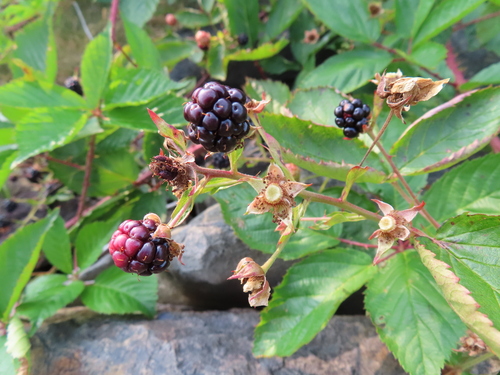
(c) Sean Blaney, some rights reserved (CC BY-NC), uploaded by Sean Blaney

(c) Sean Blaney, some rights reserved (CC BY-NC)
What to Eat
Edible parts: Fruit
The fruit are eaten.
Dangerous Lookalikes
This plant can be confused with the following toxic species. Always verify identification carefully before consuming any wild plant.


Red Baneberry: Short herbaceous plant (no thorns), berries on thick red stems, each berry has a single seed, compound sharply-toothed leaves.
Showy blackberry: Thorny woody canes (brambles), aggregate berry made of many drupelets, berries pull easily from receptacle.
Where to Find It
It is a temperate plant.
Canada, North America, USA,
How to Identify
An erect temperate shrub in the Rosaceae family that grows about 1 m tall and is armed with prickles.
Wikipedia
Source ↗Rubus elegantulus, the showy blackberry, is an uncommon North American species of flowering plant in the rose family. It grows in the northeastern and north-central United States (from Maine to West Virginia, plus Wisconsin and Minnesota) and eastern Canada (Québec, Newfoundland, and all 3 Maritime Provinces). Rubus elegantulus is an erect perennial 2–4 feet (30–120 cm) tall, with prickles but no hairs. Leaves are palmately compound with 5 leaflets, slightly darker on the upper surface than on the lower. Fruits are black, nearly spherical. The genetics of Rubus is extremely complex, so that it is difficult to decide on which groups should be recognized as species. There are many rare species with limited ranges such as this. Further study is suggested to clarify the taxonomy. Some studies have suggested that R. elegantulus may have originated as a hybrid between R. allegheniensis and R. pensilvanicus.
Names & Synonyms
References (1)
- Reis, S. V. and Lipp, F. L., 1982, New Plant Sources for Drugs and Foods from the New York Botanical Garden herbarium. Harvard. p 103
More from Rosaceae


