Acrotriche prostrata
F. Muell.
Trailing ground berry
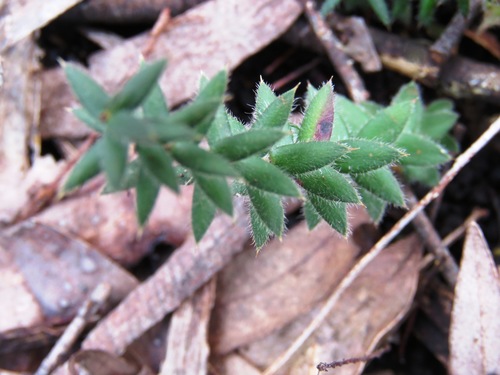
(c) Elspeth Swan, some rights reserved (CC BY), uploaded by Elspeth Swan

(c) bmoyle, some rights reserved (CC BY-NC)
What to Eat
Edible parts: Nectar, Fruit
The fruit can be eaten raw. Flowers are a source of nectar.
Where to Find It
It needs a cool location. It can be in light shade. It will grow in moist, well-drained soil.
Australia*,
How to Identify
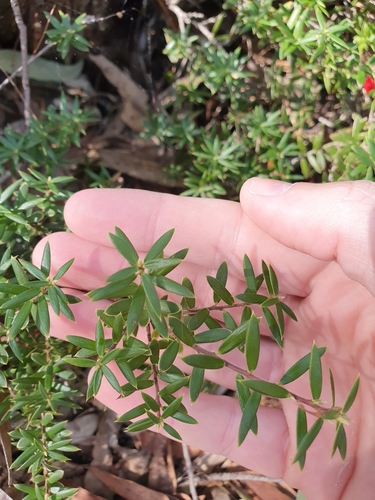
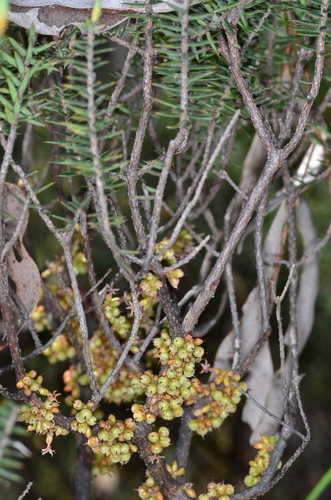
A trailing shrub or it may lie along the ground. It grows 30-50 cm high and spreads 50-100 cm wide. The small branches often produce roots at the nodes. The leaves are 1-2 cm long and 1 cm wide. The leaves are widest near the base and taper to a fine point. The leaves are hairy on the upper surface. The flowers are tube shaped. They are 0.8 cm long and in clusters or 7-10 flowers. They grow on the older wood. They are greenish and release lots of nectar.
How to Grow
Plants can be grown from cuttings.
Medicinal Uses
None known.
Other Uses
None known.
Wikipedia
Source ↗Acrotriche prostrata, commonly known as trailing ground-berry, is a species of flowering plant in the family Ericaceae and is endemic to Victoria. It is a trailing shrub with prostrate stems, widely spreading, lance-shaped to egg-shaped leaves and spikes of 5 to 14 light green flowers and spherical, green drupes.
Notes
There are 14 Acrotriche species. They are in Australia.
References (5)
- Cribb, A.B. & J.W., 1976, Wild Food in Australia, Fontana. p 181
- Cronin, L., 1989, The Concise Australian Flora. Reed. p 31
- Elliot, W.R., & Jones, D.L., 1982, Encyclopedia of Australian Plants suitable for cultivation. Vol 2. Lothian. p 145
- Hastings Advance Community College, 2017, Uses for Native Plants of the Mornington Peninsula. 86pp. p 11
- Morley, B.D., & Toelken, H.R., (Eds), 1983, Flowering Plants in Australia. Rigby. p 112