Rubus odoratus
L.
Purple-flowering raspberry

(c) Juha Haataja, some rights reserved (CC BY-NC-SA)
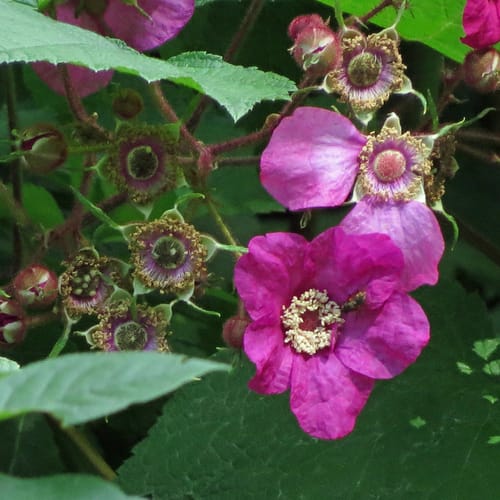
(c) cgbb2004, some rights reserved (CC BY-NC)
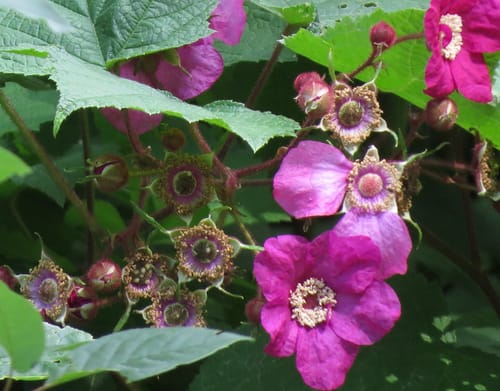
(c) cgbb2004, some rights reserved (CC BY-NC)
What to Eat
Edible parts: Fruit
The fruit can be eaten raw or cooked, though it is somewhat tart and dry, making it better suited to cooking in pies, jellies, and preserves. It can also be dried for later use. This species rarely fruits well in Britain, likely due to cooler summers.
Dangerous Lookalikes
This plant can be confused with the following toxic species. Always verify identification carefully before consuming any wild plant.


Red Baneberry: Short herbaceous plant (no thorns), berries on thick red stems, each berry has a single seed, compound sharply-toothed leaves.
Purple-flowering raspberry: Thorny woody canes (brambles), aggregate berry made of many drupelets, berries pull easily from receptacle.
Where to Find It
It is a temperate plant.
North America, Slovenia, USA,
How to Identify
A tall bramble. It loses its leaves during the year. The flowers are deep pink-purple. The fruit are flattish.
How to Grow
Easily grown in a good well-drained loamy soil in sun or semi-shade. Grows well in a sandy soil but does not like clay. Prefers a semi-shaded position. Does well in a woodland garden though it is less likely to fruit well in such a position. A very ornamental plant, it is hardy to about -30°c. The glandular hairs on the stems have a powerful resinous scent somewhat like cedarwood. A vigorous suckering shrub, it has perennial stems without prickles. Plants in this genus are notably susceptible to honey fungus.
Propagation: Seed requires stratification and is best sown in early autumn in a cold frame. Stored seed should be sown as early as possible in the year, stratified for one month at 3°C if sowing later than February. Prick out seedlings when large enough to handle, grow on in a cold frame, and plant out into permanent positions in late spring of the following year. Tip layer in July and plant out in autumn. Divide in early spring.
Medicinal Uses
The leaves are highly astringent and are used in the treatment of dysentery and diarrhoea. They have also been used as a wash for old and foul sores and boils. A decoction or infusion of the branches helps settle the stomach, and a decoction of the leaves and stems is used for kidney complaints. The root is astringent; a decoction of the root or root bark treats diarrhoea and colds, and the root has been used for toothache. The berries have been used as a diuretic.
Other Uses
A purple to dull blue dye is obtained from the fruit. Plants are very vigorous and can be grown as tall ground cover for large areas.
Wikipedia
Source ↗Rubus odoratus, the purple-flowered raspberry, flowering raspberry, or Virginia raspberry, is a species of Rubus, native to eastern North America, from Nova Scotia west to Ontario and Wisconsin, and south along the Appalachian Mountains as far as Georgia and Alabama. Rubus odoratus is a shrub growing to 3 metres (10 ft) tall, with perennial, not biennial, stems (unlike many other species in the genus). Also, unlike most other related species this plant does not have thorns. The leaves are palmately lobed with five (rarely three or seven) lobes, up to 25 cm (10 in) long and broad, superficially resembling maple leaves. The flowers are 3–5 cm (1.2–2.0 in) in diameter, with five magenta or occasionally white petals; they are produced from early spring to early fall. The red edible fruit matures in late summer to early autumn, and resembles a large, flat raspberry with many drupelets, and is rather fuzzy to the touch and tongue. This species is occasionally referred to as thimbleberry, a name more commonly associated with fellow North American species Rubus parviflorus.
Other Information
Fruit are only occasionally eaten.
Names & Synonyms
Dišeča robida, Virginia raspberry
References (5)
- http://www.botanic-gardens-ljubljana.com/en/plants
- Kermath, B. M., et al, 2014, Food Plants in the Americas: A survey of the domesticated, cultivated and wild plants used for Human food in North, Central and South America and the Caribbean. On line draft. p 763
- Medsger, O. P., 1939, Edible Wild Plants. Macmillan Company. p 23
- Toupal, R. S. & Hollenback, K., 2009, An Ethnobotany of Indiana Dunes National Lakeshore: Plant Uses of the Ojibwa People. Bureau of Applied Research in Anthropology. University of Arizona
- www.eplantscience.com
More from Rosaceae


