Chrysophyllum pruniforme
(Engl.) Pierre ex Engl.

Forest & Kim Starr (via Wikimedia Commons)
What to Eat
Edible parts: Fruit
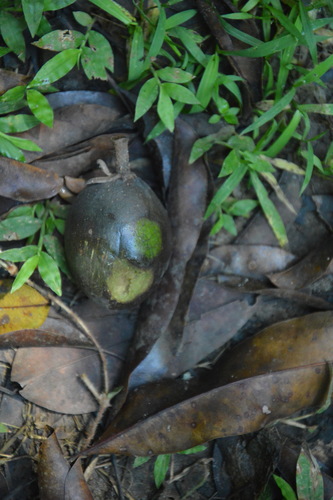
In some regions the fruit pulp is reported as edible, but in others as inedible. The fruit is a yellow, globose to ovoid berry up to 5cm × 4cm, containing up to 5 fairly large seeds.
Where to Find It
A tropical plant. It grows in lowland rainforest usually on well drained soils. It suits humid locations. In East Africa it grows up to 1,500 m altitude.
Africa, Benin, Cameroon, Central Africa, Central African Republic, CAR, Congo DR, Congo R, East Africa, Gabon, Ghana, Ivory Coast, Nigeria, Rwanda, Sierra Leone, Uganda, West Africa,
How to Identify
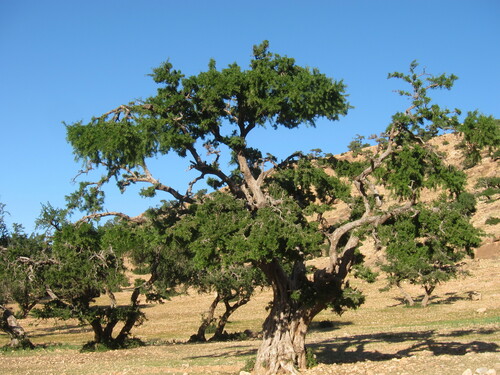
A tree. It grows to 30 m high. The trunk is 80 cm across. The trunk is straight and cylinder shaped. It may have slight buttresses. The leaves are alternate in 2 rows. They are simple and entire. The leaf blade is 4-11 cm long by 2-5 cm wide. The flowers are in tufts in the axils of leaves. They are greenish. The fruit are round of oval and 5 cm long by 4 cm wide. They are yellow when ripe. They have up to 5 seeds. The seeds are 2.5 cm long by 1.5 cm wide and shiny brown.
How to Grow
A plant of the moist tropics, where it is found at elevations up to 1,500 metres. Older plants can be grown in a sunny position, but seedlings appreciate some shade. Prefers a well-drained soil.
Medicinal Uses
A tea made from the bark is drunk to treat cough.
Other Uses
The wood is yellowish-white and moderately hard. It is used for construction, grain mortars, beehives and house construction.
Notes
There are about 80-150 Chrysophyllum species. They are mostly in tropical America. There are 44 species in tropical America.
Names & Synonyms
Abam akouk bekwe, Duatadwe
References (12)
- Abbiw, D.K., 1990, Useful Plants of Ghana. West African uses of wild and cultivated plants. Intermediate Technology Publications and the Royal Botanic Gardens, Kew. p 42
- Burkill, H. M., 1985, The useful plants of west tropical Africa, Vol. 5. Kew.
- Dalziel, J. M., 1937, The Useful plants of west tropical Africa. Crown Agents for the Colonies London.
- Ferns, Useful Tropical Plants
- Jardin, C., 1970, List of Foods Used In Africa, FAO Nutrition Information Document Series No 2.p 127
- Lemmens, R.H.M.J., 2007. Chrysophyllum pruniforme Pierre ex Engl. [Internet] Record from Protabase. Louppe, D., Oteng-Amoako, A.A. & Brink, M. (Editors). PROTA (Plant Resources of Tropical Africa), Wageningen, Netherlands. < http://database.prota.org/search.htm>. Accessed 14 October 2009.
- Monogr. afrik. Pflanzen-Fam. 8:42, t. 14a. 1904
- Nkeoua, G. & Boundzanga, G. C., 1999, Donnees sur les produits forestieres non ligneux en Republique du Congo. FAO. p 25 (As Donella pruniformis)
- Peters, C. R., O'Brien, E. M., and Drummond, R.B., 1992, Edible Wild plants of Sub-saharan Africa. Kew. p 182
- Savill, P. S. & Fox, J. E. D., Trees of Sierra Leone. p 238
- Vivien, J., & Faure, J.J., 1996, Fruitiers Sauvages d'Afrique. Especes du Cameroun. CTA p 316 (As Donella pruniformis)
- World Checklist of Useful Plant Species 2020. Royal Botanic Gardens, Kew (As Donella pruniformis)